NEET Important Dates & Deadlines
I fear missing deadlines because we are in the USA and do not track Indian timelines daily. Registration windows, correction windows, admit card, exam date, result date, and counseling dates can change. I worry that even one missed step can cancel eligibility. I need a parent calendar with reminders, buffers, and a checklist of what documents must be ready before each deadline. I also want to know which deadlines are rigid and which have correction options. I need a system for tracking official updates without getting confused by social media rumors, and a clear monthly action plan.
(Complete Planning Guide for USA-Based NRI & OCI Families)
For families living in the United States, deadlines are often more stressful than the exam itself. Time zone differences, international travel planning, document preparation, and overlapping U.S. school schedules make the NEET timeline far more complex for NRIs than for students living in India.
The National Eligibility cum Entrance Test follows a structured annual cycle conducted by the National Testing Agency (NTA). However, what many families fail to realize is that the NEET timeline does not end with the exam date. In fact, the most critical deadlines often come after the result, during counselling conducted by the Medical Counselling Committee (MCC) and respective state authorities.
This chapter explains every major stage of the NEET timeline — what happens, when it happens, and what USA-based families must do at each step.
Phase 1 - NEET Registration Window
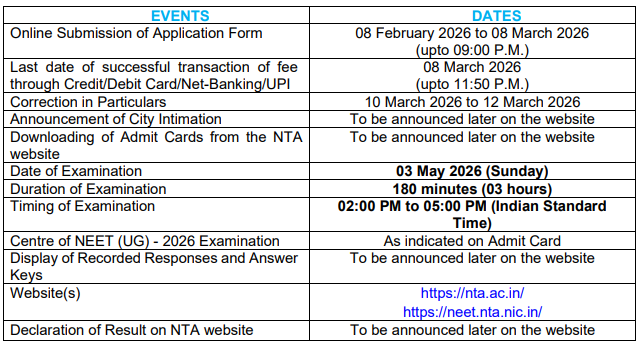
The registration window is the first critical deadline in the NEET cycle. It usually opens in the early months of the year and remains open for a limited number of weeks. During this period, candidates must complete online application submission, upload required documents, and pay the examination fee.
For USA-based families, the most important factor here is time zone awareness. All deadlines are based on Indian Standard Time (IST). A registration deadline of 11:50 PM IST may correspond to morning or early afternoon in the U.S., depending on time zone and daylight savings. Many NRI families mistakenly assume they have more time and miss the deadline due to incorrect conversion.
Additionally, registration requires accurate entry of nationality status (Indian National, NRI, OCI, or Foreign National). A mistake here can complicate later counselling stages. Parents should sit with the student during registration and cross-check passport details carefully.
Example:
A student in California submits the form at 10:30 PM PST on the last day, assuming there is still time. However, the IST deadline passed earlier. The application is rejected. There are no late submissions accepted.
Summary:
The registration deadline is strict and IST-based. Complete registration early and verify nationality details carefully.
Phase 2 - Application Correction Window
After the registration window closes, NTA usually opens a correction window. This is a limited opportunity to edit certain details in the application form.
Parents must understand that not all fields are editable. In some years, nationality or category corrections are restricted. If a student incorrectly selects “Indian National” instead of “NRI” (or vice versa), it may create complications during counselling.
This correction window is typically short — often only a few days. Missing this window means the original information remains locked. For NRI families, this stage is especially important because documentation verification later depends on consistency between registration details and submitted proofs.
Example:
If the passport spelling differs from the entered name, the correction window allows rectification. Without correction, admit card and later documents may mismatch.
Summary:
Use the correction window wisely. It is often the only chance to fix errors before admit card issuance.
NEET NRI Counseling & Admission eBook Download
A practical guide covering NRI quota admission process, fee, colleges, counseling, sponsor rules, document checklist, verification traps, NRI quota admission details.

Schedule Trial Session For NEET Prep
Get a short academic diagnostic report, study roadmap: syllabus gaps (NCERT vs U.S. curriculum) and the exact weekly plan needed to improve accuracy under time.
Phase 3 - City Intimation & Admit Card Release
Before the exam, NTA releases a city intimation slip indicating the city where the candidate will appear. This is not the final admit card but gives an early indication for travel planning.
The admit card is released closer to the exam date. It contains the exact exam center address, reporting time, and important instructions. For USA-based students, the admit card release is the travel trigger. Families should avoid booking non-refundable international tickets before admit card confirmation.
The admit card must be printed and carried physically. Digital copies on phones are not sufficient. Passport should be carried as primary ID for NRI students.
Travel Planning Tip:
Arrive in India at least 3-5 days before the exam to adjust to time zone differences and reduce jet lag impact.
Summary:
Do not finalize travel until admit card confirms the exam center. Plan arrival in India with sufficient buffer.
Phase 4 - NEET Examination Date
NEET is conducted once per year. There is no retest if a candidate misses the exam due to travel delay or illness.
For USA-based students, exam timing may conflict with AP exams, IB finals, or U.S. school graduation ceremonies. Families must prioritize well in advance.
The exam duration is approximately three hours, and entry rules are strict. Late arrival results in denial of entry. Therefore, arriving in India at least a few days before the exam is essential to avoid last-minute travel stress.
Example:
A student arrives in India one day before the exam. A flight delay reduces rest time, causing fatigue during the test. Performance suffers. Proper buffer planning could have prevented this.
Summary:
NEET is conducted once annually. Plan travel and academic calendar carefully.
Phase 5 - Provisional Answer Key & Objection Window
After the exam, NTA releases a provisional answer key. Candidates are given a short window to challenge specific answers by paying a fee per question.
This window is often brief (a few days). Parents must monitor announcements closely. While most students do not file objections, those confident of discrepancies may consider it.
Challenges must be supported by valid academic references. Random objections without justification are rejected.
Summary:
The answer key window is short and time-bound. Monitor official notifications carefully.
Phase 6 - Result Declaration
The NEET result is typically declared weeks after the exam. The scorecard includes:
- Marks obtained
- Percentile
- All India Rank (AIR)
- Qualifying status
However, parents must understand a crucial distinction: qualifying NEET does not guarantee admission. It simply makes the student eligible for counselling participation.
Result day often creates emotional reactions. Families should avoid immediate decisions and instead begin structured counselling planning.
Summary:
Result declaration triggers the counselling phase. It is the midpoint of the process, not the end.
Phase 7 - Counselling Registration Deadlines
After the result, counselling registration begins. For AIQ and Deemed universities, counselling is conducted by the Medical Counselling Committee.
State counselling authorities conduct separate processes for state quota seats. Each authority has independent registration deadlines, choice filling windows, and reporting timelines.
Missing counselling registration means losing that opportunity entirely. There is no late entry.
Example:
A student qualifies NEET but forgets to register for MCC counselling before the deadline. They cannot participate in Round 1 and must wait for later rounds.
Summary:
Counselling registration is separate from NEET registration. Track deadlines independently.
Phase 8 - Seat Allotment & Reporting Deadlines
After each counselling round, seat allotment results are declared. Students must report to the allotted college within a specified window — often 3-7 days.
For USA-based families, this is another major travel trigger. Reporting requires physical presence with original documents. Delayed reporting leads to automatic cancellation.
Parents should keep flexible flight options during counselling season. Multiple rounds may require more than one travel window.
Summary:
Seat reporting deadlines are strict and short. Travel flexibility is essential.
Mop-Up & Stray Vacancy Rounds
If seats remain vacant after initial rounds, mop-up and stray rounds are conducted. These rounds often include Deemed universities and NRI quota seats.
Timelines are fast and unpredictable. Families must stay alert to official notifications. Waiting passively after Round 1 can lead to missed opportunities.
Summary:
Mop-up rounds are critical backup opportunities. Stay informed and prepared.
USA-Specific Timeline Considerations
USA-based NRI families face additional planning layers:
- Time zone conversion (IST vs EST/PST/CST)
- AP/IB exam overlap
- Summer travel peak season
- Passport validity
- Visa/residency document coordination
It is advisable to create a NEET timeline calendar with alerts set in U.S. local time.
Practical Tip:
Always subtract 12-13 hours from IST when calculating U.S. deadlines (depending on daylight savings).
Deadlines That Can Cost a Full Year
The most dangerous deadlines are:
- Registration closing date
- Correction window
- Counselling registration
- Seat reporting deadline
Missing any of these usually means waiting until the next NEET cycle.
Parents must treat these deadlines as non-negotiable.
Final Takeaway for USA-Based NRI Families
The NEET timeline is structured, strict, and unforgiving.
From registration to final reporting, every stage operates under firm deadlines governed by the National Testing Agency and the Medical Counselling Committee.
For NRI families in the United States, success depends on:
- Early awareness
- Time zone precision
- Travel flexibility
- Document readiness
- Emotional discipline during counselling
One missed deadline can cost an entire academic year. A well-planned timeline transforms stress into structured execution.