NEET Exam Paper Pattern
I do not know how to train my child for time pressure and negative marking. My child may know concepts but still lose marks due to speed and silly mistakes. I need clarity on how the paper is structured, how many questions to attempt safely, and how to manage time across Biology, Chemistry, and Physics. I also want a mock test strategy, how often to test, and how to review mistakes. I need a parent friendly explanation of what a good attempt looks like, how accuracy targets change over months, and what practice routines build exam temperament.
A Complete Exam Structure & Strategy Guide for USA-Based NRI & OCI Families
For USA-based families considering MBBS admission in India, understanding the NEET exam paper pattern is just as important as understanding the syllabus. Many academically strong students struggle not because they lack knowledge, but because they are unfamiliar with how the National Eligibility cum Entrance Test is structured and administered.
The NEET exam is conducted by the National Testing Agency (NTA) in a highly standardized format. Unlike the SAT or MCAT, NEET is an offline, OMR-based examination with strict timing and negative marking. The format rewards speed, precision, and strategic decision-making under pressure.
This chapter explains the NEET paper pattern in depth — how the exam is structured, how marking works, how time should be allocated, how USA-based students can adapt to the format, and what common mistakes must be avoided.
Overall Structure of the NEET Examination
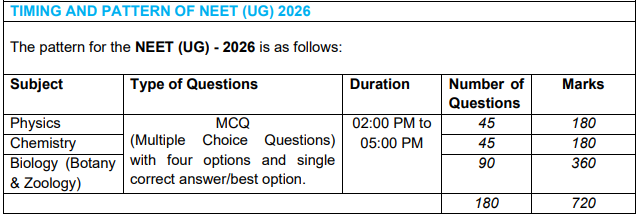
The NEET exam consists of 180 compulsory multiple-choice questions to be completed within 3 hours (180 minutes).
The subject distribution is:
- Physics – 45 questions
- Chemistry – 45 questions
- Biology – 90 questions
Each question carries 4 marks, making the total maximum score 720 marks.
The paper is designed to test conceptual clarity, factual recall, and time management. Unlike U.S. standardized exams that often incorporate long passages or case-based reasoning, NEET questions are direct and topic-specific.
For USA-based students, this means preparation must focus on rapid recognition of concepts and quick elimination of wrong options rather than extended analysis of long text.
Summary:
NEET is a 180-question, 720-mark exam conducted in 3 hours with a fixed subject distribution and fully objective format.
Offline OMR-Based Examination Format
One of the biggest adjustments for U.S.-educated students is the offline OMR format.
Students are given:
- A printed question booklet
- An OMR (Optical Mark Recognition) answer sheet
Answers must be filled by shading circles corresponding to selected options using a black or blue ballpoint pen (as specified in instructions).
Unlike computer-based tests, OMR sheets do not allow corrections. If a student fills the wrong circle and attempts to erase or overwrite it, the answer may not be evaluated correctly.
For students accustomed to digital exams, practicing OMR marking beforehand is critical. Speed in marking without misalignment is a skill that must be developed.
Example:
A student answers questions correctly in the booklet but accidentally shifts one line down on the OMR sheet. This misalignment affects multiple answers, reducing overall score.
Summary:
OMR marking requires precision. Practice under real conditions is essential.
NEET NRI Counseling & Admission eBook Download
A practical guide covering NRI quota admission process, fee, colleges, counseling, sponsor rules, document checklist, verification traps, NRI quota admission details.

Schedule Trial Session For NEET Prep
Get a short academic diagnostic report, study roadmap: syllabus gaps (NCERT vs U.S. curriculum) and the exact weekly plan needed to improve accuracy under time.
Marking Scheme & Negative Marking Rules
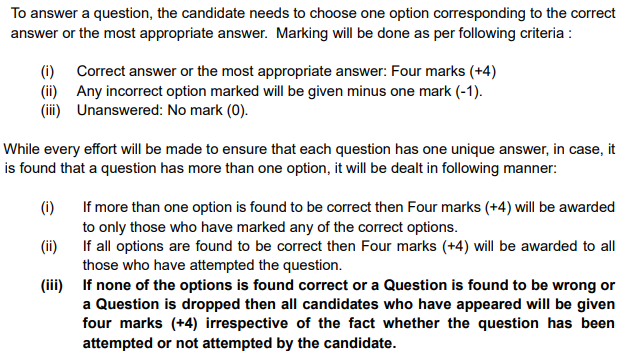
The marking scheme is simple but strategically important:
- +4 marks for each correct answer
- -1 mark for each incorrect answer
- 0 marks for unattempted questions
Negative marking plays a major role in overall rank. Guessing blindly can significantly reduce score.
For USA-based students accustomed to exams without negative marking, this adjustment is critical. Strategic answering is necessary. If a student can eliminate two options confidently, attempting the question may be reasonable. If completely unsure, leaving the question unanswered may be safer.
Example:
If a student attempts 15 questions by guessing and gets 10 wrong, they lose 10 marks — equivalent to losing 2.5 correct answers.
Summary:
Negative marking demands disciplined answering. Avoid blind guessing.
Subject-Wise Question Distribution
Physics (45 Questions)
Physics questions are generally calculation-based and concept-driven. They require formula recall and numerical accuracy.
Physics often becomes the differentiating subject because many students struggle with speed under time pressure. Questions are rarely descriptive; they focus on applying formulas efficiently.
USA-based students who have taken AP Physics may understand the concepts well but must practice rapid calculation.
Chemistry (45 Questions)
Chemistry is divided into Physical, Organic, and Inorganic sections.
Physical Chemistry involves numerical problem-solving. Organic Chemistry tests reaction understanding. Inorganic Chemistry often requires memorization of properties and trends.
Chemistry is considered a scoring subject if prepared thoroughly. It rewards clarity and structured revision.
Biology (90 Questions)
Biology carries the highest weightage — 50% of the total paper.
Most Biology questions are direct and theory-based. Strong memorization of textbook content significantly improves performance.
For USA-based students, Biology may feel more comfortable if they have strong AP Biology background, but NEET requires greater depth in certain areas like plant physiology and taxonomy.
Summary:
Biology dominates weightage, Chemistry provides scoring stability, and Physics often determines rank differentiation.
Time Management Strategy During the Exam
With 180 minutes for 180 questions, students theoretically have 1 minute per question. However, time distribution must be strategic.
A common time allocation model is:
- Biology: 75–90 minutes
- Chemistry: 45–60 minutes
- Physics: 60–75 minutes
Many students attempt Biology first to build confidence and secure marks quickly. Physics is often left for the middle or end, depending on individual strength.
USA-based students should practice full-length mock tests at the exact time NEET is conducted in India to simulate real conditions.
Summary:
Effective time management can add 20–40 marks to performance without improving knowledge level.
Question Type Characteristics
NEET questions are:
- Single-correct multiple choice
- Concept-based
- Fact-based
- Numerically solvable
There are no subjective answers, essays, or long explanations required.
Questions are generally straightforward but designed to test clarity and eliminate careless mistakes. Trick questions are rare, but distractor options are carefully designed.
For U.S.-educated students, the biggest adjustment is shifting from passage-based reasoning to rapid fact recall.
Example:
Instead of reading a long case study as in MCAT, NEET may directly ask: “Which enzyme catalyzes this reaction?”
Summary:
NEET questions are concise, direct, and syllabus-specific.
Exam Duration & Physical Endurance
The total duration is 3 hours without breaks. Students must maintain concentration throughout.
International travel may impact physical stamina due to jet lag. USA-based families must plan arrival in India at least several days before the exam to allow body clock adjustment.
Hydration, proper sleep, and light pre-exam meals are important.
Summary:
Physical readiness and stamina are part of exam performance.
Comparison with U.S. Standardized Tests
|
|
|
|
|
|
|
|
|
|
|
|
|
|
|
|
|
|
|
|
|
|
|
|
Parents must understand that NEET’s rank-based system means small mark differences can significantly change seat outcomes.
Summary:
NEET requires a different preparation mindset compared to U.S. exams.
Common Paper Pattern Mistakes by USA-Based Students
- Not practicing OMR sheets
- Ignoring negative marking strategy
- Spending too much time on one Physics question
- Not attempting easier Biology questions first
- Underestimating time pressure
These mistakes can cost valuable marks.
Summary:
Understanding paper pattern prevents avoidable scoring losses.
Mock Tests & Simulation Strategy
Mock exams should simulate:
- Real time limit (3 hours)
- OMR marking
- Same subject sequence
- Same break-free duration
Students should analyze:
- Accuracy rate
- Time spent per subject
- Error patterns
- Guessing accuracy
USA-based students should practice at Indian exam timing to adapt circadian rhythm.
Summary:
Simulation builds familiarity and reduces exam-day surprises.
Final Takeaway for USA-Based NRI Families
The National Eligibility cum Entrance Test paper pattern is predictable, structured, and strictly regulated by the National Testing Agency.
Success depends not only on syllabus knowledge but also on:
- Understanding OMR mechanics
- Managing negative marking
- Allocating time strategically
- Practicing under real conditions
- Maintaining exam-day discipline
For USA-based students, mastering the paper pattern is as important as mastering the syllabus.
Overall Summary
NEET is a 3-hour, 180-question offline exam totaling 720 marks with negative marking. Biology carries 50% weightage. The exam requires fast recall, precise marking, and disciplined time management.
Adapting from computer-based U.S. tests to an OMR-based, rank-driven system is essential. With structured practice and strategic awareness, USA-based NRI students can confidently navigate the NEET exam format and maximize their performance.