About NEET Examination
I know NEET is mandatory, but I do not understand the full system. I am confused about syllabus, exam pattern, negative marking, and how NEET connects to AIQ, state counseling, deemed universities, and NRI quota. I also worry whether my USA educated child will struggle due to NCERT style questions and statement traps. I need a parent friendly overview that explains how the exam works, what score and rank really mean, and what the year timeline looks like. I want a simple plan for what to focus on first, what resources are essential, and how to track readiness through tests.
(USA NRI Guide for MBBS Admission in India)
Planning for MBBS in India while living in the United States can feel overwhelming. The systems are different, the timelines are different, and the academic expectations are structured very differently from the American pre-med pathway. At the center of this journey is one examination — the National Eligibility cum Entrance Test (NEET).
For USA-based NRI and OCI families, understanding NEET is not just about knowing “what the exam is.” It is about understanding how it affects eligibility, seat allocation, counselling pathways, documentation, and long-term career plans — including the possibility of returning to the United States.
This chapter explains NEET in depth — how it works, who conducts it, who must take it, what happens after it, and what it truly means for NRI families.
What Is NEET?
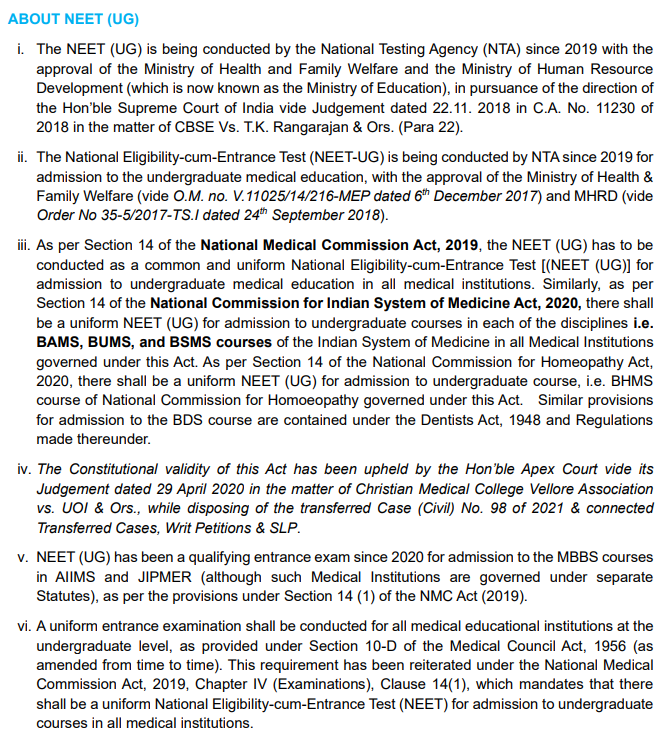
The National Eligibility cum Entrance Test is India’s single, centralized entrance examination for undergraduate medical courses such as MBBS (Bachelor of Medicine and Bachelor of Surgery). It is conducted annually by the National Testing Agency (NTA), an official government testing body responsible for conducting national-level entrance examinations.
Unlike the United States, where medical school admission requires a bachelor’s degree followed by the MCAT and a holistic application process, India follows a direct-entry model. Students can enter MBBS immediately after high school (12th grade equivalent), provided they qualify NEET. This makes NEET the only gateway to becoming a doctor in India at the undergraduate level.
NEET is mandatory for admission to:
- Government medical colleges
- Private medical colleges
- Deemed universities
- NRI quota seats
- Central institutions
There is no alternative entrance exam for MBBS in India. Whether a student is an Indian citizen, NRI, OCI, or foreign national, qualifying NEET is compulsory.
Summary:
NEET is the single national entrance examination required for all MBBS admissions in India. Without qualifying NEET, admission is not possible in any recognized institution.
NEET NRI Counseling & Admission eBook Download
A practical guide covering NRI quota admission process, fee, colleges, counseling, sponsor rules, document checklist, verification traps, NRI quota admission details.

Schedule Trial Session For NEET Prep
Get a short academic diagnostic report, study roadmap: syllabus gaps (NCERT vs U.S. curriculum) and the exact weekly plan needed to improve accuracy under time.
Is NEET Mandatory for NRI & OCI Students?
Yes — NEET is mandatory for NRI, OCI, and foreign national students as well.
A common misconception among USA-based families is that NRI quota seats may allow admission without NEET. This is incorrect. Even for NRI quota seats in private or deemed institutions, qualifying NEET is compulsory. The quota may affect fees and seat category, but it does not waive the examination requirement.
For example, if a student holds a U.S. passport with OCI status and wishes to apply under the NRI category in a deemed university, they must still appear for NEET and secure at least the qualifying percentile set by NTA. Without this, counselling authorities will not consider the application.
This ensures standardization across all candidates and prevents separate or parallel admission systems.
Summary:
NRI or OCI status does not eliminate the need to take NEET. All MBBS admissions in India require NEET qualification.
Can Students Living in the USA Appear for NEET?
Yes, students studying in the USA can appear for NEET, provided they meet academic eligibility requirements.
However, families must understand the practical implications. NEET is primarily conducted in India. Overseas centers are limited and vary by year. Historically, the United States has not consistently had examination centers. Therefore, most USA-based students travel to India to take the exam.
From an academic standpoint, the student must have completed Physics, Chemistry, Biology (PCB), and English at the 12th-grade level or equivalent. U.S. high school transcripts must clearly reflect completion of these subjects. Advanced Placement (AP) Biology alone is not sufficient if Physics and Chemistry are missing.
Parents should verify equivalency early to avoid last-minute eligibility concerns.
Summary:
Yes, U.S.-based students can take NEET. But they must meet PCB subject requirements and usually travel to India for the exam.
H2: Who Conducts NEET and Who Handles Admission?
Understanding the difference between exam authority and admission authority is critical.
The NEET exam is conducted by the National Testing Agency (NTA). NTA is responsible for:
- Registration
- Admit card release
- Conducting the examination
- Publishing answer key
- Declaring results
However, NTA does not conduct seat allotment.
Admission counselling is handled by:
- Medical Counselling Committee (MCC) for All India Quota (AIQ) and Deemed Universities
- Individual state counselling authorities for state quota seats
This separation often confuses USA-based families. NEET qualification is one stage. Counselling and seat allocation are entirely separate processes with independent deadlines.
Summary:
NTA conducts the exam. MCC and state authorities conduct counselling. Exam and admission are separate stages.
NEET Exam Pattern Overview
NEET is a pen-and-paper (OMR-based) examination consisting of:
- 180 multiple-choice questions
- 720 total marks
- Physics, Chemistry, Biology (Botany + Zoology)
- Negative marking for incorrect answers
Biology carries 50% weightage (90 questions), while Physics and Chemistry carry 45 questions each.
Unlike the MCAT, which emphasizes analytical reasoning and passage-based problem-solving, NEET is highly syllabus-driven and memory-intensive. Questions are drawn strictly from prescribed academic content equivalent to Indian Class 11 and 12.
For U.S.-educated students, this often requires adapting study methods. The exam rewards accuracy, speed, and strong conceptual recall rather than essay writing or holistic evaluation.
Summary:
NEET is a 720-mark, multiple-choice, syllabus-based exam with heavy emphasis on Biology and strict negative marking.
NEET vs MCAT – Understanding the Difference
For USA-based families, it is essential to understand how NEET differs from the American pathway.
|
|
|
|
|
|
|
|
|
|
|
|
|
|
|
In India, admission depends almost entirely on NEET rank. There are no essays, interviews (for most colleges), or extracurricular evaluations at the undergraduate MBBS level.
This means preparation must be targeted and strategic. Academic performance in one three-hour exam determines ranking and eligibility.
Summary:
NEET is rank-driven and exam-focused, unlike the holistic U.S. medical school pathway.
What Happens After NEET?
Qualifying NEET does not guarantee admission. It allows participation in counselling.
The post-NEET sequence is:
- Counselling registration
- Choice filling
- Seat allotment
- Reporting to allotted college
- Document verification
Seat allotment depends on:
- Rank
- Category (General/NRI/OCI/etc.)
- College preferences
- Seat availability
For example, an NRI student with moderate rank may not secure a government seat but may secure a deemed university seat under the NRI quota.
Understanding this flow prevents false expectations.
Summary:
NEET qualification leads to counselling. Admission depends on rank and seat availability.
Seat Routes Available After NEET
There are multiple seat pathways:
All India Quota (AIQ)
15% of government seats nationwide. Highly competitive.
State Quota
85% of government seats within each state. Often domicile-dependent.
Deemed Universities
Common route for NRI students. Higher fees but wider eligibility.
NRI Quota Seats
Available in select private/deemed institutions. Requires strict documentation proving NRI status.
Each route has different fee structures, competitiveness, and documentation requirements.
Summary:
Multiple seat routes exist. Strategy depends on rank, budget, domicile, and documentation.
How Competitive Is NEET?
NEET is one of the most competitive examinations in India. Millions of students appear annually, competing for limited MBBS seats.
Even high scores may not guarantee government seats. Rank plays a crucial role. Small mark differences can significantly change rank positions.
For NRI students, while NRI quota seats may offer flexibility, they involve higher tuition fees. Financial planning becomes essential.
Summary:
NEET is highly competitive. Rank and strategy determine final admission outcome.
Timeline Overview for USA-Based Students
A typical annual cycle:
- Early Year → Registration
- Mid Year → Examination
- Weeks Later → Result
- Following Months → Counselling
USA families must align:
- Travel planning
- Academic schedules (AP/IB exams)
- Document preparation
- Financial readiness
Planning backward from counselling dates reduces stress.
Summary:
NEET follows a fixed annual cycle. Travel and documentation must align with this schedule.
Common Mistakes USA-Based NRI Students Make
- Assuming U.S. curriculum automatically meets eligibility
- Selecting wrong nationality during registration
- Underestimating preparation difficulty
- Ignoring counselling registration deadlines
- Confusing qualifying marks with competitive admission rank
Early clarity prevents a lost academic year.
Final Takeaway for USA-Based NRI Families
NEET is:
- Mandatory
- Centralized
- Rank-driven
- Highly competitive
- Document-sensitive
For NRI families in the United States, the key to success lies in:
- Verifying academic eligibility early
- Preparing specifically for NEET pattern
- Understanding counselling structure
- Planning travel carefully
- Aligning financial expectations
NEET is not just an exam. It is the gateway to the entire MBBS admission process in India. With structured preparation and informed planning, USA-based students can navigate it successfully.
If you would like, next we can expand:
- A detailed “Seat Strategy by Score Range” chapter
- A full “NEET Counselling Deep Dive” chapter
- Or a “USA NRI Planning Timeline Workbook” section