NEET Eligibility
I worry my USA educated child might face eligibility issues because of subject requirements, category selection, or document problems. I need clarity on who is eligible under NRI, OCI, or foreign passport scenarios, and what proofs are required. I fear spending years preparing and then facing disqualification due to a technical issue. I need an eligibility checklist that includes school subjects, identity status, age and document rules, and what must match across portals. I also want a prevention plan: what to check in Grade 10 or 11 so we do not discover problems after the NEET result.


A Complete Eligibility Framework for USA-Based NRI & OCI Families Planning MBBS in India
For USA-based families exploring MBBS admission in India, one of the most critical starting points is understanding NEET eligibility. Before preparation, before travel, before counselling — eligibility determines whether a student can even appear for the National Eligibility cum Entrance Test.
The NEET examination is conducted by the National Testing Agency (NTA). Eligibility rules are defined in the official information bulletin each year. These rules apply to all candidates — including Indian residents, NRIs, OCI cardholders, and foreign nationals.
For families living in the United States, eligibility questions often revolve around:
- Can my child with a U.S. high school diploma apply?
- Does OCI status qualify?
- What subject requirements must be met?
- Is age a factor?
- Does NRI status change anything?
This chapter explains NEET eligibility in detail, with examples, scenarios, and strategic guidance for USA-based parents.
Who Is Eligible to Appear for NEET?
NEET eligibility is based on three major criteria:
- Nationality
- Age
- Academic qualifications
Nationality categories include:
- Indian citizens
- Non-Resident Indians (NRIs)
- Overseas Citizen of India (OCI)
- Persons of Indian Origin (PIO)
- Foreign nationals
All these categories are eligible to appear for NEET, subject to academic requirements.
For USA-based families, this means that holding a U.S. passport with OCI status does not disqualify a student from appearing for NEET. However, eligibility to appear for NEET is different from eligibility to claim specific seat quotas during counselling.
Summary:
NRI and OCI students are eligible to appear for NEET, provided academic and age criteria are met.
NEET NRI Counseling & Admission eBook Download
A practical guide covering NRI quota admission process, fee, colleges, counseling, sponsor rules, document checklist, verification traps, NRI quota admission details.

Schedule Trial Session For NEET Prep
Get a short academic diagnostic report, study roadmap: syllabus gaps (NCERT vs U.S. curriculum) and the exact weekly plan needed to improve accuracy under time.
Age Criteria for NEET
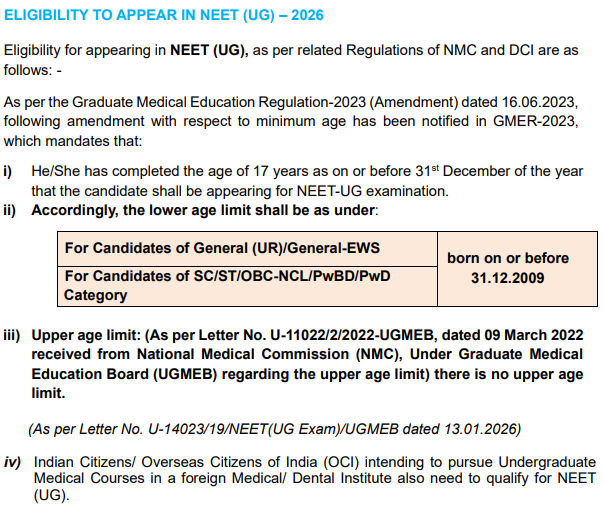
To be eligible for NEET, candidates must meet the minimum age requirement. The lower age limit is typically 17 years at the time of admission or by a specified date in the admission year.
There is currently no upper age limit in most recent regulations, but families should verify official updates in the annual bulletin issued by the National Testing Agency.
For USA-based students graduating high school at 17 or 18 years, age eligibility is usually not an issue. However, early graduates must ensure they meet the minimum age by the specified cutoff date.
Example:
A student turning 17 after the specified cutoff date may not qualify for that admission cycle.
Summary:
Students must be at least 17 by the specified date in the admission year.
Academic Qualification Requirements
The most critical eligibility requirement for USA-based students is academic qualification.
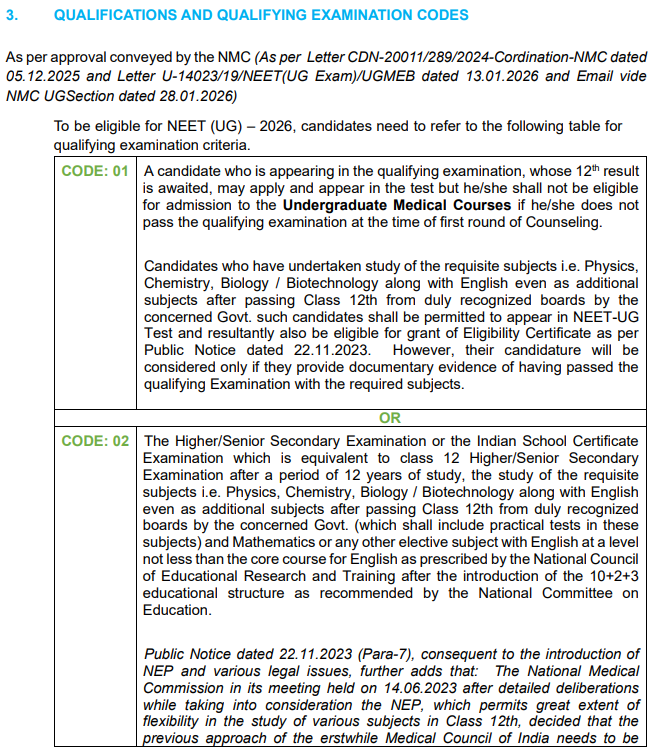
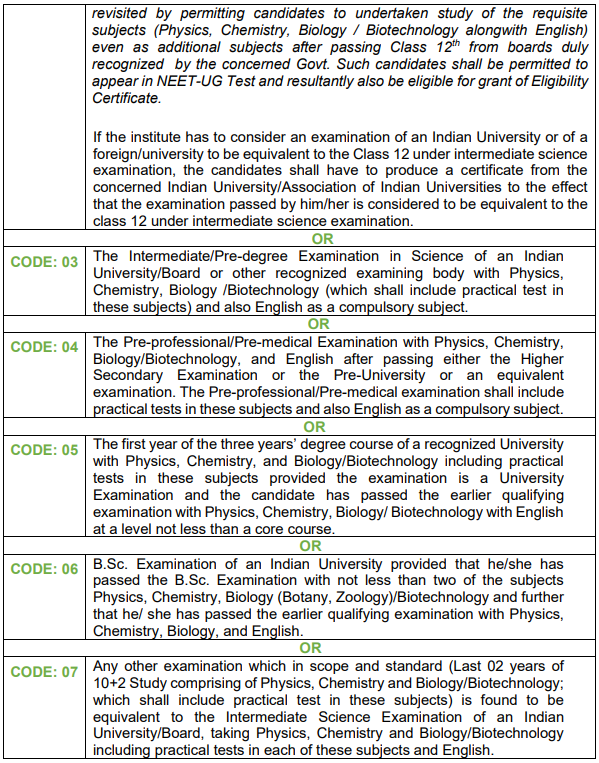
To appear for NEET, candidates must have completed or be appearing in Grade 12 (or equivalent) with:
- Physics
- Chemistry
- Biology (or Biotechnology)
- English
These subjects must be studied as core academic subjects, not as minor electives.
For U.S. high school students, transcripts must clearly reflect completion of these subjects. If Biology or Chemistry was taken as an integrated science course without clear subject breakdown, eligibility questions may arise during counselling.
Example:
A transcript listing “Integrated Science” without specifying Physics, Chemistry, and Biology separately may require clarification.
Summary:
PCB (Physics, Chemistry, Biology) plus English must be clearly reflected in academic records.
Minimum Marks Requirement in 12th Grade
NEET eligibility also requires minimum aggregate marks in Physics, Chemistry, and Biology (PCB). The required percentage varies by category, but generally:
- General category: minimum aggregate threshold
- Reserved categories: slightly lower threshold
For NRI and OCI students, category rules depend on how the student is classified during registration and counselling.
USA-based students should ensure their grades in PCB subjects meet minimum criteria. Grade conversion from U.S. GPA to Indian percentage equivalency may be required during document verification.
Example:
If a student has lower performance in Chemistry, overall PCB aggregate may fall below eligibility threshold.
Summary:
Minimum PCB aggregate marks must be met. Grade equivalency may be required for U.S. transcripts.
Equivalence of U.S. High School Diploma
Many parents ask:
“Is a U.S. high school diploma equivalent to Indian 10+2?”
In most cases, yes — provided the required subjects (PCB + English) are completed.
However, equivalence certification may be required during counselling or college reporting. Some universities request equivalency certificates from recognized Indian authorities to confirm that the foreign qualification matches Indian standards.
Families should prepare:
- Official transcripts
- Subject breakdown
- Course descriptions if needed
Example:
An IB student in the U.S. must show Higher Level Biology and Chemistry to demonstrate adequate subject depth.
Summary:
U.S. high school diploma is generally acceptable, but subject clarity and equivalency proof may be required.
Eligibility for NRI & OCI Students Specifically
NRI and OCI students are eligible to appear for NEET, but nationality status affects counselling categories.
- NRI (Indian passport holder living abroad)
- OCI (Foreign passport holder with OCI card)
Both must meet academic criteria. However, during counselling, eligibility for specific seat quotas (such as NRI quota) may require additional documentation.
Parents should understand that NEET eligibility is uniform, but admission eligibility under specific quotas differs.
Summary:
NRI/OCI status does not waive academic eligibility requirements.
Attempt Limits & Gap Years
Currently, there is no fixed attempt limit for NEET, provided age and academic eligibility are satisfied.
Students who take gap years to prepare are eligible as long as they meet age and academic criteria.
USA-based students considering a gap year for focused preparation must ensure visa and academic planning align with long-term goals.
Summary:
No strict attempt limit exists. Gap years are permitted under eligibility guidelines.
Eligibility vs Admission Eligibility
A crucial distinction for NRI families:
NEET eligibility = permission to take the exam.
Admission eligibility = permission to claim specific seat types.
For example:
- A student may qualify for NEET.
- But may not qualify for certain state quota seats due to domicile rules.
Admission under AIQ, deemed universities, or NRI quota seats depends on counselling authority rules, such as those set by the Medical Counselling Committee.
Summary:
Exam eligibility does not automatically ensure eligibility for every seat category.
Common Eligibility Mistakes USA-Based Families Make
- Assuming U.S. curriculum automatically qualifies
- Not verifying subject breakdown on transcript
- Ignoring minimum PCB aggregate requirement
- Selecting incorrect nationality category during registration
- Waiting until counselling to verify equivalence
These mistakes can delay or jeopardize admission.
Summary:
Early verification of eligibility prevents last-minute complications.
Practical Checklist for USA-Based Parents
Before NEET registration, confirm:
- Age meets minimum requirement
- PCB subjects completed
- English included
- Minimum PCB aggregate achieved
- Transcript clarity
- Passport and nationality status consistent
Parents should maintain organized document folders well before registration.
Summary:
Advance document readiness ensures smooth registration and counselling.
Final Takeaway for USA-Based NRI Families
NEET eligibility is structured and clearly defined by the National Testing Agency. It requires compliance with age, academic, and nationality criteria.
For USA-based families, the key areas of focus are:
- PCB subject completion
- Minimum marks
- Transcript clarity
- Nationality selection during registration
Eligibility should be confirmed well before preparation begins. Early clarity prevents stress later in the admission cycle.
Overall Summary
NEET eligibility requires:
- Minimum age (17 years)
- Completion of Physics, Chemistry, Biology, and English
- Minimum aggregate marks in PCB
- Proper documentation
NRI and OCI students are eligible to appear for NEET but must carefully manage documentation and counselling category selection.
Planning eligibility early ensures a smoother MBBS admission journey.