




Hi, I’m TestprepKart.
Your Partner In Exam Preparation

I E Irodov Physical Fundamentals of Mechanics is one of the most recommended Physics books for students preparing for JEE Advanced, Physics Olympiads and other competitive examinations.
This chapter on Relativistic Mechanics introduces more advanced concepts of length contraction, dilation of time, Lorentz transformation and relativistic motion. These problems help students to develop good conceptual understanding and analytical thinking skills.
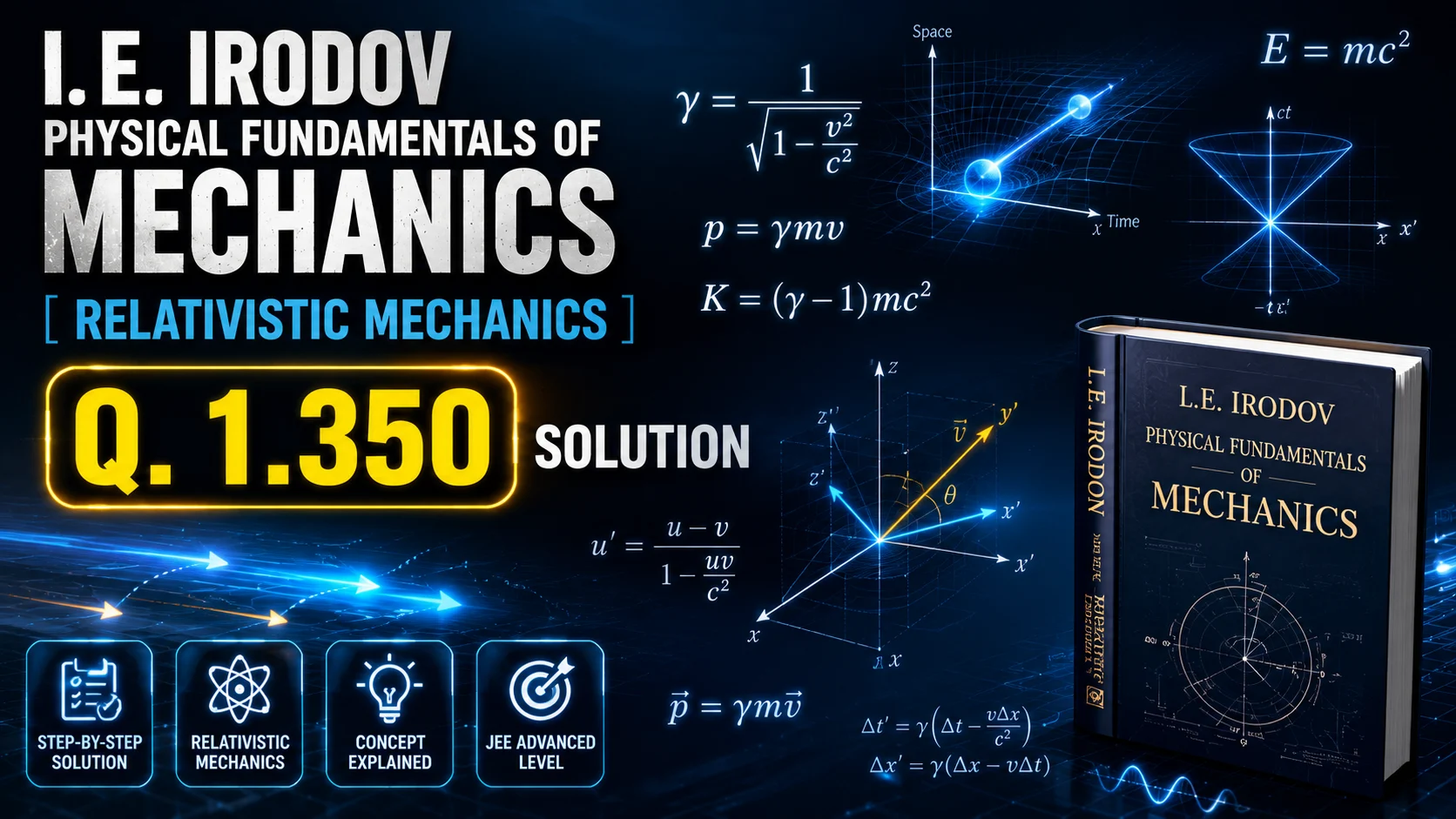
This page contains detailed solution of I E Irodov Physical Fundamentals of Mechanics (Relativistic Mechanics) Question 1.350 with explanation of concepts and formulae used.
Download JEE Advanced revision notes and solution support material to revise advanced Physics concepts with better preparation.
| Resource | Purpose | Download |
| JEE Advanced Revision Notes | Full solution support and advanced Physics revision | Download Full Solution |
Question:
Two rods with equal proper length l_0 move towards each other parallel to a common horizontal axis.
In the frame of reference attached to one of the rods the time between the moments when the right ends and the left ends of the two rods coincide is Δt.
Find the velocity of one rod relative to the other.
This question is based on the Special Theory of Relativity.
Important concepts involved are:
The problem demonstrates how the observed length of a moving rod changes depending on the observer’s frame of reference.
Since we are observing from the frame fixed to one rod,
The stationary rod has its proper length:
[
L_1=l_0
]
The moving rod undergoes length contraction.
Therefore,
[
L_2=l_0\sqrt{1-\frac{v^2}{c^2}}
]
Initially, the front ends of the rods coincide.
After time Δt, the rear ends coincide.
During this interval, the moving rod travels a distance equal to the sum of the two visible lengths.
Therefore,
l_0+l_0\sqrt{1-\frac{v^2}{c^2}}
]
or
l_0
\left(
1+\sqrt{1-\frac{v^2}{c^2}}
\right)
]
Divide both sides by l₀:
1+\sqrt{1-\frac{v^2}{c^2}}
]
Move 1 to the left side:
\sqrt{1-\frac{v^2}{c^2}}
]
Now square both sides.
After simplification, the required relative velocity satisfies
[
\boxed{
v=
\frac{2l_0c^2\Delta t}
{c^2(\Delta t)^2+l_0^2}
}
]
This is the required velocity of one rod relative to the other.
The relative velocity of the rods is
[
\boxed{
v=
\frac{2l_0c^2\Delta t}
{c^2(\Delta t)^2+l_0^2}
}
]
After checking the final answer, revise related JEE Advanced Physics concepts and practice more advanced-level questions.
One rod is fixed and the second rod moves towards it.
The moving rod is contracted in length . This means its length as seen by the observer is less than its proper length .
In the time allowed the moving rod sweeps the entire visible length of both rods.
Then we can use the length contraction formula and the relation between distance velocity and time to get the required expression for relative velocity.
The solution demonstrates the relation between the proper length, length contraction and relative motion in Special Relativity.
Planning DASA counselling through JEE Main for NIT, IIIT, SPA or engineering admission in India? Download the free TestPrepKart JEE E-Book and understand the right preparation strategy, syllabus planning, mock test approach and admission roadmap for NRI students.

| Factor | Details |
| Book | I E Irodov |
| Chapter | Relativistic Mechanics |
| Question | 1.350 |
| Difficulty | Advanced |
| Main Concept | Length Contraction |
| Formula Used | Lorentz Length Contraction |
| Final Result | Relative Velocity of Rods |
| Best For | JEE Advanced & Advanced Physics |
Students commonly make these mistakes:
Always identify which object is stationary before applying the length contraction formula.
I E Irodov problems help students develop advanced Physics concepts beyond routine JEE problems.
Benefits include:
Improved analytical thinking
Better mathematical implementation
Confidence in advanced numeracy problems
Better preparation for JEE Advanced and Physics Olympiad
Students should solve selected I E Irodov problems only after mastering NCERT concepts, JEE Main questions and JEE Advanced level Physics.
Nope. Q. 1.350 I E Irodov Relativistic Mechanics is not a usual JEE Main level problem.
This question is based on the Special Theory of Relativity and involves understanding the concepts of length contraction, proper length, Lorentz factor and relative motion. These ideas are typically studied in advanced Physics preparation.
This question is recommended for:
If you are preparing for JEE Main, start with NCERT, standard JEE level numerical problems, previous year papers and mock tests before you start referring advanced reference books like I E Irodov.
Relativistic Mechanics is not a high weightage chapter in JEE Main. But it helps students to build up the advanced Physics concepts required for the JEE Advanced.
Students learn important topics like:
Only a few questions are based on relativity, but if you understand these concepts, your problem solving ability will improve overall.
| Topic | Practice Level |
| Kinematics | I E Irodov Problems |
| Dynamics | I E Irodov Problems |
| Conservation of Energy & Momentum | I E Irodov Problems |
| Universal Gravitation | I E Irodov Problems |
| Dynamics of a Solid Body | I E Irodov Problems |
| Elastic Deformation of Solids | I E Irodov Problems |
| Hydrodynamics | I E Irodov Problems |
| Relativistic Mechanics | I E Irodov Problems |
The best way to use I E Irodov is after building strong Physics fundamentals.
Recommended preparation strategy:
This approach helps students understand advanced concepts without becoming overwhelmed.
Selected I E Irodov questions are very useful for NRI students from USA, UAE, Saudi Arabia, Qatar, Oman, Kuwait and Bahrain preparing for JEE Advanced.
Students appearing for AP, IB, British or any other international boards must first complete the JEE syllabus and then solve advanced reference books.
Recommended preparation sequence:
This structured approach helps NRI students strengthen conceptual understanding and advanced problem-solving skills.
NRI students preparing from USA, UAE, Saudi Arabia, Qatar, Oman, Kuwait and Bahrain can use selected I E Irodov questions with JEE Advanced guidance, previous year papers and mock tests.
After completing Question 1.350, students can also practice:
Link each question to its corresponding TestPrepKart solution page to improve concept continuity.
After solving this question, students should continue with:
Regular practice of advanced numerical problems improves analytical thinking and conceptual understanding.
| Resource | Purpose | Action |
| JEE Advanced Revision Notes | Revise JEE Advanced Physics concepts and solution methods | Download Notes |
| JEE Previous Year Papers | Practice JEE Main previous year papers | Download PDF |
| JEE Preparation Video | Watch JEE preparation guidance video | Watch Video |
| JEE Online Coaching | Start structured JEE Main and JEE Advanced preparation | Explore Courses |
| Book Free Demo | Get a personalized JEE preparation plan | Book Demo |
| JEE Coaching Inquiry | Connect with TestPrepKart counsellors for JEE preparation | Submit Inquiry |
| General Inquiry | Ask admission-related questions for engineering in India | Send Inquiry |
| JEE E-Book | Plan syllabus, mock tests, previous papers and admission strategy | Download |
| WhatsApp Updates | Get JEE, DASA and engineering admission updates | Join Group |
| JEE NRI Eligibility | Understand JEE eligibility criteria for NRI students | Read Guide |
| JEE Coaching for NRI Students | Understand online JEE preparation for NRI students | Read Guide |
| Engineering Entrance for NRIs | Understand entrance examination routes for engineering in India | Read Guide |
| NRI Admissions in NITs | Understand NRI quota, eligibility, fee and cutoff for NIT admission | Read Guide |
| DASA Brochure | Understand DASA admission rules for NRI students | Download |
| DASA Eligibility | Check eligibility before DASA registration | Read Guide |
| Complete DASA UG Guide | Understand colleges, eligibility, dates, fees, registration, cutoff and refund | Read Full Guide |
| DASA Fee Structure | Understand DASA and CIWG fee planning | View Fees |
| DASA Seat Matrix | Check institute-wise and branch-wise seat availability | Check Seats |
| DASA Seat Allotment | Understand allotment rounds, acceptance and reporting | View Allotment |
| DASA Cutoff | Plan college and branch choices using cutoff trends | Check Cutoff |
| CIWG Scheme | Understand CIWG rules for Gulf NRI students | Understand CIWG |
| Required Documents | Prepare scanned documents for DASA and CIWG counselling | View Documents |
| JEE Coaching in California | JEE preparation guidance for students in California | Read Guide |
| JEE Coaching in Texas | JEE preparation guidance for students in Texas | Read Guide |
| JEE Coaching in New York | JEE preparation guidance for students in New York | Read Guide |
| NIT Trichy NRI Admission | Understand NIT Trichy admission guidance for NRI students | Read Guide |
| NIT Surathkal NRI Admission | Understand NIT Surathkal admission guidance for NRI students | Read Guide |
| NIT Warangal NRI Admission | Understand NIT Warangal admission guidance for NRI students | Read Guide |
| NIT Rourkela NRI Admission | Understand NIT Rourkela admission guidance for NRI students | Read Guide |
| NIT Calicut NRI Admission | Understand NIT Calicut admission guidance for NRI students | Read Guide |
The problem is based on length contraction, proper length and relative motion in Special Relativity.
This question is above the usual JEE Main level and is mainly recommended for JEE Advanced preparation.
Length contraction occurs only for the rod moving relative to the observer. The rod at rest in the chosen reference frame keeps its proper length.
The most important relation is the Lorentz length contraction formula:
[
L=L_0\sqrt{1-\frac{v^2}{c^2}}
]
No. Students should first complete Mechanics, Modern Physics and JEE-level questions before attempting advanced relativity problems from I E Irodov.
Yes. Selected I E Irodov problems help students strengthen advanced Physics concepts and improve their performance in JEE Advanced.








Copyright © 2024 CounselKart Educational Services Pvt. Ltd.. All Rights Reserved

Post a Comment