






Hi, I’m TestprepKart.
Your Partner In Exam Preparation

Download Testprepkart SAT Prep Guide
If you are preparing for the Digital SAT in 2026, the quality of your practice tests matters more than how many you download.
The College Board, which creates the real SAT, also provides the only official Digital SAT practice exams through the Bluebook app. These tests use the same adaptive scoring and difficulty models as the actual exam, making them far more accurate than third-party PDFs.
This page is designed for:
U.S. high school students preparing for college admissions
Indian and NRI families planning SAT-based scholarships
Students targeting 1200–1600 scores on the Digital SAT
 |  |  |
Download All 71 Practice Papers

With the help of this free SAT Prep Guide, students can study with a clear plan rather than speculating about what to do next. Priority themes, creative practice methods, timing tactics, and common mistakes that often result in lower scores are all covered. It was developed for Indian NRI families and high school students in the US, and it makes SAT preparation more organised and manageable with school and AP tasks. Get it to start planning with more clarity, assurance, and direction.
To begin your preparation with organized practice, download our free SAT Prep E-Book, SAT Math Question Bank, and SAT English Question Bank. These tools are intended to assist students in comprehending the style of the Digital SAT, increasing their accuracy, and boosting their self-assurance prior to test day.
Downloading a lot of SAT practice papers is only the first step. What makes the difference between a mediocre score and a high score is how you use them.
Here’s a step-by-step method used by many U.S. test-prep programs:
Before you begin heavy practice, take one full Digital SAT practice test in Bluebook or PDF format.
Purpose:
To identify your baseline strengths and weaknesses.
This gives you a real starting point and helps you plan your study instead of guessing.
Many students jump into books without knowing what actually needs work – this wastes time.
After finishing a practice test, do not just check the score.
Go question by question:
Why was your answer wrong?
What trap did you fall for?
What clue in the passage or math problem did you miss?
Was it a timing issue or a misunderstanding?
This kind of review builds metacognition – the ability to think about how you think, which is one of the biggest predictors of score improvement.
Create a simple error log with categories like:
Careless reading
Trap answers
Time pressure
Math concept gap
Vocabulary misunderstanding
This tells you what type of improvements matter most – not just how many questions you got wrong.
Thousands of U.S. students improve faster by fixing Patterns instead of repeating Tests.
After reviewing a test, take another one with a specific focus.
For example:
Next Bluebook test, ignore questions you already know
Focus on sections where your error log shows repeated mistakes
Try timing yourself more strictly or differently
This targeted practice is far more effective than random test-after-test drilling.
Many websites host “SAT papers.”
Only one organization designs the real SAT: the College Board.
That matters because the Digital SAT is not just a question set – it is a statistical system.
Every official Bluebook test is calibrated using:
Real student performance data
Difficulty scaling models
Adaptive module logic
This means:
If you score 1280 on Bluebook Test 6, it predicts your real SAT score far more accurately than any third-party PDF.
Most unofficial PDFs:
Are not adaptive
Do not use official difficulty balancing
Do not reflect how Module 2 changes based on Module 1
That is why U.S. counselors and high schools rely on College Board tests for score planning.
In U.S. schools, SAT improvement does not come from “studying more.”
It comes from changing how you take the test.
A real improvement cycle looks like this:
Take Bluebook Test 5
Miss 12 Reading questions
7 of them are inference traps
Student drills only inference questions for 2 weeks
Retakes Test 6
Inference errors drop to 2
Score jumps by 80–120 points
This is how SAT prep works in New Jersey, Texas, California, and New York – not by doing random worksheets.
Your downloads only matter if they are used this way.
Many Indian NRI students in U.S. are trained to:
Solve everything
Memorize formulas
Practice volume
The SAT does not reward volume.
It rewards decision-making.
On the Digital SAT:
You are expected to prioritize questions strategically, not solve every problem perfectly.
You are expected to skip traps.
You are expected to recognize patterns.
That is why U.S. students can score 1400+ with fewer practice hours – they use tests as strategy tools, not homework.
You do not need 71 tests.
High-scoring U.S. students typically use:
1 diagnostic test
4–6 full Bluebook tests
10–20 targeted PDF drills
More than that causes:
Burnout
False confidence
No score growth
Quality beats quantity on the Digital SAT.
A 1350 in 2026 does not mean “average.”
It means:
Top 15–20 percent of test takers
Strong merit-aid potential
Competitive for many public universities
That is why SAT practice tests are not just academic tools – they are financial tools.
Every 100 points can mean:
Thousands of dollars in scholarships
Admission to better programs
Less student debt
Recommended Digital SAT Prep Books (2026 Updated)
| The College Board’s Official SAT Study Guide, 2026 Edition | Download |
| Kallis’ Digital SAT Pattern Strategy | Download |
| Dr. Steve Warner’s 500 New SAT Math Problems | Download |
| Dr. Jang’s Digital SAT 800 Math Workbook New Edition | Download |
| PWN The SAT: Math Guide, 4th Edition | Download |
| The Critical Reader: The Ultimate Guide to SAT Grammar, 4th Edition | Download |
| Digital SAT Prep Black Book, 2nd Edition | Download |
| McGraw-Hill Education SAT Elite 2022 | Download |
| Barron’s SAT, 29th Edition(Premium 2025 also available) | Download |
| The Princeton Review’s Cracking the SAT, 2025 Edition | Download |
A practice test score alone is just a number.
What’s more important is:
Are you improving on the types of questions you previously missed?
Have your error types shifted from careless to conceptual?
Is your timing improving in each digital module?
Top U.S. students track trends, not raw scores.
For example:
If your Reading & Writing score stayed at 680 but now you miss fewer inference questions and more trap answer traps instead, you are closer to a real strategy breakthrough.
| Feature | Digital SAT (2026) | Why it helps you | Quick tip |
| Format | Fully digital in the Bluebook app | Less paperwork, smoother test-day | Install Bluebook and do 1 practice test this week |
| Sections | 2 – Reading & Writing, Math | Simple structure to plan study | Study R&W one day, Math the next |
| Test length | 2 hr 14 min total | Shorter than old SAT → less fatigue | Always time your practice |
| Adaptive | Yes (questions adjust to you) | More relevant difficulty, fairer feel | Focus on accuracy in Module 1 |
| Questions | R&W 54 (27+27), Math 44 (22+22) | Fewer items → more focus per question | Aim 75–85% correct on first pass, then review |
| Calculator | Allowed for all of Math (built-in graphing + approved handhelds) | Faster solving, fewer manual errors | Learn the built-in graphing tools |
| On-screen tools | Timer, flag/mark, review list | Easier pacing and revisits | Mark tough items, don’t get stuck |
| Break | 10-minute break between sections | Reset your brain & eyes | Stretch, sip water, small snack |
| Score release | Faster than paper (about 2–3 weeks) | Plan applications/retakes sooner | Check release dates when you book |
| Devices | Laptop/tablet/iPad or school-managed Chromebook | Clear rules avoid test-day issues | Fully charge device; carry charger/ID |
| Quick prep plan | Baseline full test → Daily mini-drills→Two full mocks before test | Steady improvement without burnout | Keep an error log: concept → cause → fix |
| Day | What to Do | Purpose |
| Monday | Reading & Writing Module 1 (timed) + review mistakes | Build comprehension, evidence tracking, and grammar accuracy |
| Tuesday | Drill weak Reading & Writing topics (from error log) | Fix recurring mistakes like central ideas, evidence, and transitions |
| Wednesday | Math Module 1 (timed) + review mistakes | Improve algebra, data analysis, and accuracy under time pressure |
| Thursday | Drill weak Math topics (from error log) | Strengthen problem areas like linear equations, word problems, and graphs |
| Friday | Mixed practice (10 R&W + 10 Math questions) | Maintain balance and avoid skill decay |
| Saturday | Full-length Digital SAT practice test (Bluebook or PDF) | Simulate real test day and measure true score |
| Sunday | Deep review + error log update | Turn mistakes into score gains and lock in learning |
This schedule mirrors how high-scoring U.S. SAT students actually train:
focused modules → targeted drills → full test → deep review → repeat.
The Digital SAT Exam is divided into two sections: Reading and Writing and Math. Each portion contains a specific number of questions and a time limit, and each section must be finished within the time limit. To learn more about the Digital SAT Exam Pattern.
Reading & Writing Section Structure:
The Reading and Writing part has two sections. Each section has 25 questions you need to answer, along with 2 practice questions. You have a total of 32 minutes for each section. Check the table below for more details on the exam structure:
|
DIGITAL SAT EXAM STRUCTURE | |
|
Section |
Reading and Writing |
|
Test length |
Module 1: 25 operational questions and 2 pretest questions Module 2: 25 operational questions and 2 pretest questions |
|
Time per module |
Module 1: 32 minutes and Module 2: 32 minutes |
|
Number of questions |
54 questions |
|
Total time |
64 minutes |
Math Section Structure:
The Math part has two sections. Each section has 23 regular questions and 2 practice questions. You get a total of 70 minutes for Math, split evenly between the two sections. In the Digital SAT, the calculator is available throughout the exam. The table below has more details about the exam structure:
|
DIGITAL SAT EXAM STRUCTURE | |
|
Section |
Mathematics |
|
Test length |
Module 1: 20 operational questions and 2 pretest questions Module 2: 20 operational questions and 2 pretest questions |
|
Time per module |
Module 1: 35 minutes and Module 2: 35 minutes |
|
Number of questions |
44 questions |
|
Total time |
70 minutes |
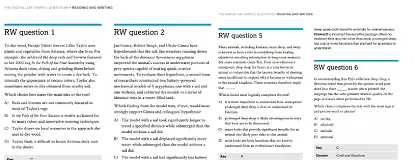
Math Paper Screenshot
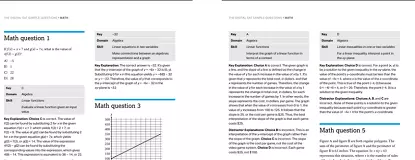
Download Digital SAT Sample Paper
How to Download College Board Bluebook Application for Digital SAT 2026
To take the tests, you must download the College Board Bluebook app. Here are the Steps to download the Bluebook application.
Step 1. Open the College Board Site.
Step 2. Download the Bluebook application.

Step 3. Register yourself on the College Board Site.
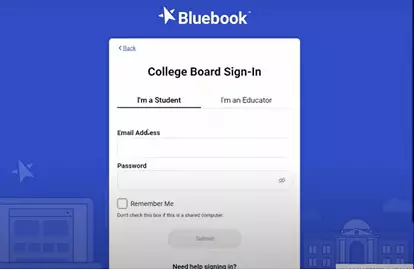
Step 4. Start solving the Sample Papers.
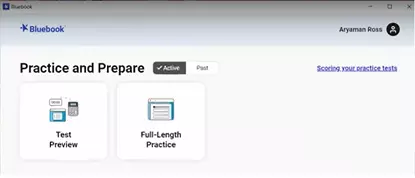
Advantages of Full-Length Digital SAT Practice Exams

Sample Papers Related FAQs
Q. Why you should not download practice papers from random websites?
A: Because sample papers from any random website might not be authentic or the latest. So, it is always recommended to go for trusted websites or the official website.
Q. What is a good Digital SAT score?
A: On average, anything above 1200 is considered to be a good score. And the maximum one can score is 1600.
Q. Are Digital practice papers accurate?
A: The difficulty level is almost the same as the real one. But it also depends on your level of seriousness. If you take the test as the real one, you will get the result. But it would not help you much if you took an ordinary test.
Q. Is the digital SAT a tough test?
A: We cannot tell the exact toughness level. It is the standard exam for taking undergraduate admission in the USA and Canada. With a little effort and seriousness, you can get a decent score.
Q. Is the Digital SAT practice paper harder than the real ones?
A: No, they are almost at the same level. You might feel harder in the real world because of the environment and the anxiety.
Q. Are Digital SAT Sample Papers reflective of the actual exam content?
A: The College Board’s practice tests are like blueprints for the real SAT. Sample papers were designed by the same experts who created the actual exam, so you can be confident they reflect the exact structure and content you’ll face on test day.
Q. How can Digital SAT Sample Papers enhance my preparation?
A: Practicing with Digital SAT Sample Papers helps familiarize you with the exam format, improve time management, and identify areas for improvement, contributing to a more effective preparation strategy.
Q. Can I access Digital SAT Sample Papers on mobile devices?
A: Yes, most PDFs are compatible with mobile devices, allowing you to practice conveniently on smartphones or tablets.
Q. Are answer keys provided with the Digital SAT Sample Papers?
A: Yes, reputable sources typically include answer keys and detailed explanations to help you understand and learn from your mistakes.
Q. How often should I practice with Digital SAT Sample Papers?
A: Consistent practice is key. Aim for regular sessions leading up to the exam to build confidence, refine skills, and enhance overall performance.
FAQs
Q. When can I take the digital SAT?
A: You might be able to take the digital SAT this very spring of 2024! The digital SAT rollout began in spring 2023 for international students, and for US students, it started in spring 2024 [SAT digital ON The College Board, collegeboard.org].
Here’s some additional information to help you out:
Q. How long is the digital SAT?
A: The digital SAT is designed to be shorter than the traditional paper and pencil version. The total testing time is 2 hours and 14 minutes.
Here’s a breakdown of the testing schedule:
Even though it’s shorter overall, you’ll have more time per question on average compared to the paper SAT. This should allow you to focus more on your critical thinking and problem-solving skills rather than racing against the clock.
Q. Is the digital SAT adaptive?
A: Yes, the digital SAT is adaptive! It uses a multistage adaptive testing method [SAT digital ON The College Board, collegeboard.org]. This means the test adjusts to your ability level as you go through it.
Here’s how it works:
This approach aims to give you a more personalized testing experience and a score that accurately reflects your abilities.
Q. How does scoring work on the digital SAT?
A: The scoring process for the digital SAT works similarly to the paper-and-pencil version, but with a twist due to the adaptive nature of the test. Here’s a breakdown:
Raw Score:
Scaled Score and Adaptive Twist:
Total Score:
Additional Insights:
Q. Is the digital SAT easier?
A: The College Board maintains that the digital SAT isn’t designed to be inherently easier or harder than the traditional paper-and-pencil version. They aim to assess the same knowledge and skills in both formats.
However, the digital format offers some features that might make the test feel easier for some test-takers:
On the other hand, some aspects of the digital format could be challenging for others:
Quick Connect: +91 800085231013 (toll-free) Email: [testprepkart.com]
Q. How can I get ready for the digital SAT?
A: Take a full-length practice test in Bluebook to simulate test day. This will provide you the opportunity to practice digital testing, get acquainted with the test materials, and confirm that your testing device is compatible with the software and prepared for usage on test day.
Q. How Many Digital SAT Sample papers are available on Bluebook?
A: The College Board’s new digital testing software, Bluebook, now offers four full-length, adaptive SAT practice tests to all students.
Q. How can I download the Bluebook app?
A: You can download the Bluebook app from the College Board’s official website.
Q. What makes the digital SAT unique?
A: The new digital SAT will take about two hours instead of three, which is less time than the existing paper and pencil test. There will be a pause in between the two sections (Reading and writing, math).
Q. What is the digital SAT format?
A: Each digital SAT Suite test is divided into two sections: reading and writing and math. Students have 64 minutes to finish the reading and writing section and 70 minutes to finish the math section. Each segment is made up of two equal-length test-question modules.

He is a Digital SAT mentor with 10+ years of experience, working primarily with SAT students all Over worldwide. Their students have consistently progressed toward 1520+ scores by improving timing, accuracy, and trap-answer control through official-style practice, detailed mistake analysis, and clear weekly action plans.
Copyright © 2024 CounselKart Educational Services Pvt. Ltd.. All Rights Reserved




Post a Comment