


Hi, I’m TestprepKart.
Your Partner In Exam Preparation
For NEET students who are preparing for the exam, there’s good news. The NEET 2026 syllabus has been released on the NTA website. So, don’t waste even a single moment and stay fully focused on your studies.
In this blog, we have arranged the entire NEET 2026 syllabus in a clear and easy-to-understand way. You’ll find the syllabus divided class-wise, subject-wise, and unit-wise, along with details about what’s new and what has been removed compared to the previous year.
We’ve also provided useful study resources such as recommended books, previous years’ question papers, and downloadable study materials in PDF format, which will help both Indian and NRI students cover the NEET syllabus effectively.
Here is the complete, separate NEET 2026 syllabus for Physics, Chemistry, and Biology in PDF format. Save it to your computer or mobile phone and start your preparation right away.
| Subject | Resource |
| Physics | Download Now |
| Chemistry | Download Now |
| Biology | Download Now |
I hope everyone has saved the PDF, because now we’ll start explaining the latest NEET 2026 syllabus. Here, we’ll go through the entire new syllabus step by step so that students can easily understand it and begin their preparation confidently
Here is the complete list of units and their corresponding chapters covered in the NEET 2026 Physics syllabus for Class 11 and Class 12, based on the latest NMC and NCERT guidelines. This includes every topic officially prescribed for the NEET exam.
| Class 11 Units | Chapters |
| Physical World and Measurement | Units and Measurements |
| Kinematics | Motion in a Straight LineMotion in a Plane |
| Laws of Motion | Laws of Motion |
| Work, Energy and Power | Work, Energy and Power |
| Motion of System of Particles and Rigid Body | System of Particles and Rotational Motion |
| Gravitation | Gravitation |
| Properties of Bulk Matter | Mechanical Properties of SolidsMechanical Properties of FluidsThermal Properties of Matter |
| Thermodynamics | Thermodynamics |
| Behaviour of Perfect Gas and Kinetic Theory of Gases | Kinetic Theory |
| Oscillations and Waves | OscillationsWaves |
| Class 12 Units | Chapters |
| Electrostatics | Electric Charges and Fields |
| Electrostatic Potential and Capacitance | |
| Current Electricity | Current Electricity |
| Magnetic Effects of Current and Magnetism | Moving Charges and Magnetism |
| Magnetism and Matter | |
| Electromagnetic Induction and Alternating Currents | Electromagnetic Induction |
| Alternating Current | |
| Electromagnetic Waves | Electromagnetic Waves |
| Optics | Ray Optics and Optical Instruments |
| Wave Optics | |
| Dual Nature of Radiation and Matter | Dual Nature of Radiation and Matter |
| Atoms and Nuclei | Atoms |
| Nuclei | |
| Electronic Devices | Semiconductor Electronics – Materials, Devices and Simple Circuits |
Complete list of units and their corresponding chapters included in the NEET 2026 Chemistry syllabus for Class 11 and Class 12, as per the latest NMC and NCERT guidelines. This detailed syllabus covers all categories like Physical, Organic, and Inorganic Chemistry, ensuring students have a clear for effective NEET preparation.
| Class 11 Units | Class 11 Chapters from NCERT |
| Some Basic Concepts of Chemistry | Some Basic Concepts of Chemistry |
| Structure of Atom | Structure of Atom |
| Classification of Elements & Periodicity in Properties | Classification of Elements and Periodicity in Properties |
| Chemical Bonding & Molecular Structure | Chemical Bonding and Molecular Structure |
| States of Matter | States of Matter: Gases and Liquids |
| Thermodynamics | Thermodynamics |
| Equilibrium | Equilibrium |
| Redox Reactions | Redox Reactions |
| Hydrogen | Hydrogen |
| s-block & p-block Elements | The s-Block Element (Alkali and Alkaline Earth Metals) |
| The p-Block Element (Group 13 and 14) | |
| Organic Chemistry – Basics + Hydrocarbons | Organic Chemistry: Some Basic Principles and Techniques |
| Hydrocarbons | |
| Environmental Chemistry | Environmental Chemistry |
| Units | Chapters (from NCERT Class 12 Chemistry) |
| Solid State | The Solid State |
| Solutions | Solutions |
| Electrochemistry | Electrochemistry |
| Chemical Kinetics | Chemical Kinetics |
| Surface Chemistry | Surface Chemistry |
| General Principles & Processes of Isolation of Elements | General Principles and Processes of Isolation of Elements |
| p-Block Elements | The p-Block Elements |
| d and f Block Elements | The d and f Block Elements |
| Coordination Compounds | Coordination Compounds |
| Haloalkanes & Haloarenes | Haloalkanes and Haloarenes |
| Alcohols, Phenols & Ethers | Alcohols, Phenols and Ethers |
| Aldehydes, Ketones & Carboxylic Acids | Aldehydes, Ketones and Carboxylic Acids |
| Amines | Amines |
| Biomolecules | Biomolecules |
| Polymers | Polymers |
| Chemistry in Everyday Life | Chemistry in Everyday Life |
The NEET 2026 Biology syllabus has been carefully structured according to the latest NMC and NCERT guidelines. Below is the complete breakdown of units and their corresponding chapters from Class 11 and Class 12, required for NEET preparation and helping both Indian and NRI students.
| Units | Chapters (from NCERT Class 11 Biology) |
| Diversity in Living World | The Living World |
| Biological Classification | |
| Plant Kingdom | |
| Animal Kingdom | |
| Structural Organisation in Animals & Plants | Morphology of Flowering Plants |
| Anatomy of Flowering Plants | |
| Structural Organisation in Animals | |
| Cell Structure & Function | The Unit of Life |
| Biomolecules | |
| Cell Cycle and Cell Division | |
| Plant Physiology | Transport in Plants |
| Mineral Nutrition | |
| Photosynthesis in Higher Plants | |
| Respiration in Plants | |
| Plant Growth and Development | |
| Human Physiology | Digestion and Absorption |
| Breathing and Exchange of Gases | |
| Body Fluids and Circulation | |
| Excretory Products and Their Elimination | |
| Locomotion and Movement | |
| Neural Control and Coordination | |
| Chemical Coordination and Integration |
| Units | Chapters (from NCERT Class 12 Biology) |
| Reproduction | Reproduction in Organisms |
| Sexual Reproduction in Flowering Plants | |
| Human Reproduction | |
| Reproductive Health | |
| Genetics and Evolution | Principles of Inheritance and Variation |
| Molecular Basis of Inheritance | |
| Evolution | |
| Biology and Human Welfare | Human Health and Disease |
| Strategies for Enhancement in Food Production | |
| Microbes in Human Welfare | |
| Biotechnology and Its Applications | Biotechnology – Principles and Processes |
| Biotechnology and Its Applications | |
| Ecology and Environment | Organisms and Populations |
| Ecosystem | |
| Biodiversity and Conservation | |
| Environmental Issues |
For better understanding and clarity, this page provides complete, topic-wise details of the NEET 2026 syllabus for Physics, Chemistry, and Biology from both Class 11 and Class 12. Students can refer to each topic listed here to know exactly where NEET 2026 questions will be asked from, helping them plan and prepare effectively for the exam.
Here’s the complete list of NEET 2026 Physics syllabus topics from Class 11 and 12. It includes all the important chapters from which questions will be asked in the NEET 2026 exam. Go through these topics carefully to plan your preparation effectively
| Units / Topics (Class 11) | Important Topics |
| Physical World & Measurement | • Physics – scope and excitement • Nature of physical laws • Units of measurement • SI units • Dimensional analysis • Accuracy and errors in measurement • Significant figures • Measuring instruments – vernier callipers, screw gauge • Use of dimensional analysis for checking equations |
| Kinematics | • Frame of reference • Motion in a straight line – position, path length, displacement, speed, velocity, acceleration • Graphs of motion • Motion in two dimensions – projectile motion, uniform circular motion • Relative velocity |
| Laws of Motion | • Newton’s laws of motion • Inertia, momentum, impulse • Law of conservation of momentum • Friction – types and laws • Circular motion • Equilibrium of forces • Motion of connected bodies (pulleys) |
| Work, Energy & Power | • Work done by constant and variable force • Kinetic and potential energy • Work-energy theorem • Power • Conservative and non-conservative forces • Potential energy of a spring • Conservation of mechanical energy |
| Motion of System of Particles & Rigid Body | • Centre of mass and its motion • Conservation of momentum • Rotational motion • Torque and angular momentum • Moment of inertia and radius of gyration • Theorems of parallel and perpendicular axes • Equilibrium of rigid bodies |
| Gravitation | • Universal law of gravitation • Acceleration due to gravity and its variation • Gravitational potential and potential energy • Escape and orbital velocity • Satellite motion • Kepler’s laws of planetary motion |
| Properties of Bulk Matter | • Elasticity-stress and strain, Hooke’s law • Pressure in fluids, Pascal’s law and applications • Viscosity and Stoke’s law • Surface tension and capillarity • Fluid dynamics and Bernoulli’s theorem • Heat transfer and conduction |
| Thermodynamics | • Thermal equilibrium and temperature • Zeroth law of thermodynamics • First law – internal energy and heat transfer • Specific heat capacity • Isothermal and adiabatic processes • Second law of thermodynamics • Carnot engine and efficiency |
| Behaviour of Perfect Gas & Kinetic Theory | • Equation of state PV = nRT • Work done during expansion and compression • Kinetic interpretation of temperature • Degrees of freedom • Mean free path • Avogadro’s law • Root mean square speed and gas pressure |
| Units / Topics (Class 12) | Topics Covered |
| Electrostatics | • Electric charges and their conservation • Coulomb’s law • Electric field and field lines • Electric flux and Gauss’s theorem • Electric potential and potential energy • Conductors and insulators • Dielectrics and capacitors • Combination of capacitors and energy stored in a capacitor |
| Current Electricity | • Electric current and drift of electrons • Ohm’s law and electrical resistance • Electrical resistivity and conductivity • Combination of resistors • Temperature dependence of resistance • Electric power and energy • Kirchhoff’s laws and their applications • Wheatstone bridge and meter bridge |
| Magnetic Effects of Current & Magnetism | • Biot-Savart law and magnetic field due to current • Ampere’s circuital law • Force on a moving charge and current-carrying conductor • Torque on a current loop • Magnetic dipole and bar magnet • Earth’s magnetism • Moving coil galvanometer |
| Electromagnetic Induction & Alternating Currents | • Faraday’s laws of electromagnetic induction • Lenz’s law and induced emf • Eddy currents, self and mutual induction • AC generator • LC oscillations • LCR series circuit and resonance • Power in AC circuits and power factor |
| Electromagnetic Waves | • Need for displacement current • Maxwell’s equations (basic idea) • Electromagnetic spectrum • Applications of electromagnetic waves – radio, microwaves, IR, UV, X-rays, gamma rays |
| Optics | • Reflection and refraction of light • Mirror and lens formulae • Total internal reflection • Refraction through a prism • Optical instruments – microscope and astronomical telescope • Interference, diffraction and polarization |
| Dual Nature of Matter & Radiation | • Photoelectric effect and Einstein’s equation • Wave-particle duality • de Broglie wavelength • Davisson-Germer experiment |
| Atoms & Nuclei | • Rutherford’s and Bohr’s atomic models • Energy levels and hydrogen spectrum • Radioactivity – alpha, beta, gamma decay • Mass-energy equivalence • Binding energy per nucleon and nuclear fission/fusion |
| Electronic Devices | • Semiconductor materials – intrinsic and extrinsic • pn junction diode and Zener diode • Transistor as amplifier and switch • Logic gates – AND, OR, NOT, NAND, NOR • Basics of digital electronics |
| Communication Systems | • Elements of communication system • Modulation and demodulation • Bandwidth of signals • Propagation of radio waves • Satellite and optical fiber communication |
Here’s the complete NEET 2026 Chemistry syllabus topics from Class 11 and 12. It includes all the important topics and subtopics from which questions will appear in the NEET exam. This detailed list will help students clearly understand what to study and etc..
| Units (Class 11) | Important Topics |
| Some Basic Concepts of Chemistry | • Matter and its nature • Laws of chemical combination • Dalton’s atomic theory • Atomic and molecular masses • Mole concept and molar mass • Percentage composition • Empirical and molecular formulas • Chemical reactions and stoichiometric calculations • Limiting reagent |
| Structure of Atom | • Discovery of electron, proton, and neutron • Atomic models – Thomson, Rutherford, Bohr • Dual nature of matter and radiation • de Broglie relation • Heisenberg uncertainty principle • Concept of shells and subshells • Quantum numbers • Electronic configuration • Aufbau principle, Pauli exclusion principle, Hund’s rule |
| Classification of Elements & Periodicity in Properties | • Modern periodic law and periodic table • Periodic trends – atomic radii, ionization enthalpy, electron gain enthalpy, electronegativity, valency • Chemical reactivity across periods and groups |
| Chemical Bonding & Molecular Structure | • Ionic and covalent bonding • Bond parameters • Lewis structures and VSEPR theory • Hybridization • Molecular orbital theory • Hydrogen bonding |
| States of Matter (Gases and Liquids) | • Gas laws – Boyle’s, Charles’, Gay Lussac’s, Avogadro’s • Ideal gas equation • Kinetic molecular theory of gases • Concept of pressure, temperature, and volume • Mean free path • Real gases and deviation from ideal behaviour • Liquefaction of gases |
| Thermodynamics | • System and surroundings • Types of systems – open, closed, isolated • Extensive and intensive properties • State functions • First law of thermodynamics – internal energy and enthalpy • Hess’s law and heat capacity • Second law of thermodynamics • Entropy, spontaneity, Gibbs free energy |
| Equilibrium | • Concept of equilibrium in physical and chemical processes • Dynamic nature of equilibrium • Law of mass action • Equilibrium constant (Kc, Kp) • Le Chatelier’s principle • Factors affecting equilibrium • Ionic equilibrium – acids and bases, pH, buffers, solubility product, common ion effect |
| Redox Reactions | • Concept of oxidation and reduction • Redox reactions as electron transfer • Oxidation number • Balancing redox reactions • Applications of redox reactions |
| Hydrogen | • Position of hydrogen in periodic table • Isotopes of hydrogen • Preparation and properties of hydrogen • Hydrides • Water and hydrogen peroxide • Heavy water • Hydrogen as a fuel |
| The s-Block Element (Alkali and Alkaline Earth Metals) | • Group 1 and 2 elements • Electronic configuration and occurrence • Anomalous properties • Diagonal relationship • Properties of oxides, hydroxides, halides, and carbonates • Biological importance of Na, K, Mg, and Ca |
| The p-Block Element (Group 13 and 14) | • General introduction to p-block elements • Electronic configuration and oxidation states • Trends in chemical reactivity • Boron family and carbon family • Important compounds of boron, aluminium, carbon, and silicon |
| Organic Chemistry – Some Basic Principles and Techniques | • General introduction to organic compounds . • Classification and nomenclature • Types of organic reactions • Inductive, resonance, and hyperconjugation effects • Reaction intermediates – carbocation, carbanion, free radical • IUPAC naming • Purification and qualitative analysis of organic compounds |
| Hydrocarbons | • Classification – alkanes, alkenes, alkynes, aromatic hydrocarbons • Physical and chemical properties • Combustion, substitution, addition, and elimination reactions • Mechanism of electrophilic substitution in benzene |
| Environmental Chemistry | • Environmental pollution – air, water, soil • Chemical reactions in the atmosphere • Acid rain, ozone layer depletion, greenhouse effect • Waste management • Green chemistry principles |
| Units (Class 12) | Important Topics |
| Solid State | • General characteristics of solid-state matter • Classification of solids – molecular, ionic, metallic, covalent • Crystal lattices and unit cells • Packing efficiency and density of unit cells • Imperfections in solids (point and line defects) . • Electrical and magnetic properties of solids |
| Solutions | • Types of solutions and concentration terms (mole fraction, molarity, molality, percent) • Solubility of gases and solids in liquids • Henry’s law and Raoult’s law • Ideal and non-ideal solutions • Colligative properties – elevation of boiling point, depression of freezing point, osmotic pressure • Determination of molar mass from colligative properties • Abnormal molar masses (association and dissociation) |
| Electrochemistry | • Electrochemical and galvanic cells • EMF of a cell and standard electrode potential • Nernst equation and its applications • Conductivity, molar conductivity, and variation with concentration • Kohlrausch’s law • Electrolysis and Faraday’s laws • Batteries and fuel cells • Corrosion and its prevention |
| Chemical Kinetics | • Rate of a reaction and rate law • Order and molecularity of a reaction • Integrated rate equations for first and second order reactions • Half-life period • Effect of temperature on rate (Arrhenius equation and activation energy) • Catalysis |
| Surface Chemistry | • Adsorption – types and characteristics • Adsorption isotherms – Freundlich and Langmuir • Catalysis – homogeneous and heterogeneous • Colloids and emulsions • Tyndall effect and Brownian motion • Coagulation and electrophoresis |
| General Principles & Processes of Isolation of Elements | • Principles and methods of extraction (crushing, concentration, calcination, roasting) • Thermodynamic and electrochemical principles • Refining methods – distillation, liquation, zone refining, electrolytic refining • Extraction examples – aluminium, copper, zinc, iron |
| p-Block Elements | • Group 15 elements – nitrogen family • Group 16 elements – oxygen family • Group 17 elements – halogens • Group 18 elements – noble gases • Preparation, properties, and compounds of key elements • Interhalogen compounds and oxides of nitrogen and sulfur |
| d- and f-Block Elements | • General properties of transition elements • Electronic configuration and oxidation states • Color, magnetic properties, catalytic behavior • Lanthanoids and actinoids – comparison and trends • Important compounds like KMnO₄ and K₂Cr₂O₇ |
| Coordination Compounds | • Nomenclature and terminology of coordination compounds • Werner’s theory, coordination number, and isomerism • Bonding theories – VBT and CFT • Color, magnetic properties, and applications (medicinal and industrial) |
| Haloalkanes & Haloarenes | • Classification and nomenclature • Nature of C–X bond • Mechanism of nucleophilic substitution (SN1 and SN2) • Elimination reactions • Physical and chemical properties • Uses and environmental effects (DDT, freons) |
| Alcohols, Phenols & Ethers | • Classification and nomenclature • Methods of preparation • Physical and chemical properties • Reactions of –OH group • Electrophilic substitution in phenols • Dehydration and oxidation reactions |
| Aldehydes, Ketones & Carboxylic Acids | • Nomenclature and structure of carbonyl group • Preparation methods • Physical and chemical properties • Mechanism of nucleophilic addition • Aldol condensation, Cannizzaro reaction, haloform reaction • Acidity of carboxylic acids |
| Amines | • Classification and nomenclature • Preparation of primary, secondary, and tertiary amines • Basicity of amines • Diazonium salts – preparation and reactions • Importance of aromatic amines |
| Biomolecules | • Carbohydrates – classification and reactions • Proteins – structure and classification • Enzymes and their functions • Vitamins and hormones • Nucleic acids – DNA and RNA structure |
| Polymers | • Classification of polymers • Types – addition, condensation, copolymers • Natural and synthetic polymers • Biodegradable polymers and their importance |
| Chemistry in Everyday Life | • Chemicals in medicines – analgesics, antacids, disinfectants • Chemicals in food – preservatives, sweeteners • Cleansing agents – soaps and detergents • Environmental chemistry and applications in daily life |
Here’s the complete NEET 2026 Biology syllabus topics for Class 11 and 12. It includes all the chapters and subtopics from which questions will be asked in the NEET 2026 exam. Students are advised to go through each topic carefully.
| Units (Class 11) | Important Topics |
| Diversity in Living World | • The Living World – characteristics of living organisms, taxonomic categories and aids • Biological Classification – five-kingdom system, monera, protista, fungi, plantae, animalia, viruses, and viroids • Plant Kingdom – classification up to angiosperms, life cycles, alternation of generations • Animal Kingdom – classification up to phyla level, salient features, examples of chordates and non-chordates |
| Structural Organisation in Animals & Plants | • Morphology of Flowering Plants – root, stem, leaf, inflorescence, flower, fruit, seed • Anatomy of Flowering Plants – tissues, anatomy of dicot and monocot roots, stems, and leaves • Structural Organisation in Animals – animal tissues (epithelial, connective, muscular, nervous) and organ systems (earthworm, cockroach, frog) |
| Cell Structure & Function | • Cell – The Unit of Life – cell theory, prokaryotic and eukaryotic cells, cell organelles • Biomolecules – structure and function of carbohydrates, proteins, lipids, nucleic acids, enzymes • Cell Cycle and Cell Division – mitosis, meiosis, and cell cycle regulation |
| Plant Physiology | • Transport in Plants – means of transport, diffusion, osmosis, active transport • Mineral Nutrition – essential elements, deficiency symptoms, nitrogen metabolism • Photosynthesis in Higher Plants – light and dark reactions, C3 and C4 cycles, photorespiration • Respiration in Plants – glycolysis, Krebs cycle, electron transport chain, fermentation • Plant Growth and Development – growth regulators (auxins, gibberellins, cytokinins, ABA, ethylene), photoperiodism, vernalization |
| Human Physiology | • Digestion and Absorption – alimentary canal, digestive glands, enzymes, absorption of digested food • Breathing and Exchange of Gases – respiratory organs, mechanism of breathing, transport of gases, regulation of respiration • Body Fluids and Circulation – blood composition, cardiac cycle, ECG, lymph • Excretory Products and Their Elimination – structure of nephron, urine formation, osmoregulation • Locomotion and Movement – muscles, types of movement, skeletal system • Neural Control and Coordination – neuron structure, transmission of impulses, brain and spinal cord • Chemical Coordination and Integration – endocrine glands and hormones, feedback mechanisms |
| Units (Class 12) | Important Topics |
| Reproduction | • Reproduction in Organisms – modes of reproduction, asexual and sexual reproduction • Sexual Reproduction in Flowering Plants – flower structure, pollination, double fertilization, seed and fruit formation • Human Reproduction – male and female reproductive systems, gametogenesis, menstrual cycle, fertilization, pregnancy, parturition, lactation • Reproductive Health – contraception, infertility, reproductive health programs |
| Genetics & Evolution | • Principles of Inheritance and Variation – Mendel’s laws, incomplete dominance, co-dominance, linkage and recombination • Molecular Basis of Inheritance – DNA and RNA structure, replication, transcription, translation, genetic code, gene expression regulation, human genome project • Evolution – origin of life, theories of evolution, evidence for evolution, Hardy-Weinberg principle, speciation |
| Biology & Human Welfare | • Human Health and Disease – pathogens, immunity, vaccines, common diseases (malaria, AIDS, cancer) • Strategies for Enhancement in Food Production – animal husbandry, plant breeding, single-cell protein, tissue culture • Microbes in Human Welfare – role of microbes in food, antibiotics, sewage treatment, biofertilizers, biogas production |
| Biotechnology & Its Applications | • Biotechnology – principles and processes – tools like restriction enzymes, cloning vectors, PCR, electrophoresis • Biotechnology and Its Applications – genetically modified organisms (GMOs), bioethics, biopiracy, gene therapy, transgenic animals, insulin production |
| Ecology & Environment | • Organisms and Populations – habitat, niche, population interactions, adaptations • Ecosystem – structure and function, productivity, decomposition, energy flow, ecological pyramids • Biodiversity and Conservation – levels of biodiversity, threats, conservation strategies, IUCN categories • Environmental Issues – pollution, global warming, ozone depletion, solid waste management, deforestation, climate change |
The NEET 2026 syllabus includes a few new topics and updated sections compared to the previous year’s syllabus, helping students focus on recent concepts and important changes introduced by NMC and NCERT.
| Physics | • Practical & experimental skills (vernier calliper, screw gauge, calorimeter) • Error analysis and significant figures clarified under Physical World & Measurement • Two-dimensional and non-uniform circular motion questions highlighted • Elastic & inelastic collisions examples added to Laws of Motion • Satellite motion & escape velocity formulae explicitly listed under Gravitation • Deeper coverage of q, w, ΔU, ΔH in Thermodynamics • RMS speed & mean free path calculations in Kinetic Theory • Logic gates and semiconductor examples expanded in Electronics |
| Chemistry | • Stoichiometry with limiting reagent and % yield problems • Titration & volumetric analysis examples reintroduced • Hess’s law, ΔG, spontaneity, Le Chatelier for ionic equilibria detailed • Electrochemistry adds fuel cells, batteries, corrosion mechanism • Conductivity and molar conductance vs concentration graphs emphasized • Reaction mechanisms (SN1, SN2, E1, E2) and industrial examples for halo-compounds • Environmental effects (DDT, Freons) as case studies • Inductive, resonance, hyperconjugation effects explicit in chapter 1 of organic chemistry • Oxidation states, magnetic properties in d-& f-block elements • KMnO₄ and K₂Cr₂O₇ reactions re-explained • Polymers and Environmental Chemistry moved to optional reading (basic overview only) |
| Biology | • Reproductive health technologies (IVF, ICSI, contraceptives) added • Feedback and hormonal control loops clarified in Human Physiology • Transport in plants – osmosis and water potential derivations clearer • Nitrogen metabolism pathways expanded in Mineral Nutrition • Molecular basis of inheritance adds Human Genome Project and regulatory gene concepts • Evolution – Hardy-Weinberg applications with numerical questions • Biotechnology – tools (PCR, electrophoresis, cloning vectors) detailed • GMOs, gene therapy, bioethics and biopiracy examples included • Ecology – climate change, biodiversity hotspots, ozone depletion updated • Human Health – COVID-like viral disease references and vaccine examples |
The NEET 2026 syllabus has been simplified compared to 2025. Some outdated and complex topics have been removed to make the syllabus more student-friendly.
| Subject | What Was Removed or Reduced in 2026 Syllabus |
| Physics | • Rolling motion and related problems under Laws of Motion • Reynolds number, Poiseuille’s law, shear modulus, Poisson’s ratio (from Properties of Bulk Matter) • Heat engines and refrigerators (from Thermodynamics) • Damped and forced oscillations, Doppler effect (from Oscillations & Waves) • Van de Graaff generator (from Electrostatics) • Transistor biasing circuits and deep semiconductor theory (kept only basics) • Long derivations in Kinematics (vector calculus, differentiation/integration) |
| Chemistry | • Polymers – full chapter marked optional/reference • Chemistry in Everyday Life – full chapter removed from core syllabus • Surface Chemistry – detailed adsorption & colloid properties reduced • Metallurgy (General Principles & Processes of Isolation) – Ellingham diagram + reduction methods shortened • Hydrogen – industrial preparation and isotope details trimmed • States of Matter – kinetic theory derivations simplified • Thermodynamics – advanced entropy and ΔG calculations removed |
| Biology | • Taxonomic Aids (from The Living World) • Detailed Plant Family descriptions (Solanaceae, Liliaceae etc.)• Vernalization and Seed Dormancy (from Plant Growth & Development)• Water potential derivation and mineral transport formulas (from Transport in Plants)• Succession theory (from Ecology) – shortened• Detailed case studies in Environmental Issues• Outdated disease examples (Plague, Influenza etc.) – replaced by modern context (COVID, vaccines)• Selective breeding examples (from Strategies for Enhancement in Food Production) reduced |
The NEET Physics section includes 45 questions, making up a total of 180 marks in the exam.
Below is the chapter-wise weightage, this helps students easily understand which topics are most important and have a higher chance of appearing in the NEET 2026 exam.
| Class | Chapter (from NCERT) | Approx. No. of Questions |
| Class 11 | Units and Measurements | 1 |
| Class 11 | Motion in a Straight Line | 1 – 2 |
| Class 11 | Motion in a Plane | 1 |
| Class 11 | Laws of Motion | 2 – 3 |
| Class 11 | Work, Energy and Power | 2 |
| Class 11 | System of Particles and Rotational Motion | 2 – 3 |
| Class 11 | Gravitation | 1 – 2 |
| Class 11 | Mechanical Properties of Solids | 1 |
| Class 11 | Mechanical Properties of Fluids | 1 |
| Class 11 | Thermal Properties of Matter | 1 |
| Class 11 | Thermodynamics | 2 |
| Class 11 | Kinetic Theory | 1 |
| Class 11 | Oscillations | 1 – 2 |
| Class 11 | Waves | 1 – 2 |
| Class 12 | Electric Charges and Fields | 1 |
| Class 12 | Electrostatic Potential and Capacitance | 1 – 2 |
| Class 12 | Current Electricity | 3 |
| Class 12 | Moving Charges and Magnetism | 2 |
| Class 12 | Magnetism and Matter | 1 – 2 |
| Class 12 | Electromagnetic Induction | 2 |
| Class 12 | Alternating Current | 1 – 2 |
| Class 12 | Electromagnetic Waves | 1 |
| Class 12 | Ray Optics and Optical Instruments | 2 |
| Class 12 | Wave Optics | 1 – 2 |
| Class 12 | Dual Nature of Radiation and Matter | 2 |
| Class 12 | Atoms | 1 |
| Class 12 | Nuclei | 1 – 2 |
| Class 12 | Semiconductor Electronics – Materials, Devices and Simple Circuits | 1 – 2 |
The Chemistry section in NEET 2026 carries 180 marks, consisting of 45 questions. Here’s the complete chapter-wise weightage for Class 11 and 12 Chemistry. This breakdown helps students easily identify high-weightage topics and plan their preparation strategically to score maximum marks in the Chemistry section.
| Class | Chapter (from NCERT) | Approx. No. of Questions |
| Class 11 | Some Basic Concepts of Chemistry | 2 |
| Class 11 | Structure of Atom | 2 |
| Class 11 | Classification of Elements and Periodicity in Properties | 1 |
| Class 11 | Chemical Bonding and Molecular Structure | 2 – 3 |
| Class 11 | States of Matter (Gases and Liquids) | 1 – 2 |
| Class 11 | Thermodynamics | 2 |
| Class 11 | Equilibrium | 2 – 3 |
| Class 11 | Redox Reactions | 1 |
| Class 11 | Hydrogen | 1 |
| Class 11 | The s-Block Element (Alkali & Alkaline Earth Metals) | 2 |
| Class 11 | The p-Block Element (Groups 13 & 14) | 1 – 2 |
| Class 11 | Organic Chemistry – Some Basic Principles and Techniques | 2 |
| Class 11 | Hydrocarbons | 2 – 3 |
| Class 12 | Solutions | 2 – 3 |
| Class 12 | Electrochemistry | 2 |
| Class 12 | Chemical Kinetics | 2 |
| Class 12 | The p-Block Elements | 2 |
| Class 12 | The d and f Block Elements | 2 – 3 |
| Class 12 | Coordination Compounds | 2 – 3 |
| Class 12 | Haloalkanes and Haloarenes | 1 – 2 |
| Class 12 | Alcohols, Phenols and Ethers | 1 – 2 |
| Class 12 | Aldehydes, Ketones and Carboxylic Acids | 3 – 4 |
| Class 12 | Amines | 2 |
| Class 12 | Biomolecules | 1 – 2 |
Biology is the most important section in NEET, carrying 90 questions worth 360 marks.
Below is the chapter-wise weightage for Class 11 and 12 Biology based on recent NEET trends. This will help you understand which chapters hold the most importance and where to focus your preparation for maximum marks in NEET 2026.
| Class | Chapter (from NCERT) | Approx. No. of Questions |
| Class 11 | The Living World | 1 |
| Class 11 | Biological Classification | 2 |
| Class 11 | Plant Kingdom | 1 – 2 |
| Class 11 | Animal Kingdom | 2 – 3 |
| Class 11 | Morphology of Flowering Plants | 1 |
| Class 11 | Anatomy of Flowering Plants | 1 |
| Class 11 | Structural Organisation in Animals | 1 – 2 |
| Class 11 | The Unit of Life | 1 |
| Class 11 | Biomolecules | 1 – 2 |
| Class 11 | Cell Cycle and Cell Division | 2 |
| Class 11 | Transport in Plants | 1 |
| Class 11 | Mineral Nutrition | 1 |
| Class 11 | Photosynthesis in Higher Plants | 2 |
| Class 11 | Respiration in Plants | 1 |
| Class 11 | Plant Growth and Development | 1 |
| Class 11 | Digestion and Absorption | 1 – 2 |
| Class 11 | Breathing and Exchange of Gases | 1 |
| Class 11 | Body Fluids and Circulation | 2 |
| Class 11 | Excretory Products and Their Elimination | 1 |
| Class 11 | Locomotion and Movement | 1 |
| Class 11 | Neural Control and Coordination | 2 |
| Class 11 | Chemical Coordination and Integration | 2 |
| Class 12 | Reproduction in Organisms | 1 |
| Class 12 | Sexual Reproduction in Flowering Plants | 1 – 2 |
| Class 12 | Human Reproduction | 2 – 3 |
| Class 12 | Reproductive Health | 1 |
| Class 12 | Principles of Inheritance and Variation | 3 |
| Class 12 | Molecular Basis of Inheritance | 3 – 4 |
| Class 12 | Evolution | 1 – 2 |
| Class 12 | Human Health and Disease | 2 – 3 |
| Class 12 | Strategies for Enhancement in Food Production | 1 |
| Class 12 | Microbes in Human Welfare | 1 – 2 |
| Class 12 | Biotechnology – Principles and Processes | 2 |
| Class 12 | Biotechnology and Its Applications | 1 – 2 |
| Class 12 | Organisms and Populations | 1 |
| Class 12 | Ecosystem | 1 – 2 |
| Class 12 | Biodiversity and Conservation | 1 – 2 |
| Class 12 | Environmental Issues | 1 |
Best NEET books for Physics, Chemistry, and Biology, highly recommended by toppers and teachers. These books cover theory, solved examples, previous year questions, and chapter-wise MCQs that help build strong fundamentals and improve problem-solving accuracy.
| Books Name | Author | Resource |
| Concepts of Physics (Part 1 and 2) | H.C. Verma | Download PDF |
| NEET Objective Physics (Volumes 1 and 2) | D.C. Pandey | Download PDF |
| MTG Objective NCERT at Your Fingertips Physics | MTG Editorial Board | Download PDF |
| Problems In General Physics | I.E. Irodov | Download PDF |
| Fundamentals of Physics (1st edition) | David Halliday and Robert Resnick | Download PDF |
| Books Name | Author | Resource |
| Physical Chemistry by O.P. Tandon | O.P. Tandon | Download PDF |
| Physical Chemistry by N. Awasthi | N. Awasthi | Download PDF |
| Concise Inorganic Chemistry by J.D. Lee | J.D. Lee | Download PDF |
| Inorganic Chemistry by V.K. Jaiswal | V.K. Jaiswal | Download PDF |
| Organic Chemistry by M.S. Chauhan | M.S. Chauhan | Download PDF |
| Books | Author | Resource |
| NCERT textbooks class 11th and 12th biology | NCERT | Download PDF |
| Dinesh Objective Biology for | K.N. Bhatia, K. Bhatia | Download PDF |
| Pradeep’s a Text book of Biology | P.S. Dhami, Dr. G. Chopra, and Dr. H.N. Srivastava. | Download PDF |
| Trueman’s Elementary Biology – Vol 1 & 2 | K.N. Bhatia and M.P. Tyagi | Download PDF |
| Objective NCERT at your Fingertips – Biology | MTG Editorial Board | Download PDF |
To prepare better for the NEET 2026 exam, students should practice previous years’ question papers from 2015 to 2025 for Physics, Chemistry, and Biology. These papers help you understand the exam pattern, difficulty level, and important topics that are frequently repeated.
| Subject | Resources |
| Physics (PYQ’s) | Download PDF |
| Chemistry (PYQ’s) | Download PDF |
| Biology (PYQ’s) | Download PDF |
| Important Study Materials | Resources |
| NEET Chapters-Wise Notes | Download PDF |
| NEET 2026 Formula Sheet | Download PDF |
| NEET Sample Paper | Download PDF |
| NEET Mock Test Paper | Download PDF |
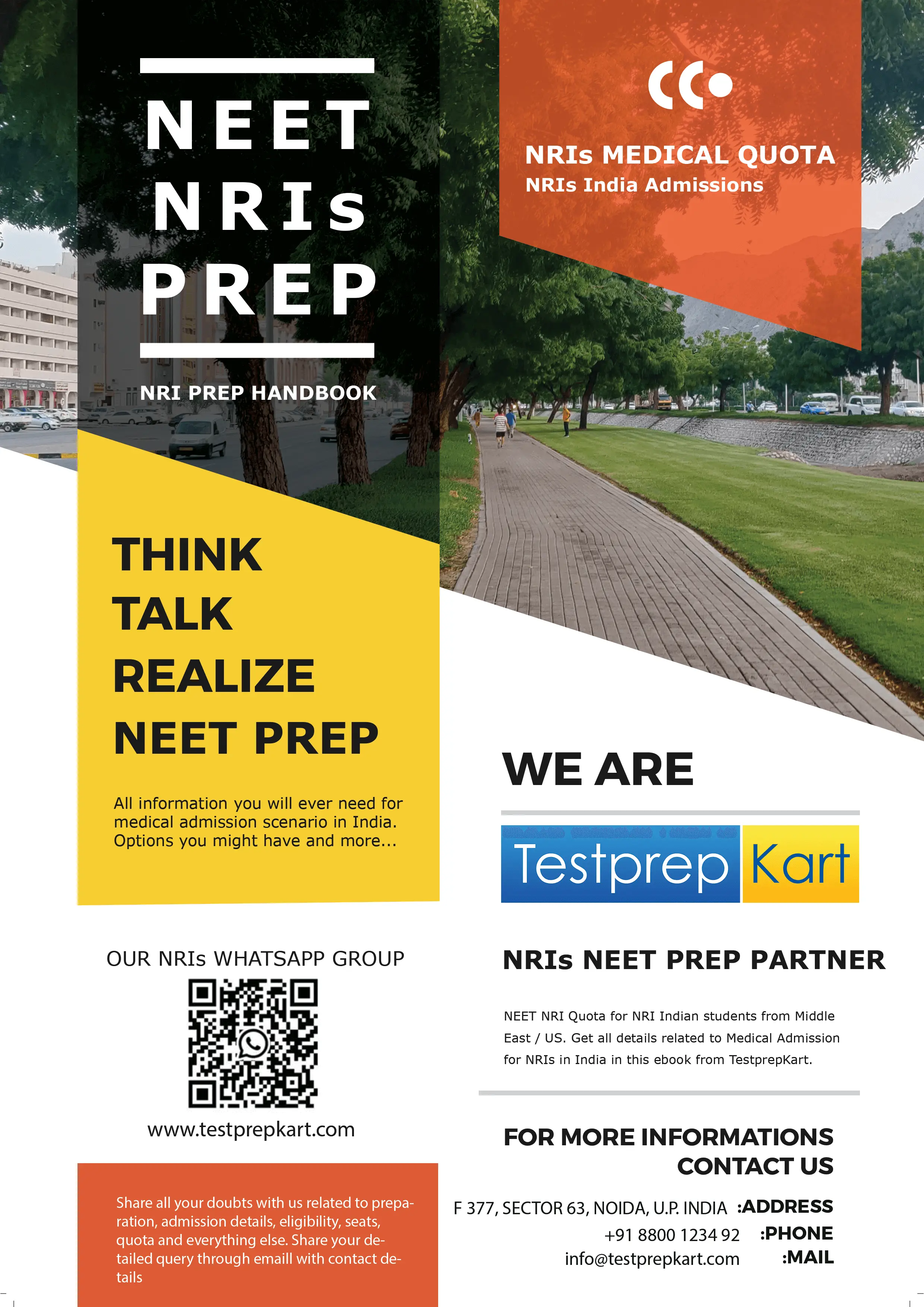
NEET NRI Preparation eBook is specially designed for the NRI students which will help students to clear some of the basic question related the NRI Quota, Preparation and others. Download the NRI NEET Prep eBook from the download button below.

1. Has the NEET 2026 syllabus been changed?
Yes. The NEET 2026 syllabus has been updated by the National Medical Commission
(NMC)
to align with the latest NCERT textbooks. Some new topics have been added, and a few outdated ones have been removed compared to NEET 2025.
2. Who releases the official NEET 2026 syllabus?
The official NEET syllabus is released by the National Testing Agency
(NTA)
based on the academic framework set by the National Medical Commission (NMC).
3. What subjects are included in the NEET 2026 syllabus?
The NEET syllabus covers Physics, Chemistry, and Biology from Classes 11 and 12 NCERT textbooks. Biology has the highest weightage, followed by Chemistry and Physics.
4. Is the NEET 2026 syllabus the same for Indian and NRI students?
Yes, the NEET 2026 syllabus is exactly the same for both Indian and NRI students. The exam pattern, subjects, and marking scheme remain identical, regardless of whether students appear from India or abroad.
5. What are the new topics added in the NEET 2026 syllabus?
Topics such as experimental skills (vernier calliper, calorimeter), logic gates in Electronics, fuel cells in Electrochemistry, and Human Genome Project in Biology have been added in the NEET 2026 syllabus.
6. What topics have been removed from the NEET 2026 syllabus?
Chapters like Chemistry in Everyday Life, Vernalization, Taxonomic Aids, Rolling Motion, and Poiseuille’s Law have been removed or simplified in NEET 2026.
7. What is the total mark distribution for NEET 2026?
The NEET exam carries a total of 720 marks, divided as follows:
8. Which books are best for NEET 2026 preparation?
For best results, study NCERT Class 11 and 12 books thoroughly and refer to:
9. Is NCERT enough to crack NEET 2026?
Yes, NCERT is the foundation for NEET 2026. Around 80–85% of NEET Biology questions come directly from NCERT. However, for Physics and Chemistry, solving additional MCQs and numerical problems from reference books is necessary.
10. How can NRI students prepare for NEET 2026 from abroad?
NRI students can enroll in online NEET coaching programs offered by platforms like TestprepKart, which provide live classes, recorded lectures, and mock tests aligned with the NMC syllabus, making NEET preparation possible from anywhere in the world.





Copyright © 2024 CounselKart Educational Services Pvt. Ltd.. All Rights Reserved


Post a Comment