


Hi, I’m TestprepKart.
Your Partner In Exam Preparation

If you are starting NEET Physics preparation, Concepts of Physics by Dr. H.C. Verma is a useful supporting resource for building conceptual clarity and improving numerical problem-solving. The book is divided into Part 1 and Part 2, covering topics from mechanics and waves to electricity, magnetism, optics and modern physics.
Each chapter combines clear explanations, solved examples, objective questions and numerical exercises. For NEET, however, students should use H.C. Verma selectively alongside the current NEET Physics syllabus, NCERT, previous-year questions and exam-pattern mock tests.
Yes. H.C. Verma is especially useful for students who need stronger Physics concepts and better numerical-solving skills. Part 1 mainly supports Class 11 topics, while Part 2 covers most Class 12 areas. It should not replace NCERT or NEET PYQs, and students do not need to solve every advanced problem in the books.
Use the two volume cards below to access the H.C. Verma preparation-book resources already available on TestPrepKart. Students should check the current NEET syllabus before deciding which chapters and exercises to complete.

Class 11-oriented topics including kinematics, mechanics, gravitation, waves and optics.
Access Part 1 Resource
Class 12-oriented topics including heat, electricity, magnetism, electromagnetic induction and modern physics.
Access Part 2 ResourceH.C. Verma’s Concepts of Physics Part 1 is widely used to build a strong foundation in Physics. Its explanations and practice problems are useful for Class 11 topics such as kinematics, laws of motion, work and energy, rotational mechanics, gravitation, fluids, waves and optics.
For NEET preparation, students should not assume that every chapter or exercise carries equal importance. Complete the syllabus-relevant theory and selected questions, then move to NEET PYQs and timed practice.
| Concepts of Physics Part 1 Chapters | |
|---|---|
| Chapter 1: Introduction to Physics | Chapter 12: Simple Harmonic Motion |
| Chapter 2: Physics and Mathematics | Chapter 13: Fluid Mechanics |
| Chapter 3: Rest and Motion: Kinematics | Chapter 14: Some Mechanical Properties of Matter |
| Chapter 4: The Forces | Chapter 15: Wave Motion and Waves on a String |
| Chapter 5: Newton’s Laws of Motion | Chapter 16: Sound Waves |
| Chapter 6: Friction | Chapter 17: Light Waves |
| Chapter 7: Circular Motion | Chapter 18: Geometrical Optics |
| Chapter 8: Work and Energy | Chapter 19: Optical Instruments |
| Chapter 9: Centre of Mass, Linear Momentum and Collision | Chapter 20: Dispersion and Spectra |
| Chapter 10: Rotational Mechanics | Chapter 21: Speed of Light |
| Chapter 11: Gravitation | Chapter 22: Photometry |
H.C. Verma’s Concepts of Physics Part 2 supports advanced Class 12 topics such as heat, thermodynamics, electrostatics, current electricity, magnetism, electromagnetic induction and modern physics. It is most effective when the chapter is studied after the corresponding NCERT topic.
Some chapters go beyond the direct requirements of NEET. Use the official syllabus as the final checklist and ask a teacher to identify the questions that are worth your preparation time.
| Concepts of Physics Part 2 Chapters | |
|---|---|
| Chapter 23: Heat and Temperature | Chapter 36: Permanent Magnets |
| Chapter 24: Kinetic Theory of Gases | Chapter 37: Magnetic Properties of Matter |
| Chapter 25: Calorimetry | Chapter 38: Electromagnetic Induction |
| Chapter 26: Laws of Thermodynamics | Chapter 39: Alternating Current |
| Chapter 27: Specific Heat Capacities of Gases | Chapter 40: Electromagnetic Waves |
| Chapter 28: Heat Transfer | Chapter 41: Electric Current through Gases |
| Chapter 29: Electric Field and Potential | Chapter 42: Photoelectric Effect and Wave-Particle Duality |
| Chapter 30: Gauss’s Law | Chapter 43: Bohr’s Model and Physics of the Atom |
| Chapter 31: Capacitors | Chapter 44: X-Rays |
| Chapter 32: Electric Current in Conductors | Chapter 45: Semiconductors and Semiconductor Devices |
| Chapter 33: Thermal and Chemical Effects of Current | Chapter 46: The Nucleus |
| Chapter 34: Magnetic Field | Chapter 47: The Special Theory of Relativity |
| Chapter 35: Magnetic Field Due to a Current | |

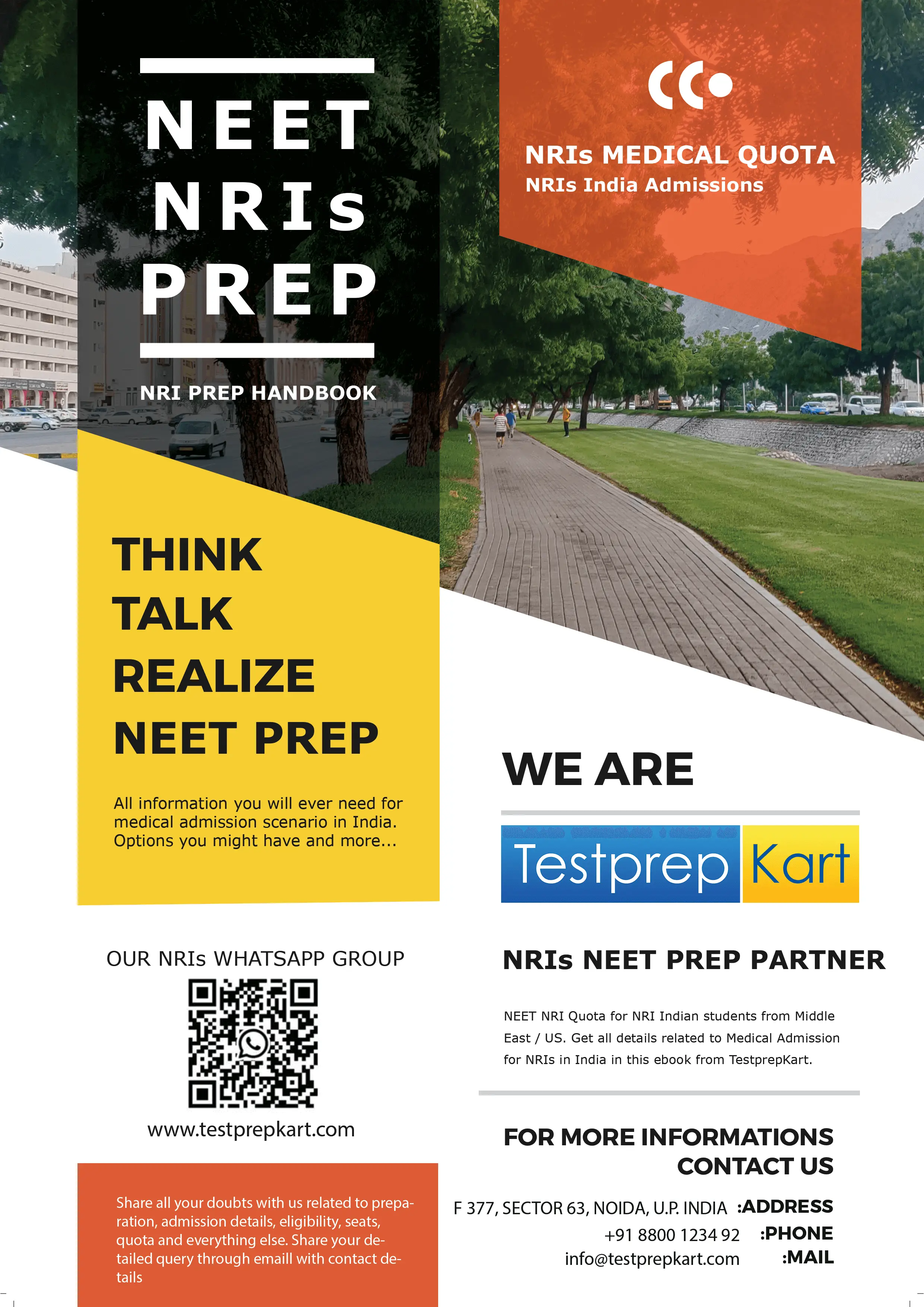
Planning to pursue MBBS in India through the NRI quota? This free NEET guide for USA-based NRI students and parents brings together eligibility, required documents, NRI quota fees, seat availability, medical-college options, preparation planning and the admission process.
Download NEET E-BookThe book is recommended because it explains the logic behind formulas instead of asking students to memorise steps. Its worked examples help students understand how a concept is applied, while the objective and numerical questions reveal whether the chapter has actually been understood.
H.C. Verma should still be treated as a concept-building book. The wording, difficulty and time pressure of the actual examination are best understood through NEET Physics questions, previous-year papers and full-length tests.
Get expert NEET guidance, NRI-focused preparation support, and structured study resources for better admission planning.
| Comparison Point | H.C. Verma | NCERT Physics |
|---|---|---|
| Main purpose | Concept building and numerical practice | Core theory and syllabus foundation |
| NEET role | Supplementary | Essential |
| Difficulty | Basic to advanced | Mostly foundational and syllabus-focused |
| Best sequence | Use after learning the chapter | Study first |
| Complete every question? | Not necessary for NEET | Cover all relevant syllabus content carefully |
These examples show why a good book works best inside a structured NEET plan. Strong school grades or access to many resources do not automatically produce an exam-ready score.
Karan had performed well in AP Biology and AP Chemistry, so his family expected the transition to NEET to be straightforward. His early mock scores, however, remained between 380 and 420. He was taking too long on individual questions, guessing without properly accounting for negative marking, and missing a few NCERT-specific areas, including parts of semiconductor physics.
His preparation was then reorganized around the gaps in his syllabus, regular timed practice, and a careful review of mistakes after each test. He eventually scored 556 out of 720 and secured an NRI quota seat at a private medical college in Maharashtra.
Rahul scored 312 in his first attempt after preparing through a mix of unrelated online resources. He spent more time on the chapters he enjoyed, kept postponing weaker areas, and had done very little practice under timed conditions with negative marking.
During his gap year, he worked through the full syllabus in sequence, took weekly tests, attempted monthly full-length mocks, and reviewed his performance in detail. In his second attempt, his score increased to 541 out of 720, which was 229 marks higher than his first-attempt score.
Student outcomes differ and depend on the starting level, consistency, curriculum background, test performance, and admission category.
Get expert NEET guidance, NRI-focused preparation support, and structured study resources for better admission planning.
Most students do not struggle because they lack Physics books. The real challenge is deciding which concepts need more work, which questions are worth the time, and when to move from concept practice to NEET-pattern testing. TestPrepKart teachers place H.C. Verma within a syllabus-based study plan, so the book supports preparation instead of becoming another resource students try to finish without direction.
| Student Challenge | How TestPrepKart Supports the Student |
|---|---|
| Unsure which H.C. Verma questions are worth solving | Teachers shortlist questions according to the chapter, the student’s current level, and their relevance to NEET |
| The theory seems clear, but numerical questions are still difficult | Live problem-solving, simpler alternative methods, and guided practice |
| Slow calculations and avoidable errors in Physics | Timed assignments, chapter tests, and a review of repeated mistakes |
| Gaps between US, IB, or other international curricula and NEET | Topic-by-topic mapping with NCERT and the NEET syllabus |
| Parents find it difficult to judge whether preparation is on track | Clear test reports, progress tracking, and scheduled updates for parents |
|

|
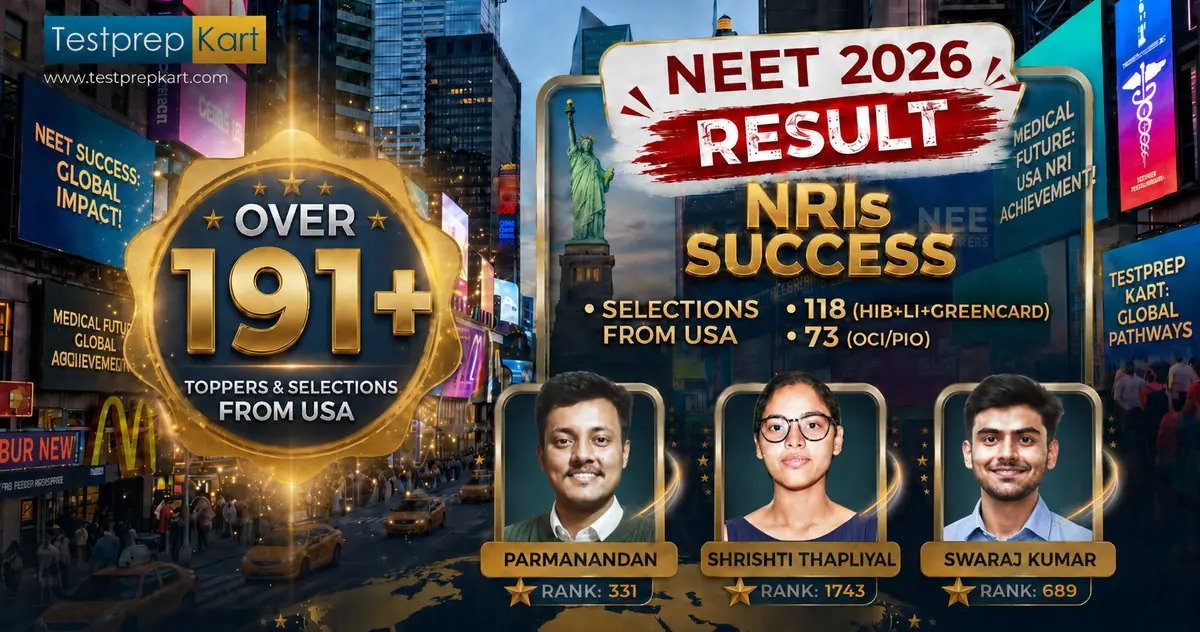
TestPrepKart’s NEET 2026 results page highlights the performance of students studying in the United States, including selections in government medical colleges and strong All India Ranks.
TestPrepKart’s NEET courses are designed to give independent study a clear structure rather than replace it. Core lessons are conducted live, with room for questions and interaction. Recordings of completed classes remain available for revision or a genuinely missed session, while regular tests and doubt sessions keep preparation aligned with the examination.
 |
 |
 |
 |
Explore NEET Courses Schedule Free Trial
| Course | Duration | Best Suited For | Details |
|---|---|---|---|
| NEET 1-Year Course | 1 year, approximately 400 course hours | Grade 12 students who need complete syllabus coverage, a regular testing schedule, and planned revision. | View Course |
| NEET 2-Year Course | 2 years | Grade 11 students who want to cover the Class 11 and Class 12 syllabus gradually while building a strong foundation. | View Course |
| NEET Foundation Course | 1 year | Younger students who want to strengthen Biology, Chemistry, and Physics before beginning full NEET preparation. | View Course |
| NEET Crash Course and Test Preparation | Short-term plan | Students who need focused revision, timed tests, negative-marking practice, and closer performance tracking. | View Options |
Students may use another Physics resource alongside H.C. Verma for objective-question practice or revision, but trying to complete several books is rarely useful. A more practical combination is one reliable concept book, one NEET-focused question source, and regular mock tests.
| Books Name | Author | Resource |
|---|---|---|
| NEET Objective Physics (Volumes 1 and 2) | D.C. Pandey | Download PDF |
| MTG Objective NCERT at Your Fingertips Physics | MTG Editorial Board | Download PDF |
| Problems In General Physics | I.E. Irodov | Download PDF |
| Fundamentals of Physics (1st edition) | David Halliday and Robert Resnick | Download PDF |
Use Chemistry reference books only after the relevant NCERT chapter and class notes are complete. The resource links below have been retained from the original article.
| Books Name | Author | Resource |
|---|---|---|
| Physical Chemistry by O.P. Tandon | O.P. Tandon | Download PDF |
| Physical Chemistry by N. Awasthi | N. Awasthi | Download PDF |
| Concise Inorganic Chemistry by J.D. Lee | J.D. Lee | Download PDF |
| Inorganic Chemistry by V.K. Jaiswal | V.K. Jaiswal | Download PDF |
| Organic Chemistry by M.S. Chauhan | M.S. Chauhan | Download PDF |
NCERT remains the primary Biology source for NEET. Additional books should mainly support revision, objective practice and repeated testing.
| Books | Author | Resource |
|---|---|---|
| NCERT Textbooks for Class 11 and 12 Biology | NCERT | Download PDF |
| Dinesh Objective Biology | K.N. Bhatia, K. Bhatia | Download PDF |
| Pradeep’s Textbook of Biology | P.S. Dhami, Dr. G. Chopra, and Dr. H.N. Srivastava | Download PDF |
| Trueman’s Elementary Biology – Vol 1 & 2 | K.N. Bhatia and M.P. Tyagi | Download PDF |
| Objective NCERT at your Fingertips – Biology | MTG Editorial Board | Download PDF |
Use the topic-wise notes below to revise important Physics, Chemistry and Biology areas. Start with the chapters currently being taught and add a short test after each revision block.






Copyright © 2024 CounselKart Educational Services Pvt. Ltd.. All Rights Reserved




Post a Comment