






Hi, I’m TestprepKart.
Your Partner In Exam Preparation
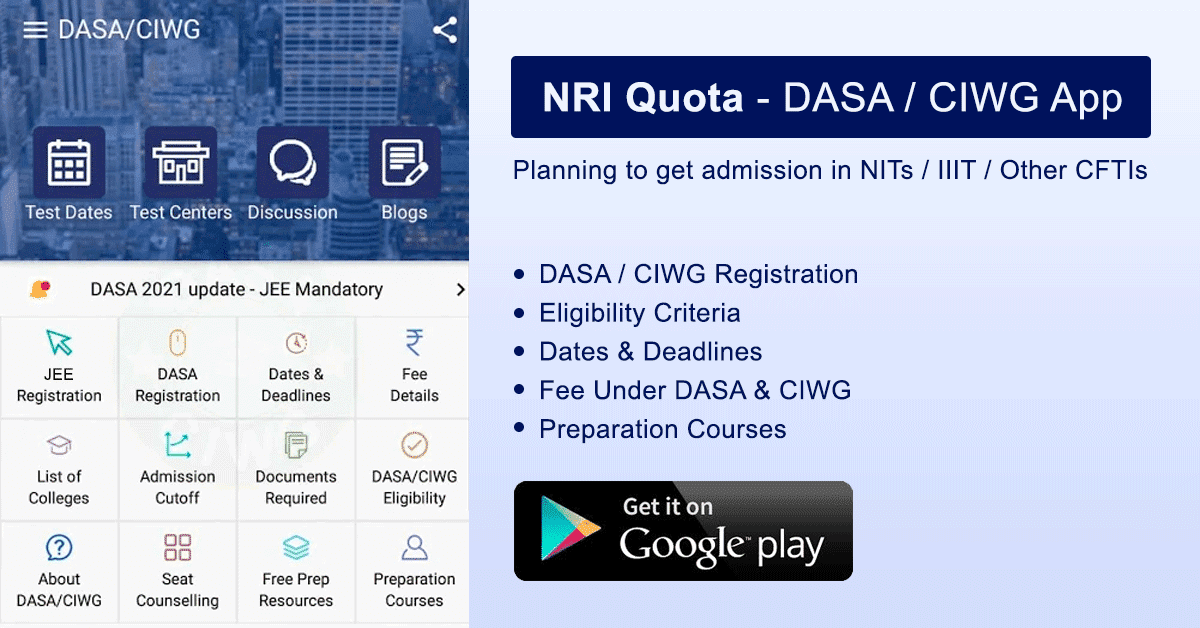
DASA CIWG Scheme is a reservation scheme for NRI, OCI and PIO students in Indian Engineering Colleges only. There are a list of Colleges which are known as CFTIs in India that accept the DASA / CIWG Quota for NRI Students, especially those living in the USA and the Middle East (UAE, Qatar, Oman, Kuwait, Bahrain, Saudi Arabia).
Under DASA / CIWG Scheme (Quota), students are allowed to write the JEE Main Test, and on the basis of their score they can get admission in these CFTIs in India.
Seats are reserved in CFTIs specifically for DASA / CIWG students.
Here are a couple of points you need to know to understand how DASA / CIWG Quota is going to be helpful for you in 2026 and onward (for NRI students in the USA & Middle East)
Download Full DASA CIWG EBookBelow are the points that will help you understand further:
1. Is DASA / CIWG available for 2025–26 admissions?
Yes. DASA and CIWG will continue for 2025–26, allowing NRI, OCI, and PIO students living in the USA and Middle East to apply for NITs, IIITs, CFIs, and SPAs using JEE Main scores. The scheme remains unchanged structurally.
2. Is JEE Main mandatory for DASA / CIWG 2025–26?
Yes. JEE Main remains 100% compulsory for DASA / CIWG admissions. SAT Subject Tests are permanently discontinued. Students studying in USA and Middle East schools must plan early JEE preparation since their curriculum differs from India’s NCERT-based structure.
3. What is the eligibility for DASA / CIWG 2025–26?
Eligibility remains unchanged: students must be NRI/OCI/PIO, complete Class 11–12 outside India, study Maths, Physics, and one science subject, and secure at least 60% in Class 12. No new modifications have been announced for 2025–26 admissions yet.
4. How many seats are available under DASA / CIWG?
Typically around 3,000–4,000 DASA seats exist across NITs, IIITs, and CFIs, while CIWG seats remain limited. The exact seat matrix for 2025–26 is not released yet, but major participating institutes are expected to follow previous year patterns.
5. Do USA and Middle East NRI students need coaching for JEE Main?
Yes. Due to curriculum differences between CBSE/NCERT and international/American/Gulf boards, most USA and Middle East NRI students require structured JEE coaching, regular mock tests, and problem-solving practice to match the competition level of India-based students.
6. What JEE Main percentile is safe for DASA 2025-26?
A safe percentile range is generally 92–97 for most NIT branches, while Computer Science and Electronics require higher scores. The exact cutoffs for 2025–26 are not published yet, but trends indicate rising competition among NRI applicants.
7. What is the CIWG fee structure for 2025-26?
CIWG students continue to pay the Indian fee structure, approximately ₹1.25 lakh per year. The official 2025–26 fee notification is still pending, but no major change is expected based on previous DASA / CIWG circulars.
8. Can OCI students apply under DASA / CIWG 2025-26?
Yes. OCI students are fully eligible for both DASA and CIWG as long as they complete Class 11–12 outside India and meet subject and grade requirements. Many OCI applicants from USA and Middle East benefit from these reserved seats.
9. What documents do NRI parents need for DASA / CIWG?
NRI parents must provide passport, visa/residency proof, employment certificate, NRI status proof, proof of stay abroad, and the student’s academic documents. Families in the USA and Gulf countries should ensure all documents are updated before registration.
10. How to submit JEE Main rank to DASA for 2025-26?
After JEE Main results are announced, students must upload their rank and required details on the official DASA portal. The complete 2025-26 instructions are not released yet but are expected to follow the 2024-25 submission process.
Non-resident Indian students are also referred to as Indian Diaspora, the people of Indian birth or descent who live outside of the Republic of India, this includes a very large number of NRI families residing in the USA and the Middle East (UAE, Qatar, Oman, Kuwait, Bahrain, Saudi Arabia).
As per the Ministry of External Affairs, there are approximately 32 million Indian diasporas residing outside India (latest available figure).
This includes the large NRI population in the USA and Gulf region.
India has the highest diaspora population in the world with more than 18 million according to the United Nations Department of Economic and Social Affairs.
Income Tax Act considers an individual as a Non-resident Indian if he/she fulfills the following requirements:
‘Non-Resident Indian’ is an individual who is a citizen of India or a person of Indian origin and who is not a resident of India.
To determine NRI status under Section 6 of the Income Tax Act:
An individual is non-resident in India if:
However, condition No. 2 does not apply where an individual being a citizen of India or a person of Indian origin, who being outside India (such as USA or Middle East residents), comes on a visit to India.
A person shall be deemed to be of Indian origin if he, or either of his parents or any of his grandparents, was born in undivided India.
The Person of Indian Origin (PIO) is also called Overseas Indians. They are individuals who are Indians at birth or descent and live outside of India in countries like the USA and those in the Middle East.
PIO Definition:
A foreign citizen (not a national of Pakistan, Afghanistan, Bangladesh, China, Iran, Bhutan, Sri Lanka or Nepal) who:
The PIO Card program came into effect on September 15, 2002.
On January 15, 2015, the PIO Card scheme was withdrawn and merged with the OCI Card scheme.
Currently, all PIO cards are treated as OCI cards.
PIO cardholders received a stamp stating “lifelong validity” and “registration not required”, making PIO equal to OCI.
Overseas Citizenship of India (OCI) is an immigration status allowing foreign citizens of Indian origin to live and work in India indefinitely. A large number of OCI cardholders reside in the USA and the Middle East.
The OCI scheme was introduced via the Citizenship (Amendment) Act 2005 and launched officially in 2006.
To apply for and use an OCI document, a holder must be a citizen of a foreign country (excluding Pakistan and Bangladesh).
Before February 2015, OCI cardholders were required to carry both the OCI card and the passport with the lifetime visa sticker.
This requirement was removed in 2015.
Now, an OCI card + current valid foreign passport is enough to travel to and from India.

TestprepKart offers guidance and a range of resources to help students looking for schools and financial assistance.
Quick Connect: +91 800085231013 (Toll Free) Email: info@testprepkart.com

Scholarships for admission of NRI, PIO , OCI Students in Indian Engineering Colleges
About JEE Advanced- Eligibility, Registration & Important Dates
JEE Main & Advance Preparation Resources:








Copyright © 2024 CounselKart Educational Services Pvt. Ltd.. All Rights Reserved


Post a Comment