






Hi, IÔÇÖm TestprepKart.
Your Partner In Exam Preparation
Gulf Quota, popularly known as the CIWG Scheme (Children of Indian Workers in Gulf Countries), continues to be one of the most preferred admission routes for NRI students living in the USA, UAE, Qatar, Kuwait, Oman, Bahrain, and Saudi Arabia who seek engineering admissions in India.
To understand how the Gulf Quota (CIWG) works in Indian engineering colleges, including NITs, IIITs, SPAs, and CFTIs, students must clearly understand the DASA Scheme and the CIWG sub-category, along with the specific seat reservation structure offered under CIWG.
Get JEE Prep Help Download NRI JEE E-Book
According to the current DASA policy, JEE Main Rank is mandatory for all NRI/OCI/PIO/Foreign National students seeking admission under both DASA and CIWG schemes.
This applies to students living in the USA and Middle East, who must appear for JEE Main 2026 to be eligible.
SAT or SAT Subject Test scores are no longer accepted for DASA/CIWG from 2021 onwards.
This requirement remains unchanged for the 2026-27 admission cycle.
Under the DASA Scheme, 15% supernumerary seats in centrally funded engineering colleges (NITs, IIITs, SPAs, and CFTIs) are reserved for NRI / OCI / PIO / Foreign National students from across the world, including those living in the USA and Middle East.
These seats are exclusively allotted based on JEE Main Rank for 2026–27 admissions.
The CIWG (Children of Indian Workers in Gulf) Scheme reserves 1/3rd of all DASA seats, which corresponds to 5% of the total engineering seats in participating institutions.
This means approximately 800 CIWG-reserved seats are available only for NRI students whose parents work in Gulf Countries:
UAE, Qatar, Kuwait, Oman, Bahrain, and Saudi Arabia.
NRI students living in the USA may also apply under CIWG only if a parent is currently employed in one of the eligible Gulf nations with valid documentation.
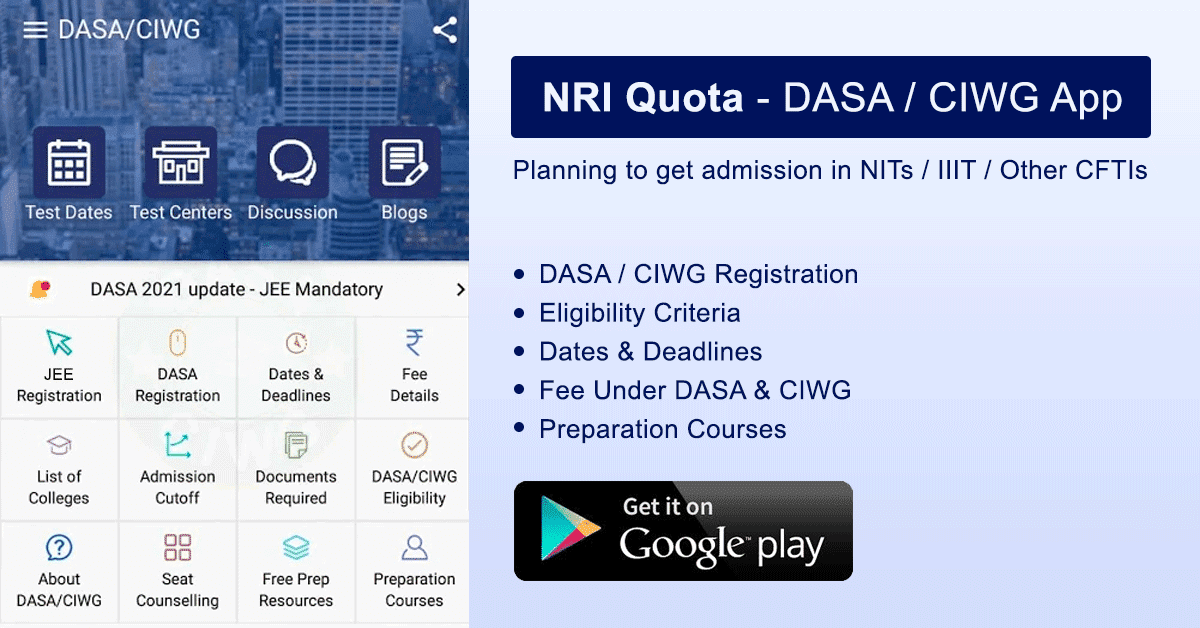
Many NRI parents, especially those living in the USA, UAE, Qatar, Oman, Kuwait, Bahrain, and Saudi Arabia are still unaware of the CIWG (Children of Indian Workers in Gulf) scheme governed by the Ministry of Education, Government of India.
To help you understand how NRI seats are reserved under the Gulf Quota, here is an updated seat overview.
Note: CIWG provides 1/3rd of total DASA seats to students whose parents work in eligible Gulf countries. Exact 2026 seat counts will be confirmed once the new DASA brochure is released.
|
State |
Name of the College |
No. of Seats |
No. of Seats Reserved for NRIs (under CIWG Quota) |
|
Andhra Pradesh |
School of Planning & Architecture, Vijayawada |
105 |
6 |
|
Arunachal Pradesh |
National Institute of Technology, Arunachal Pradesh |
210 |
12 |
|
Assam |
National Institute of Technology, Silchar |
632 |
4 |
|
Tezpur University, Assam |
Not Available |
4 | |
|
Bihar |
National Institute of Technology, Patna |
577 |
25 |
|
Chhattisgarh |
National Institute of Technology, Raipur, Chattisgarh |
955 |
8 |
|
Delhi |
National Institute of Technology, Delhi |
180 |
9 |
|
School of Planning & Architecture, Delhi |
Not Available |
5 | |
|
Delhi Technological University, Delhi |
1626 |
32 | |
|
Indraprastha Institute of Information Technology, Delhi |
Not Available |
7 | |
|
Netaji Subhash Institute of Technology, Delhi |
Not Available |
9 | |
|
Goa |
National Institute of Technology, Goa |
90 |
5 |
|
Gujarat |
Sardar Vallabhbhai National Institute of Technology, Surat |
873 |
35 |
|
Indian Institute of Information Technology, Vadodara |
140 |
5 | |
|
Pandit Deendayal Petroleum University, Gandhinagar |
Not Available |
39 | |
|
Haryana |
National Institute of Technology, Kurukshetra |
832 |
12 |
|
The University Institute of Engineering of Technology (UIET), Chandigarh |
Not Available |
21 | |
|
|
The University Institute of Chemical Engineering & Technology (UICET), Chandigarh |
Not Available |
7 |
|
Himachal Pradesh |
National Institute of Technology, Hamirpur |
718 |
11 |
|
Jammu & Kashmir |
National Institute of Technology, Srinagar |
632 |
18 |
|
Shri Mata Vaishno Devi , Katra, Jammu & Kashmir |
199 |
9 | |
|
Jharkhand |
National Institute of Technology, Jamshedpur |
601 |
8 |
|
National Institute of Foundry & Forge Technology, Ranchi |
199 |
10 | |

1. What is the CIWG Gulf Quota for NRI students?
The CIWG Gulf Quota reserves seats for NRI students whose parents work in eligible Gulf countries. It operates under the DASA Scheme and offers significantly lower tuition fees, making it a preferred admission pathway for students living in the USA and Middle East.
2. Who qualifies for the CIWG Scheme in 2026?
Students must be NRIs with at least one parent employed in a Gulf nation such as UAE, Qatar, Kuwait, Oman, Bahrain, or Saudi Arabia. Those living in the USA may also apply if their parent’s Gulf employment documentation is valid according to DASA rules.
3. Is JEE Main Rank required for CIWG admissions?
Yes. JEE Main Rank is compulsory for CIWG and DASA admissions. SAT or SAT Subject Tests are no longer accepted. All NRI students, including those in the USA and Middle East, must take JEE Main 2026 to qualify for engineering seats.
4. How many CIWG seats are available annually?
Approximately 800 engineering seats are reserved for CIWG candidates each year, which is one-third of total DASA seats. The exact number for 2026–27 will be confirmed in the official DASA brochure once it is released.
5. Which Gulf countries classify a student as CIWG-eligible?
Students qualify under CIWG if their parent is working in Kuwait, Qatar, Oman, Bahrain, the United Arab Emirates, or Saudi Arabia. USA-based NRI students are also eligible when their parent holds valid employment in any of these Gulf nations.
6. What documents are needed to prove CIWG eligibility?
Parents must provide a passport copy, Gulf work visa, work or residence permit (if applicable), and an employer certificate in Appendix-III format. These documents are essential for confirming current employment in a CIWG-eligible Gulf country.
7. What tuition fee do CIWG students pay at NITs?
CIWG applicants pay the same tuition as Indian resident students—around ₹62,500 per semester. This reduced fee is a major advantage for NRI students in the USA and Middle East pursuing engineering admissions through the CIWG quota.
8. How is CIWG different from the standard DASA category?
DASA applies to NRI, OCI, PIO, and Foreign National students worldwide, while CIWG is only for children of Indian workers in Gulf countries. CIWG candidates benefit from Indian-resident tuition fees, whereas DASA applicants pay higher USD-based fees.
9. Can students apply under both DASA and CIWG categories?
Yes. Students may select both options in the DASA application. If they are not allotted a CIWG seat, they are automatically considered under DASA. Fee differences are refunded if a CIWG seat is eventually secured.
10. Can students studying in the USA apply under CIWG?
Yes. Students studying in the USA can apply under CIWG as long as one parent is employed in a Gulf country. In such cases, the place of study does not restrict eligibility—only valid Gulf employment proof is required.
11. What is the admission process under the CIWG quota?
The process includes registering on the DASA portal, uploading academic and Gulf employment documents, paying the required fees, document verification, selecting colleges, participating in counseling rounds, and submitting the JEE Main Rank for seat allocation.
12. Which entrance exam is required for CIWG admissions?
JEE Main is the only accepted entrance exam for CIWG admissions. Students residing in the USA and Middle East must follow NCERT-aligned preparation and appear for JEE Main 2026 to be eligible for engineering seats under this scheme.
13. What happens to CIWG seats if they are not filled?
If CIWG seats remain vacant after counseling rounds, they are transferred to the general DASA category. These seats are then allotted to eligible DASA applicants strictly based on JEE Main Rank and seat availability.
14. Are hostel and living expenses included in CIWG tuition fees?
No. CIWG concessions apply only to tuition fees. Hostel, mess, and living expenses must be paid separately and vary by institution. These costs typically range between $400 and $800 annually, depending on the NIT or IIIT.
15. Who manages the CIWG and DASA admission process?
The Ministry of Education designates one NIT each year to coordinate admissions. This institute oversees registration, counseling, document verification, and seat allotment. Final details for the 2026–27 cycle will be provided in the official DASA brochure.









Copyright © 2024 CounselKart Educational Services Pvt. Ltd.. All Rights Reserved

Post a Comment