





Hi, I’m TestprepKart.
Your Partner In Exam Preparation
Mechanics, the branch of physics that deals with the motion of objects and the forces acting upon them, is a cornerstone of our understanding of the physical world. From the graceful arcs of a gymnast's routine to the intricate movements of celestial bodies, mechanics plays a pivotal role in explaining the fundamental principles governing motion.
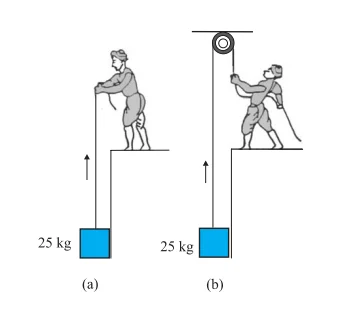
Mechanics is a branch of physics that deals with the study of motion, forces, and the behaviour of physical systems. It provides a framework for understanding the way objects move and interact under the influence of forces. Mechanics is a fundamental and essential part of classical physics, laying the groundwork for understanding the physical principles that govern the universe.
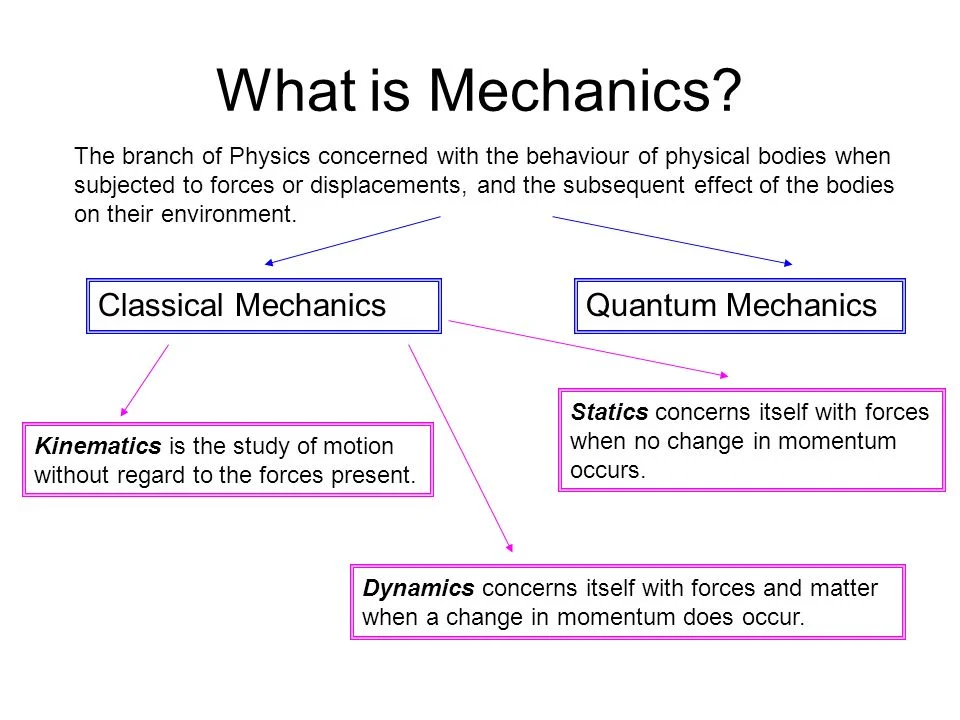
There are two main branches of mechanics:
Classical Mechanics:
Classical mechanics, also known as Newtonian mechanics, is the branch that deals with the motion of objects that are much larger than atoms and move at speeds much slower than the speed of light. It is based on Sir Isaac Newton's three laws of motion:
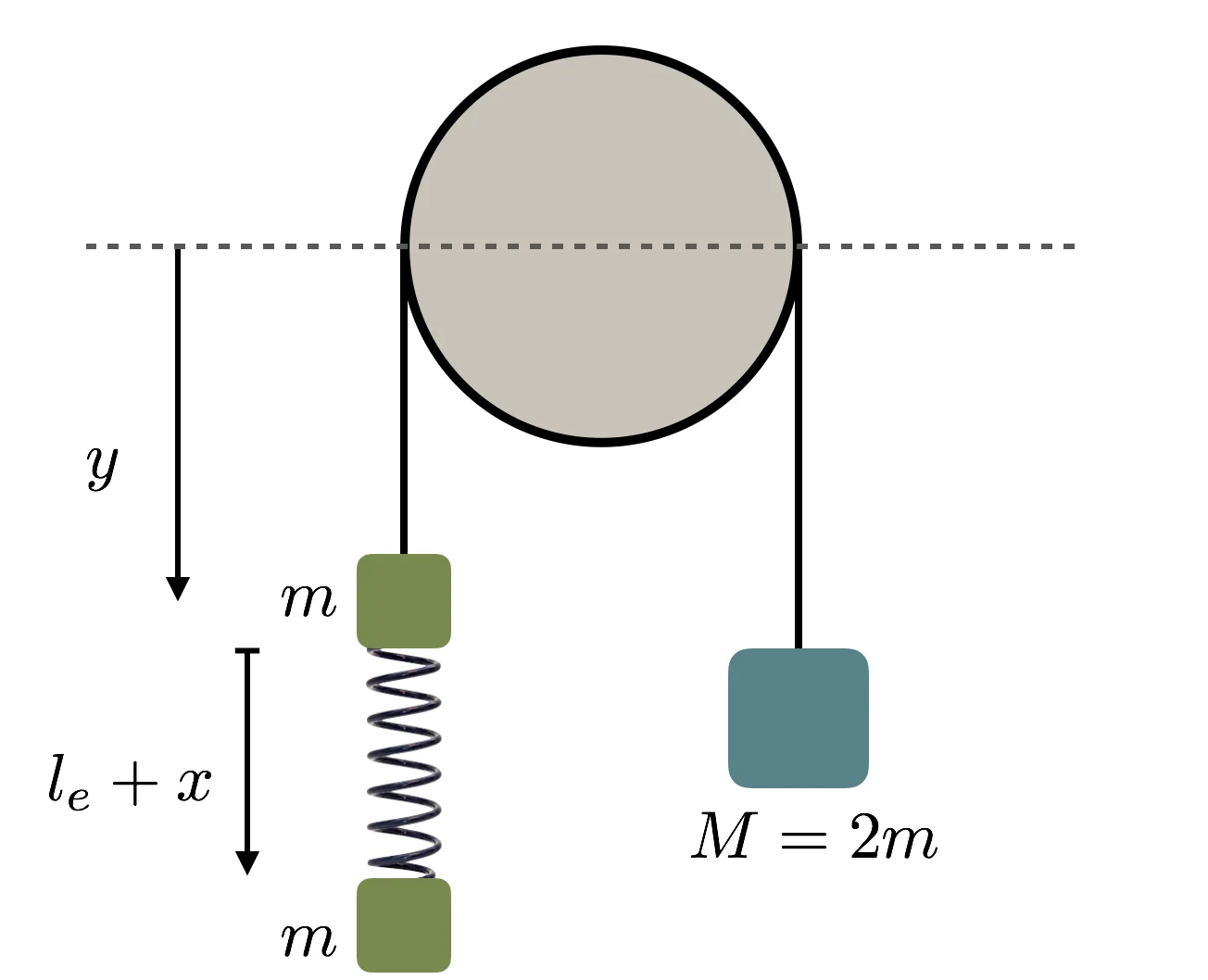
First Law (Law of Inertia): An object at rest stays at rest, and an object in motion stays in motion with the same speed and in the same direction unless acted upon by an unbalanced external force.
Second Law (Force and Acceleration): The acceleration of an object is directly proportional to the net force acting on it and inversely proportional to its mass.
Third Law (Action and Reaction): For every action, there is an equal and opposite reaction.
Quantum Mechanics:

Quantum mechanics is a branch of mechanics that deals with the behaviour of matter and energy on extremely small scales, such as the scale of atoms and subatomic particles. It introduces concepts like wave-particle duality, superposition, and uncertainty principles, challenging classical notions of determinism and causality.
Within classical mechanics, there are further subdivisions:
Kinematics: Focuses on the description of motion without considering the forces that cause the motion.
Dynamics: Deals with the forces and torques that cause motion.
Statics: Concerned with objects at rest or in equilibrium, where the net force and net torque are zero.
Kinetics: Explores the relationship between the motion of objects and the forces acting on them.
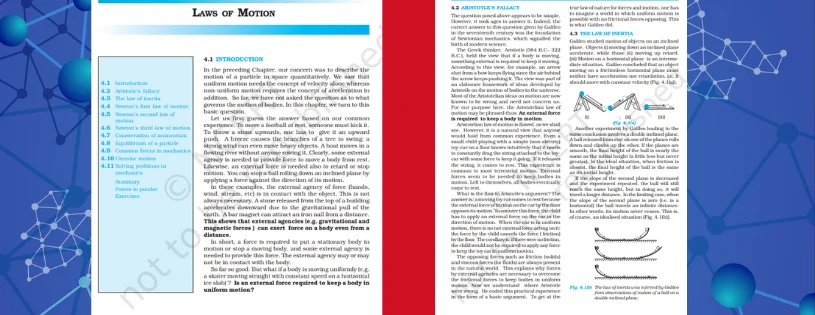
The laws of mechanics are fundamental principles that govern the motion and behaviour of physical systems. There are two main sets of laws in mechanics: Newton's Laws of Motion for classical mechanics and the principles of quantum mechanics for the microscopic scale. Let's explore both:
Newton's Laws of Motion (Classical Mechanics):
Newton's First Law (Law of Inertia):
Statement: An object at rest stays at rest, and an object in motion stays in motion with the same speed and in the same direction unless acted upon by an unbalanced external force.
Implication: It describes the natural state of motion of an object and introduces the concept of inertia, which is the tendency of an object to resist changes in its state of motion.
Newton's Second Law (Force and Acceleration):
Statement: The acceleration of an object is directly proportional to the net force acting on it and inversely proportional to its mass.
Mathematical Form: F=ma
Implication: It provides a quantitative relationship between the force applied to an object, its mass, and the resulting acceleration. This law is fundamental to understanding the dynamics of objects.
Newton's Third Law (Action and Reaction):
Statement: For every action, there is an equal and opposite reaction.
Implication: It emphasises that forces always occur in pairs. When one object exerts a force on another, the second object simultaneously exerts a force of equal magnitude in the opposite direction. This law is crucial for understanding interactions between objects.
| 1. CBSE Class 11th Topic Wise Summary | View Page / Download |
| 2. CBSE Class 11th NCERT Books | View Page / Download |
| 3. CBSE Class 11th NCERT Solutions | View Page / Download |
| 4. CBSE Class 11th Exemplar | View Page / Download |
| 5. CBSE Class 11th Previous Year Papers | View Page / Download |
| 6. CBSE Class 11th Sample Papers | View Page / Download |
| 7. CBSE Class 11th Question Bank | View Page / Download |
| 8. CBSE Class 11th Topic Wise Revision Notes | View Page / Download |
| 9. CBSE Class 11th Last Minutes Preparation Resources | View Page / Download |
| 10. CBSE Class 11th Best Reference Books | View Page / Download |
| 11. CBSE Class 11th Formula Booklet | View Page / Download |
Being in CBSE class 11th and considering the board examinations you must be needing resources to excel in your examinations. At TestprepKart we take great pride in providing CBSE class 11th all study resources in downloadable form for you to keep you going.
Below is the list of all CBSE class 11th Downloads available on TestprepKart for both Indian and NRI students preparing for CBSE class 11th in UAE, Oman, Qatar, Kuwait & Bahrain.
Answer: Mechanics is a branch of physics that deals with the behavior of physical bodies when subjected to forces or displacements and the subsequent effects on their motion.
Answer: Mechanics forms the foundation of physics, providing essential principles to understand and analyze the motion and interactions of objects in the physical world.
Answer: Mechanics can be applied to a wide range of problems, including kinematics (motion), dynamics (forces and motion), and statics (equilibrium of objects at rest).
Answer: Start by clearly defining the problem, identifying the known and unknown quantities, and selecting appropriate equations or principles from mechanics to apply to the situation.
Answer: The basic principles include Newton's Laws of Motion, the equations of motion, conservation of energy, and conservation of momentum.
| Class 11th CBSE Physics Chapters |
| Chapter1: UNITS AND MEASUREMENTS |
| Chapter2: MOTION IN A STRAIGHT LINE |
| Chapter3: MOTION IN A PLANE |
| Chapter4: LAWS OF MOTION |
| > Introduction |
| > Aristotle’s fallacy |
| > The law of inertia |
| > Newton’s first law of motion |
| > Newton’s second law of motion |
| > Newton’s third law of motion |
| > Conservation of momentum |
| > Equilibrium of a particle |
| > Common forces in mechanics |
| > Circular motion |
| Chapter5: WORK, ENERGY AND POWER |
| Chapter6: SYSTEM OF PARTICLES AND ROTATIONAL MOTION |
| Chapter7: GRAVITATION |
| Chapter8: MECHANICAL PROPERTIES OF SOLIDS |
| Chapter9: MECHANICAL PROPERTIES OF FLUIDS |
| Chapter10: THERMAL PROPERTIES OF MATTER |
| Chapter12: KINETIC THEORY |
| Chapter13: OSCILLATIONS |
| Chapter14: WAVES |
| Class 11th CBSE Chemistry Chapters |
| Chapter1: SOME BASIC CONCEPTS OF CHEMISTRY |
| Chapter2: STRUCTURE OF ATOMS |
| Chapter3: CLASSIFICATION OF ELEMENTS AND PERIODICITY IN PROPERTIES |
| Chapter4: CHEMICAL BONDING AND MOLECULAR STRUCTURE |
| Chapter5: THERMODYNAMICS |
| Chapter6: EQUILIBRIUM |
| Chapter7: REDOX REACTIONS |
| Chapter8: ORGANIC CHEMISTRY – SOME BASIC PRINCIPLE AND TECHNIQUES |
| Chapter9: Hydrocarbons HYDROCARBONS |
| Class 11th CBSE Mathematics chapter |
| Chapter1: SETS |
| Chapter2: RELATIONS AND FUNCTIONS |
| Chapter3: TRIGONOMETRIC FUNCTIONS |
| Chapter4: COMPLEX NUMBER AND QUADRATIC EQUATIONS |
| Chapter5: LINEAR INEQUALITIES |
| Chapter6: PERMUTATIONS AND COMBINATIONS |
| Chapter7: BINOMIAL THEOREM |
| Chapter8: SEQUENCES AND SERIES |
| Chapter9: STRAIGHT LINES |
| Chapter10: CONIC SECTIONS |
| Chapter11: INTRODUCTION TO THREE-DIMENSIONAL GEOMETRY |
| Chapter12: LIMITS AND DERIVATIVES |
| Chapter13: STATISTICS |
| Chapter14: PROBABILITY |
| Class 8 Link soon |
| Class 9 Link soon |
| Class 10 Link soon |
| Class 12 Link soon |








Copyright © 2024 CounselKart Educational Services Pvt. Ltd.. All Rights Reserved


Post a Comment