






Hi, I’m TestprepKart.
Your Partner In Exam Preparation
The concept of equilibrium plays a crucial role in understanding the state of objects at rest or in uniform motion. Equilibrium refers to a condition where a particle, an isolated object, or a system of objects, experiences no net force and, consequently, undergoes no acceleration. This state of balance is fundamental to the analysis of static situations, providing insights into the forces and torques acting on objects.
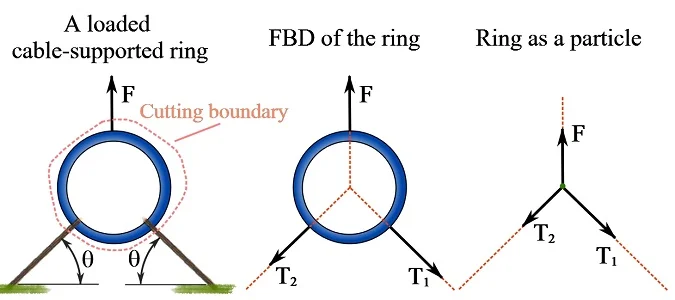
The equilibrium of a particle in physics refers to a state in which the particle is at rest or moves with a constant velocity. In this state, the net force acting on the particle is zero, and the net torque (rotational force) is also zero. The concept is based on Newton's First Law of Motion, which states that an object at rest will remain at rest, and an object in motion will remain in motion at a constant velocity unless acted upon by an external force.
Translational Equilibrium:
The vector sum of all external forces acting on the particle in the horizontal direction must be zero.
The vector sum of all external forces acting on the particle in the vertical direction must be zero.
Mathematically, this can be expressed as:
∑Fx=0
∑Fy=0
Rotational Equilibrium:
The vector sum of all torques acting on the particle about any axis must be zero.
Example of equilibrium of a particle:
Scenario: A Box on a Tabletop Forces Acting on the Box:
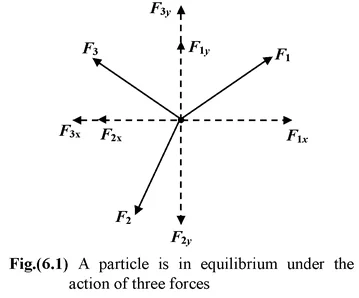
Gravity is pulling the box downward, creating a force W (weight).
The tabletop exerts an upward force N (normal force) on the box, preventing it from falling through the table.
Equilibrium Conditions:
Force Equilibrium in the Vertical Direction:
∑Fy=N−W=0
The normal force N equals the weight W, ensuring no net force in the vertical direction.
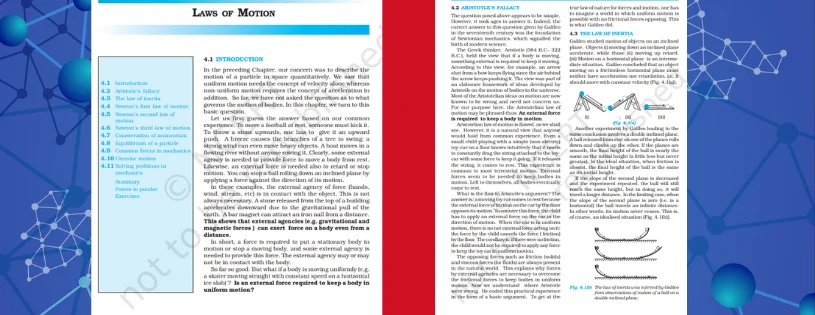
Force Equilibrium in the Horizontal Direction:
∑Fx=0
Since there is no applied horizontal force in this scenario, the sum of horizontal forces is zero.
Torque Equilibrium:
Since the box is not rotating, the sum of torques about any point is zero. Torques depend on the forces applied and their distances from a reference point.
Types of Equilibrium of a particle:
There are two main types of equilibrium for a particle: static equilibrium and dynamic equilibrium.
Static Equilibrium:
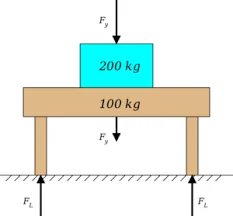
Definition: A particle is in static equilibrium when it is at rest or remains at a constant velocity. In other words, the net force acting on the particle is zero, and the net torque (rotational force) is also zero.
Conditions for Static Equilibrium:
The vector sum of all external forces acting on the particle in both horizontal and vertical directions must be zero.
The vector sum of all torques acting on the particle about any axis must be zero.
Mathematically:
∑Fx=0, ∑Fy=0, ∑t=0
Dynamic Equilibrium:
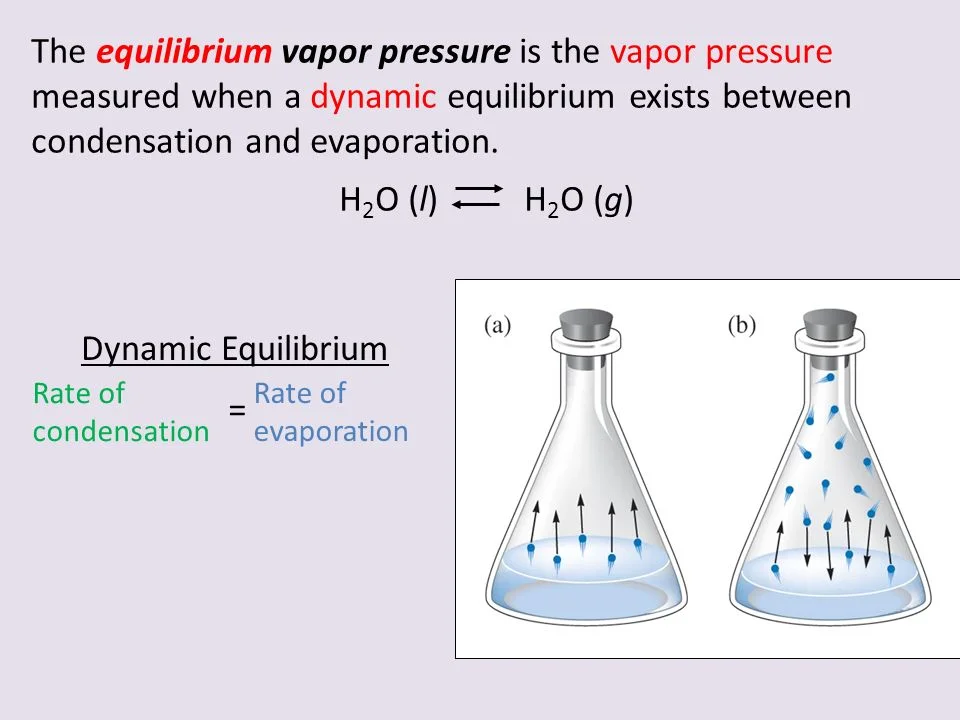
Definition: A particle is in dynamic equilibrium when it moves with a constant velocity. While the particle is in motion, the net force acting on it is still zero, and the net torque is zero.
Conditions for Dynamic Equilibrium:
The vector sum of all external forces acting on the particle in both horizontal and vertical directions must be zero.
The vector sum of all torques acting on the particle about any axis must be zero.
The particle moves at a constant velocity.
| 1. CBSE Class 11th Topic Wise Summary | View Page / Download |
| 2. CBSE Class 11th NCERT Books | View Page / Download |
| 3. CBSE Class 11th NCERT Solutions | View Page / Download |
| 4. CBSE Class 11th Exemplar | View Page / Download |
| 5. CBSE Class 11th Previous Year Papers | View Page / Download |
| 6. CBSE Class 11th Sample Papers | View Page / Download |
| 7. CBSE Class 11th Question Bank | View Page / Download |
| 8. CBSE Class 11th Topic Wise Revision Notes | View Page / Download |
| 9. CBSE Class 11th Last Minutes Preparation Resources | View Page / Download |
| 10. CBSE Class 11th Best Reference Books | View Page / Download |
| 11. CBSE Class 11th Formula Booklet | View Page / Download |
Being in CBSE class 11th and considering the board examinations you must be needing resources to excel in your examinations. At TestprepKart we take great pride in providing CBSE class 11th all study resources in downloadable form for you to keep you going.
Below is the list of all CBSE class 11th Downloads available on TestprepKart for both Indian and NRI students preparing for CBSE class 11th in UAE, Oman, Qatar, Kuwait & Bahrain.
Q1. What is meant by Equilibrium of a Particle?
Answer: Equilibrium of a particle refers to a state in which the particle is at rest or moving with constant velocity. In this state, the net force acting on the particle is zero, and the sum of all external forces and torques is balanced.
Q2. How is Equilibrium Different from Stability?
Answer: Equilibrium implies a balance of forces, while stability involves the ability of the system to return to its equilibrium position after a disturbance. A system in stable equilibrium tends to resist external forces and return to its original state.
Q3. What are the Conditions for Equilibrium of a Particle?
Answer: For equilibrium, two conditions must be met: the vector sum of all forces acting on the particle must be zero (ΣF = 0), and the sum of all torques (moments) acting on the particle about any point must be zero (Στ = 0).
Q4. Can a Particle be in Equilibrium if it is Moving?
Answer: Yes, a particle can be in equilibrium even if it is moving with a constant velocity. In such cases, the net force acting on the particle is zero, and the motion is uniform.
Q5. How Does the Free-Body Diagram Aid in Analyzing Equilibrium?
Answer: A free-body diagram is a visual representation of all forces acting on a particle. It aids in analyzing equilibrium by providing a clear picture of the forces involved, helping to determine whether the particle is in equilibrium.
| Class 11th CBSE Physics Chapters |
| Chapter1: UNITS AND MEASUREMENTS |
| Chapter2: MOTION IN A STRAIGHT LINE |
| Chapter3: MOTION IN A PLANE |
| Chapter4: LAWS OF MOTION |
| > Introduction |
| > Aristotle’s fallacy |
| > The law of inertia |
| > Newton’s first law of motion |
| > Newton’s second law of motion |
| > Newton’s third law of motion |
| > Conservation of momentum |
| > Common forces in mechanics |
| > Circular motion |
| > Solving problems in mechanics |
| Chapter5: WORK, ENERGY AND POWER |
| Chapter6: SYSTEM OF PARTICLES AND ROTATIONAL MOTION |
| Chapter7: GRAVITATION |
| Chapter8: MECHANICAL PROPERTIES OF SOLIDS |
| Chapter9: MECHANICAL PROPERTIES OF FLUIDS |
| Chapter10: THERMAL PROPERTIES OF MATTER |
| Chapter12: KINETIC THEORY |
| Chapter13: OSCILLATIONS |
| Chapter14: WAVES |
| Class 11th CBSE Chemistry Chapters |
| Chapter1: SOME BASIC CONCEPTS OF CHEMISTRY |
| Chapter2: STRUCTURE OF ATOMS |
| Chapter3: CLASSIFICATION OF ELEMENTS AND PERIODICITY IN PROPERTIES |
| Chapter4: CHEMICAL BONDING AND MOLECULAR STRUCTURE |
| Chapter5: THERMODYNAMICS |
| Chapter6: EQUILIBRIUM |
| Chapter7: REDOX REACTIONS |
| Chapter8: ORGANIC CHEMISTRY – SOME BASIC PRINCIPLE AND TECHNIQUES |
| Chapter9: Hydrocarbons HYDROCARBONS |
| Class 11th CBSE Mathematics chapter |
| Chapter1: SETS |
| Chapter2: RELATIONS AND FUNCTIONS |
| Chapter3: TRIGONOMETRIC FUNCTIONS |
| Chapter4: COMPLEX NUMBER AND QUADRATIC EQUATIONS |
| Chapter5: LINEAR INEQUALITIES |
| Chapter6: PERMUTATIONS AND COMBINATIONS |
| Chapter7: BINOMIAL THEOREM |
| Chapter8: SEQUENCES AND SERIES |
| Chapter9: STRAIGHT LINES |
| Chapter10: CONIC SECTIONS |
| Chapter11: INTRODUCTION TO THREE-DIMENSIONAL GEOMETRY |
| Chapter12: LIMITS AND DERIVATIVES |
| Chapter13: STATISTICS |
| Chapter14: PROBABILITY |
| Class 8 Link soon |
| Class 9 Link soon |
| Class 10 Link soon |
| Class 12 Link soon |








Copyright © 2024 CounselKart Educational Services Pvt. Ltd.. All Rights Reserved


Post a Comment