




Hi, I’m TestprepKart.
Your Partner In Exam Preparation
Chemistry is the language of matter, and understanding its basic principles opens the door to a world of discovery and innovation. Whether you're a student taking your first steps into the realm of chemical knowledge or an enthusiast eager to delve deeper.
Unlocking the Wonders of Chemistry a Journey into Fundamental Concepts
Chemistry, often hailed as the central science, plays a pivotal role in unraveling the mysteries of the world around us. Whether you’re stepping into the captivating realm of chemistry for the first time or seeking a refresher. let’s embark on a journey through some basic concepts that form the bedrock of this fascinating discipline. At the heart of chemistry lies the atom – the infinitesimal particle that constitutes matter. Picture a nucleus composed of protons and neutrons. Take a deep breath and delve into the gas laws and fundamental principles that govern the behavior of gases. From Boyle's Law to Charles's Law. where substances transform into entirely new entities. Understand the key components of a reaction – reactants and products – and explore the different types of reactions that occur in both the laboratory and the world around us.
Atoms
Elements
Molecules
Compounds
Chemical Reactions
Chemical Bonds
Acids and Bases
Understanding these basic concepts provides a solid foundation for exploring more advanced topics in chemistry. Whether you're intrigued by the behavior of atoms or the intricacies of chemical reactions, these fundamentals serve as the gateway to a deeper appreciation of the molecular world.
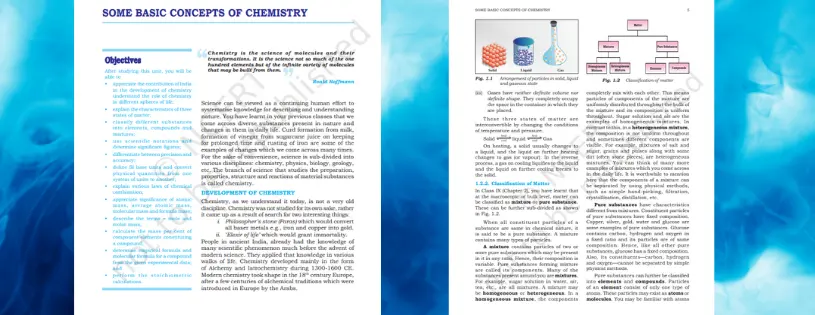
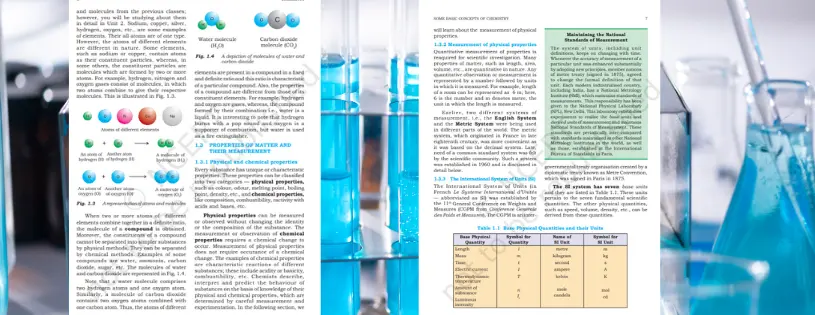
Exploring Chemistry Chapter 1 Some Basics Concepts of Chemistry in CBSE NCERT Class 11
| CHAPTER NAME | SOME BASIC CONCEPTS OF CHEMISTRY |
| Topic Number | Topic Name |
| 1.1 | Importance of Chemistry |
| 1.2 | Nature of Matter |
| 1.3 | Properties of Matter and Their Measurement |
| 1.4 | Uncertainly in Measurement |
| 1.5 | Laws of Chemical Combinations |
| 1.6 | Dalton's Atomic Theory |
| 1.7 | Atomic and molecular Masses |
| 1.8 | Mole Concept and Molar Masses |
| 1.9 | Percentage composition |
| 1.10 | Stoichiometry and Stoichiometric Calculations |
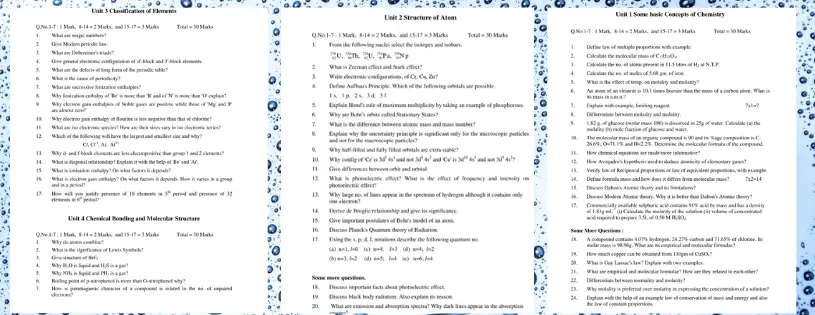
[Previous Year Question Solution Chemistry Download Button]
[Previous Year Question Solution Math Download Button]
| CBSE Class 11 Chemistry Chapters |
| Chapter2: STRUCTURE OF ATOMS |
| Chapter3: CLASSIFICATION OF ELEMENTS AND PERIODICITY IN PROPERTIES |
| Chapter4 : CHEMICAL BONDING AND MOLECULAR STRUCTURE |
| Chapter5 : THERMODYNAMICS |
| Chapter6 : EQUILIBRIUM |
| Chapter7: REDOX REACTIONS |
| Chapter8 : ORGANIC CHEMISTRY – SOME BASIC PRINCIPLE AND TECHNIQUES |
| Chapter9: Hydrocarbons HYDROCARBONS |
| CBSE Class 11 Physics Chapters |
| Chapter1: UNITS AND MEASUREMENTS |
| Chapter2: MOTION IN A STRAIGHT LINE |
| Chapter3: MOTION IN A PLANE |
| Chapter4: LAWS OF MOTION |
| Chapter5: WORK, ENERGY AND POWER |
| Chapter6: SYSTEM OF PARTICLES AND ROTATIONAL MOTION |
| Chapter7: GRAVITATION |
| Chapter8: MECHANICAL PROPERTIES OF SOLIDS |
| Chapter9: MECHANICAL PROPERTIES OF FLUIDS |
| Chapter10: THERMAL PROPERTIES OF MATTER |
| Chapter12: KINETIC THEORY |
| Chapter13: OSCILLATIONS |
| Chapter14: WAVES |
| CBSE Class 11 Mathematics chapter |
| Chapter1: SETS |
| Chapter2: RELATIONS AND FUNCTIONS |
| Chapter3: TRIGONOMETRIC FUNCTIONS |
| Chapter4: COMPLEX NUMBER AND QUADRATIC EQUATIONS |
| Chapter5: LINEAR INEQUALITIES |
| Chapter:6 PERMUTATIONS AND COMBINATIONS |
| Chapter7: BINOMIAL THEOREM |
| Chapter8: SEQUENCES AND SERIES |
| Chapter9: STRAIGHT LINES |
| Chapter10: CONIC SECTIONS |
| Chapter11: INTRODUCTION TO THREE-DIMENSIONAL GEOMETRY |
| Chapter12: LIMITS AND DERIVATIVES |
| Chapter13: STATISTICS |
| Chapter14: PROBABILITY |
| Class 8 Link soon |
| Class 9 Link soon |
| Class 10 Link soon |
| Class 12 Link soon |
CBSE Class 11th Downloadable Resources:
|
1. CBSE Class 11th Topic Wise Summary |
View Page / Download |
|
2. CBSE Class 11th NCERT Books |
View Page / Download |
|
3. CBSE Class 11th NCERT Solutions |
View Page / Download |
|
4. CBSE Class 11th Exemplar |
View Page / Download |
|
5. CBSE Class 11th Sample Papers |
View Page / Download |
|
6. CBSE Class 11th Question Bank |
View Page / Download |
|
7. CBSE Class 11th Topic Wise Revision Notes |
View Page / Download |
|
8. CBSE Class 11th Last Minutes Preparation Resources |
View Page / Download |
|
9. CBSE Class 11th Best Reference Books |
View Page / Download |
|
10. CBSE Class 11th Formula Booklet |
View Page / Download |
Being in CBSE class 11th and considering the board examinations you must be needing resources to excel in your examinations. At TestprepKart we take great pride in providing CBSE class 11th all study resources in downloadable form for you to keep you going.
Below is the list of all CBSE class 11th Downloads available on TestprepKart for both Indian and NRI students preparing for CBSE class 11th in UAE, Oman, Qatar, Kuwait & Bahrain.
Q1: What is an atom?
Answer: An atom is the basic unit of matter. It consists of a nucleus containing protons and neutrons, surrounded by electrons in orbit.
Q2: What is the Periodic Table?
Answer: The Periodic Table is a tabular arrangement of chemical elements, organized based on their atomic number and properties. It provides a systematic way to understand the relationships between different elements.
Q3: What is the difference between an element and a compound?
Answer: An element is a substance composed of only one type of atom, while a compound is a substance formed by chemically bonding different elements in fixed ratios.
Q4: How do chemical bonds form?
Answer: Chemical bonds form when atoms interact. Ionic bonds involve the transfer of electrons, and covalent bonds involve the sharing of electrons between atoms.
Q5: What is a molecule?
Answer: A molecule is a group of atoms bonded together. It can be composed of one or multiple types of atoms.







Copyright © 2024 CounselKart Educational Services Pvt. Ltd.. All Rights Reserved


Post a Comment