






Hi, I’m TestprepKart.
Your Partner In Exam Preparation
Hybridization is a captivating concept in the realm of genetics and botany, unlocking the potential for diverse and resilient organisms. It involves the interbreeding of distinct species or varieties, blending their genetic traits to create a hybrid with unique characteristics. This phenomenon has profound implications in agriculture, where hybrid crops often exhibit enhanced vigor and productivity. Additionally, hybridization plays a pivotal role in the evolution of species, fostering adaptability and genetic diversity. In this exploration of hybridization, we delve into its mechanisms, applications, and the transformative impact it has on both natural ecosystems and human endeavors.
What is Hybridization?
Hybridization is a molecular biology and genetics concept involving the combination of genetic material from different species or varieties to create a hybrid organism. In chemistry, specifically in atomic orbitals, hybridization refers to the mixing of atomic orbitals to form new hybrid orbitals, influencing the structure and properties of molecules. This process occurs to achieve optimal bonding arrangements and is commonly observed in organic chemistry. Hybridization plays a crucial role in both biological evolution, fostering diversity, and chemical reactivity, influencing the shape and stability of molecules.
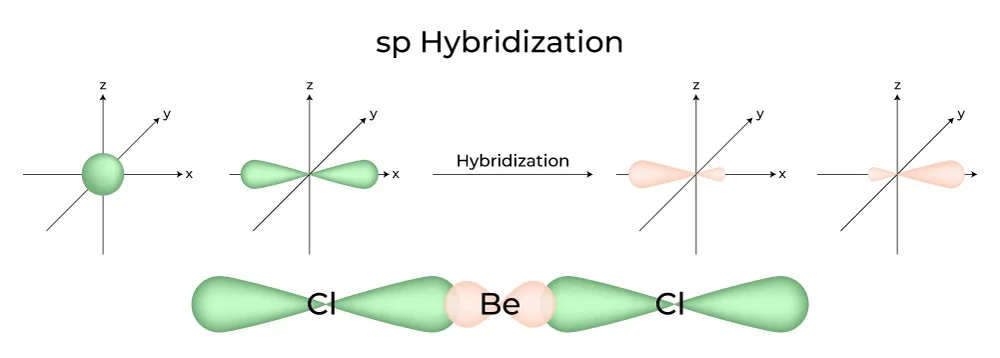
Rules for Observing the Type of Hybridisation
Types of Hybridisation
Hybridization is a concept in chemistry that involves the combination of atomic orbitals to form hybrid orbitals, influencing the shape and properties of molecules. Here are the common types of hybridization:
These hybridization types account for the geometry and bonding characteristics of molecules, providing a framework for understanding the arrangement of atoms in space.
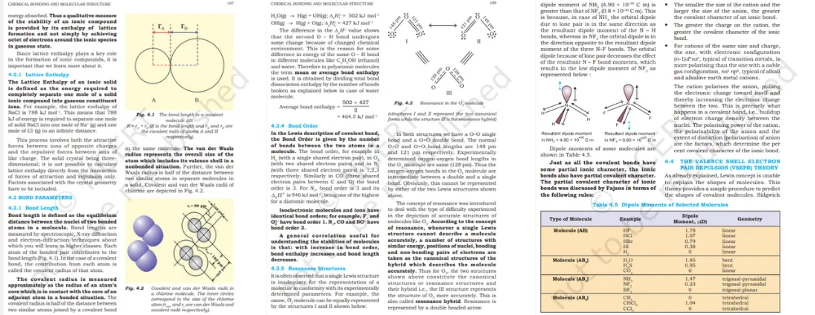
Studying the Formation of Various Molecules
Delving into these molecular formations provides insights into the hybridization, bonding, and geometrical arrangements crucial to understanding the diverse world of chemical structures.
Q1. What is hybridization in chemistry?
Answer. Hybridization is a concept in chemistry where atomic orbitals combine to form hybrid orbitals, influencing the shape and bonding of molecules.
Q2. Why does hybridization occur?
Answer. Hybridization occurs to maximize the overlap of atomic orbitals and create more stable molecular structures.
Q3. What are the common types of hybridization?
Answer. Common types include sp, sp2, sp3, sp3d, and sp3d2, each characterized by a specific combination of s and p orbitals.
Q4. Can atoms with different hybridizations bond?
Answer. Yes, atoms with different hybridizations can form bonds, and the resulting molecule may exhibit a hybridization that is a combination of the individual hybridizations.
Q5. What is the significance of sp2 hybridization?
Answer. Molecules with sp2 hybridization, such as BF3 and ethene (C2H4), have trigonal planar geometries, influencing their chemical and physical properties.
CBSE Class 11th Downloadable Resources:
| 1. CBSE Class 11th Topic Wise Summary | View Page / Download |
| 2. CBSE Class 11th NCERT Books | View Page / Download |
| 3. CBSE Class 11th NCERT Solutions | View Page / Download |
| 4. CBSE Class 11th Exemplar | View Page / Download |
| 5. CBSE Class 11th Sample Papers | View Page / Download |
| 6. CBSE Class 11th Question Bank | View Page / Download |
| 7. CBSE Class 11th Topic Wise Revision Notes | View Page / Download |
| 8. CBSE Class 11th Last Minutes Preparation Resources | View Page / Download |
| 9. CBSE Class 11th Best Reference Books | View Page / Download |
| 10. CBSE Class 11th Formula Booklet | View Page / Download |
Being in CBSE class 11th and considering the board examinations you must be needing resources to excel in your examinations. At TestprepKart we take great pride in providing CBSE class 11th all study resources in downloadable form for you to keep you going.
Below is the list of all CBSE class 11th Downloads available on TestprepKart for both Indian and NRI students preparing for CBSE class 11th in UAE, Oman, Qatar, Kuwait & Bahrain.
| CBSE CLASS 11th Chemistry Chapters |
| Chapter1: SOME BASIC CONCEPTS OF CHEMISTRY |
| Chapter2: STRUCTURE OF ATOMS |
| Chapter3: CLASSIFICATION OF ELEMENTS AND PERIODICITY IN PROPERTIES |
| Chapter4: CHEMICAL BONDING AND MOLECULAR STRUCTURE |
| > kossel lewis approach-to chemical bonding |
| > Ionic or Electrovalent Bond |
| > Bond Parameters |
| > The Valence Shell Electron Pair Repulsion (VSEPR) Theory |
| > Valence Bond Theory |
| Chapter5: THERMODYNAMICS |
| Chapter6: EQUILIBRIUM |
| Chapter7: REDOX REACTIONS |
| Chapter8: ORGANIC CHEMISTRY – SOME BASIC PRINCIPLE AND TECHNIQUES |
| Chapter9: Hydrocarbons HYDROCARBONS |
| CBSE Class 11 Physics Chapters |
| Chapter1: UNITS AND MEASUREMENTS |
| Chapter2: MOTION IN A STRAIGHT LINE |
| Chapter3: MOTION IN A PLANE |
| Chapter4: LAWS OF MOTION |
| Chapter5: WORK, ENERGY AND POWER |
| Chapter6: SYSTEM OF PARTICLES AND ROTATIONAL MOTION |
| Chapter7: GRAVITATION |
| Chapter8: MECHANICAL PROPERTIES OF SOLIDS |
| Chapter9: MECHANICAL PROPERTIES OF FLUIDS |
| Chapter10: THERMAL PROPERTIES OF MATTER |
| Chapter12: KINETIC THEORY |
| Chapter13: OSCILLATIONS |
| Chapter14: WAVES |
| CBSE Class 11 Mathematics chapter |
| Chapter1: SETS |
| Chapter2: RELATIONS AND FUNCTIONS |
| Chapter3: TRIGONOMETRIC FUNCTIONS |
| Chapter4: COMPLEX NUMBER AND QUADRATIC EQUATIONS |
| Chapter5: LINEAR INEQUALITIES |
| Chapter6: PERMUTATIONS AND COMBINATIONS |
| Chapter7: BINOMIAL THEOREM |
| Chapter8: SEQUENCES AND SERIES |
| Chapter9: STRAIGHT LINES |
| Chapter10: CONIC SECTIONS |
| Chapter11: INTRODUCTION TO THREE-DIMENSIONAL GEOMETRY |
| Chapter12: LIMITS AND DERIVATIVES |
| Chapter13: STATISTICS |
| Chapter14: PROBABILITY |
| Class 8 Link soon |
| Class 9 Link soon |
| Class 10 Link soon |
| Class 12 Link soon |








Copyright © 2024 CounselKart Educational Services Pvt. Ltd.. All Rights Reserved


Post a Comment