




Hi, I’m TestprepKart.
Your Partner In Exam Preparation
In the dance between electricity and magnetism lies a fascinating realm where invisible forces intertwine. The magnetic effects of electric current, a phenomenon discovered by Hans Christian Oersted in 1820, offer a captivating journey into the underpinnings of our technological world. As electric currents flow, magnetic fields materialize, shaping the very fabric of our devices and systems. Join us on an exploration of this symbiotic relationship, from the pioneering insights of Oersted to the practical applications in our everyday lives. Let's unravel the magnetic tapestry that powers much of modern technology, making the invisible forces around us not only visible but comprehensible.
Delving into the magnetic effects of electric current unveils a dynamic interplay between two fundamental forces, electricity, and magnetism. Originating with Hans Christian Oersted's groundbreaking revelation in 1820, this phenomenon illuminates the invisible dance shaping our technological landscape. As electric currents traverse conductors, they conjure magnetic fields, a symbiotic relationship harnessed across industries. From the simplicity of the right-hand rule to the complexity of Ampere's Circuital Law, these principles underpin the creation of electromagnets, fueling innovations in electric motors, electronics, and beyond. This exploration unravels the intricacies of a magnetic tapestry, revealing the unseen forces powering our modern world.
Magnetic Field:
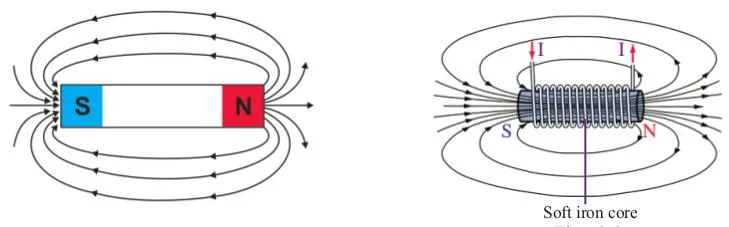
Magnetic fields, born from the intimate dance of electric currents, constitute a captivating realm within electromagnetism. Discovered by Hans Christian Oersted in 1820, these invisible forces have become fundamental to our understanding of the physical world and essential to various technological applications.
Fleming’s Left-Hand Rule:
Fleming's Left-Hand Rule is a fundamental principle in electromagnetism, offering a simple yet powerful way to determine the direction of motion, current, and magnetic force in an electromagnetic system. Named after its creator, John Ambrose Fleming, this rule is particularly useful in understanding the behavior of electric motors, generators, and other devices involving the interaction of magnetic fields and currents.
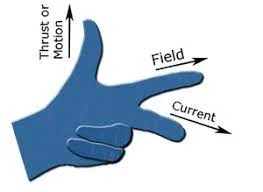
The rule involves three key elements:
Thumb (Motion): Point your thumb in the direction of the motion (the force that causes movement or the direction of the current).
Index Finger (Magnetic Field): Extend your index finger in the direction of the magnetic field (the direction of the magnetic flux).
Middle Finger (Current): Position your middle finger at a right angle to the thumb and index finger, representing the direction of the electric current.
The principle behind Fleming's Left-Hand Rule is elegantly simple: when a current-carrying conductor moves through a magnetic field, a force is exerted on the conductor. This force, known as the electromagnetic force, pushes the conductor in a specific direction.
By aligning these three elements according to the rule, the resultant motion, current, and magnetic field interactions can be easily visualized and predicted. This rule is indispensable in the study and design of electric motors and generators, providing a practical tool for engineers and students alike to grasp the dynamics of electromagnetic systems.
In essence, Fleming's Left-Hand Rule serves as a navigational guide through the intricacies of electromagnetism, empowering individuals to decipher the intricate dance between magnetic fields and electric currents in various electrical devices.
Electromagnetic Induction:
Electromagnetic induction, pioneered by Michael Faraday in the 1830s, is a captivating phenomenon at the heart of modern electricity generation and numerous technological applications. This principle unveils the intricate dance between magnetic fields and electrical currents, fundamentally altering our ability to harness and manipulate energy.
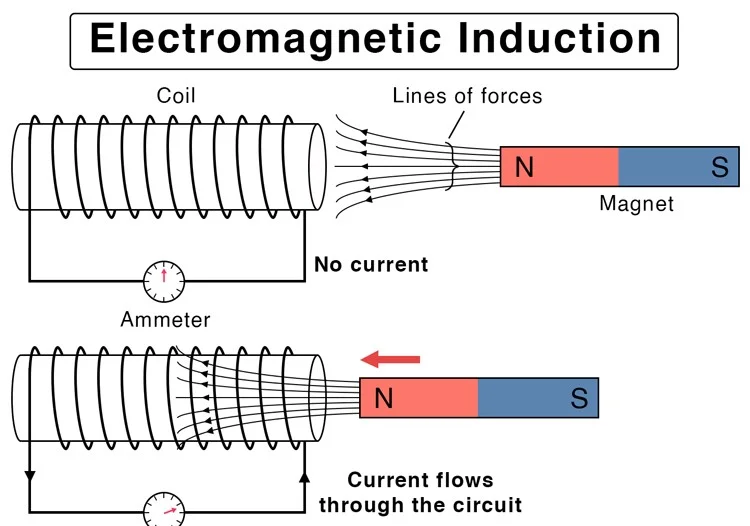
1. Faraday's Insightful Discovery:
2. Faraday's Law and Lenz's Law:
3. Power Generation with Generators:
4. Transformers and Voltage Regulation:
5. Eddy Currents and Efficiency Considerations:
6. Wireless Technologies and Communication:
7. Faraday's Legacy and Future Exploration:
In summary, electromagnetic induction stands as a testament to the transformative power of scientific inquiry. From its humble origins in Faraday's experiments, this principle has evolved into a cornerstone of modern technology, enabling the efficient generation, transmission, and utilization of electrical energy in ways that continue to shape our rapidly advancing world.
Fleming’s Right Hand Rule:
Fleming's Right-Hand Rule is a visual tool in electromagnetism, crucial for determining the direction of induced currents, magnetic forces, and motion in dynamic systems. Developed by John Ambrose Fleming, this rule simplifies complex interactions into a tangible and easy-to-remember concept.
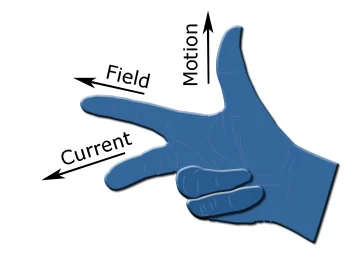
Components of Fleming's Right-Hand Rule:
Thumb (Motion):
First Finger (Magnetic Field):
Second Finger (Current):
Application Scenarios:
Motion of a Charged Particle:
Current-Carrying Conductor in a Magnetic Field:
Generators and Motors:
Direct Current and Alternating Current:
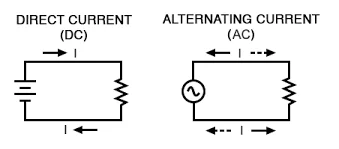
Direct Current (DC):
Direct Current is a unidirectional flow of electric charge. In a DC circuit, electrons move steadily in one direction, typically from the negative terminal to the positive terminal of a voltage source like a battery. Key characteristics of DC include:
Steady Voltage: The voltage in a DC circuit remains constant over time, providing a stable and predictable flow of electrical energy.
Applications: DC is commonly used in low-voltage applications such as electronic devices, batteries, and certain industrial processes. It is ideal for situations where a constant and steady flow of electricity is required.
Limitations: Transmission of DC over long distances encounters significant energy losses. This limitation led to the development and widespread use of Alternating Current in power distribution systems.
Alternating Current (AC):
Alternating Current periodically changes direction, reversing the flow of electrons. The most common form of AC is a sinusoidal waveform, where the voltage alternates between positive and negative values in a regular pattern. Key features of AC include:
Voltage Variations: AC voltage varies over time, creating a dynamic electrical flow. The standard frequency for AC power in most countries is 50 or 60 hertz (Hz), representing the number of cycles per second.
Efficient Transmission: AC is the preferred choice for long-distance power transmission. The ability to transform voltage levels using transformers makes it more efficient for energy distribution across vast networks.
Versatility: AC is adaptable for various applications, including both high and low-voltage scenarios. Its ease of transformation, thanks to transformers, allows for efficient distribution and utilization.
Household Power: The electricity supplied to homes and businesses is typically AC. It powers lighting, appliances, and electronic devices with ease due to its adaptability and efficient distribution capabilities.
Three-Phase AC: In industrial settings, three-phase AC systems are common due to their enhanced efficiency and power delivery. These systems utilize three alternating currents with a specific phase relationship, providing a smoother power flow.
Choosing Between DC and AC:
The selection between DC and AC depends on the specific requirements of a given application. DC is often preferred for electronic devices and certain niche applications, while AC dominates in power distribution, enabling electricity to reach our homes and industries efficiently.
In summary, the dichotomy of Direct Current and Alternating Current is foundational to the functioning of our electrical systems. While DC offers stability for certain applications, AC's adaptability and efficiency have made it the backbone of modern power grids, ensuring a reliable supply of electricity to meet the diverse needs of our technologically advanced society.
Domestic Electric Circuit:
Domestic electric circuits form the backbone of modern living, powering our homes with the seamless flow of electrical energy. This intricate network of interconnected components ensures the efficient distribution of electricity for lighting, appliances, and various electronic devices. Understanding the key elements of a domestic electric circuit is fundamental for ensuring safety and optimal functionality.
1. Components of a Domestic Electric Circuit:
2. Circuits and Outlets:
3. Switches and Controls:
4. Lighting and Appliance Circuits:
5. Safety Measures:
6. Upkeep and Maintenance:
| CHAPTER NAME | Magnetic Effects of Electric Current |
| Topic Number | Topics |
| 12.1 | Magnetic Field |
| 12.2 | Fleming’s Left-Hand Rule |
| 12.3 | Electromagnetic Induction |
| 12.4 | Fleming’s Right Hand Rule |
| 12.5 | Direct Current and Alternating Current |
| 12.6 | Domestic Electric Circuit |
[Previous Year Question Solution Maths Download Button]
[Previous Year Question Solution Science Download Button]
| CBSE CLASS 10 Mathematics Chapters |
| Chapter1: Real Numbers |
| Chapter2: Polynomials |
| Chapter3: Pair of Linear Equations in Two Variables |
| Chapter4: Quadratic Equations |
| Chapter5: Arithmetic Progressions |
| Chapter6: Triangles |
| Chapter7: Coordinate Geometry |
| Chapter8: Introduction to Trigonometry |
| Chapter9: Some Applications of Trigonometry |
| Chapter10: Circles |
| Chapter11: Areas Related to Circles |
| Chapter12: Surface Areas and Volumes |
| Chapter13: Statistics |
| Chapter14: Probability |
| CBSE CLASS 10 Science Chapters |
| Chapter1: Chemical Reactions and Equations |
| Chapter2: Acids, Bases and Salts |
| Chapter3: Metals and Non-metals |
| Chapter4: Carbon and its Compounds |
| Chapter5: Life Processes |
| Chapter6: Control and Coordination |
| Chapter7: How do Organisms Reproduce? |
| Chapter8: Heredity |
| Chapter9: Light – Reflection and Refraction |
| Chapter10: The Human Eye and the Colourful World |
| Chapter11: Electricity |
| Chapter12: Magnetic Effects of Electric Current |
| Chapter13: Our Environment |
| Class 8 |
| Class 9 |
| Class 11 |
| Class 12 |
| 1. CBSE Class 10th Topic Wise Summary | View Page / Download |
| 2. CBSE Class 10th NCERT Books | View Page / Download |
| 3. CBSE Class 10th NCERT Solutions | View Page / Download |
| 4. CBSE Class 10th Exemplar | View Page / Download |
| 5. CBSE Class 10th Previous Year Papers | View Page / Download |
| 6. CBSE Class 10th Sample Papers | View Page / Download |
| 7. CBSE Class 10th Question Bank | View Page / Download |
| 8. CBSE Class 10th Topic Wise Revision Notes | View Page / Download |
| 9. CBSE Class 10th Last Minutes Preparation Resources (LMP) | View Page / Download |
| 10. CBSE Class 10th Best Reference Books | View Page / Download |
| 11. CBSE Class 10th Formula Booklet | View Page / Download |
Being in CBSE class 10th and considering the board examinations you must be needing resources to excel in your examinations. At TestprepKart we take great pride in providing CBSE class 10th all-study resources in downloadable form for you to keep you going.
Below is the list of all CBSE class 10th Downloads available on TestprepKart for both Indian and NRI students preparing for CBSE class 10th in UAE, Oman, Qatar, Kuwait & Bahrain.
Q1. What is the magnetic effect of electric current?
Answer. The magnetic effect of electric current refers to the generation of a magnetic field around a conductor carrying an electric current. This phenomenon, known as electromagnetism, was first discovered by Hans Christian Oersted in 1820.
Q2. How does an electric current create a magnetic field?
Answer. When an electric current flows through a conductor, it produces a magnetic field around the conductor. The direction of the magnetic field is determined by the direction of the current flow.
Q3. How do magnetic fields impact electronics?
Answer. Magnetic fields play a significant role in electronics, affecting the performance of components like transformers and inductors. Managing magnetic interference is crucial to prevent unwanted effects on electronic circuits and devices.
Q4. Are there any advancements or research areas related to magnetic effects?
Answer. Ongoing research explores innovative materials and designs to enhance magnetic properties, leading to advancements in technologies like magnetic levitation and medical applications such as Magnetic Resonance Imaging (MRI).
Q5. Can you provide examples of magnetic effects in everyday life?
Answer. Magnetic effects are evident in various aspects of daily life, from the functioning of electric motors in appliances to the magnetic locks on doors. They are also essential in technologies like credit card stripes and the Earth's magnetic field influencing compass needles.








Copyright © 2024 CounselKart Educational Services Pvt. Ltd.. All Rights Reserved


Post a Comment