Managing NEET Preparation In USA
TestprepKart helps more than 5000 NRI students worldwide to prepare for NEET examination, for United States, it is a bit more challenging and here is how we do it is explained in this stage 4.
In the U.S., NRI students do not fail NEET because they lack intelligence. They fail because they cannot sustain NEET alongside GPA, AP or IB deadlines, SAT, sports, and a busy school calendar. Most families start with enthusiasm, then school peaks arrive and NEET drops for weeks. When NEET restarts, the student feels behind, confidence drops, and parents feel panic. Stage 4 is about building a system that survives U.S. school reality using grade-wise timelines, exam-season adjustments, and a summer strategy that creates real acceleration.
What this stage will help parents do
-
Set a grade wise NEET timeline that matches U.S. workload
-
Balance NEET with AP, IB, SAT without burning out and stress
-
Build a weekly NEET routine that survives finals, school exam and AP season
-
Design a NEET summer break plan that creates measurable improvement
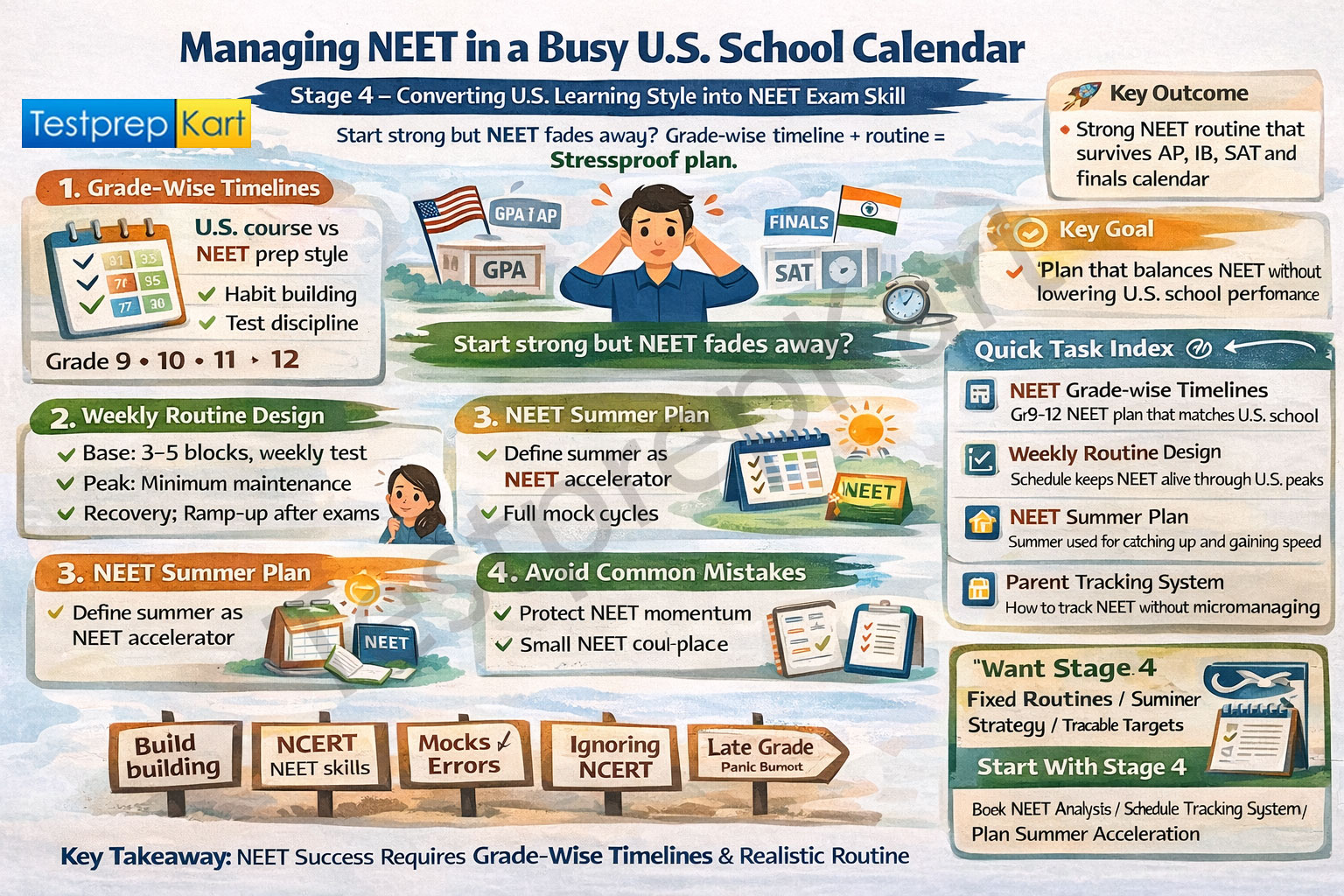
Download Stage 4 - Infographics Gallery For Quick Recall
Counseling details and information is compiled in inforgrpahics for quick recall. Download the full stack of stage 4 inforgraphics by clicking the button below.
For any additional information or detail, connect with us on info@testprepkart.com.
Key Topic Index (Quick view)
| Core Discussion Topic | What parents will gain |
|---|---|
| NEET Grade-wise timelines | What to do in Grade 9, 10, 11, 12 and what not to do if you are preparing for NEET |
| Balancing NEET with AP | How to protect and prepare NEET without hurting AP grades |
| Balancing NEET with IB | How to survive IA and EE seasons while staying consistent |
| Balancing NEET with SAT | How to avoid cognitive switching burn |
| NEET Summer break plan | How to use summer as NEET acceleration engine |
| Weekly routine design | Base, peak-week, and recovery routine |
| Parent tracking system | How to monitor NEET without micromanaging everything |
| Common mistakes | Why U.S. families lose momentum and how to avoid it |
Grade-wise timelines (USA student view)
NEET timeline should change by grade because the student’s school intensity changes every year. Grade 9 and 10 are habit and foundation years, not high-pressure completion years. Grade 11 is usually the most important year for serious alignment because school intensity rises and NEET chapters become heavy. Grade 12 is a performance year where revision, full mocks, and error correction dominate. Parents should plan NEET in a way that grows gradually and prevents last-minute overload.
Grade-wise planning principles
-
Start early with low pressure and strong consistency
-
Build test discipline by Grade 10
-
Make Grade 11 the serious alignment year
-
Make Grade 12 the revision plus mock year
| Student Grade | Main NEET goal | Weekly structure (school months) | What parents should avoid |
|---|---|---|---|
| Grade 9 | Build habits, NCERT comfort | 3 short blocks + 1 weekend block | rushing syllabus, heavy coaching load |
| Grade 10 | Strength + test discipline | 4 blocks + 1 weekend block | “study only when free” approach |
| Grade 11 | Serious alignment + weekly tests | 5 to 6 blocks + weekly test | stopping during AP peaks or finals |
| Grade 12 | Revision, mocks, performance | timed mixed sets + 1 to 2 mocks/week | starting from scratch late |
Key takeaway: The best NEET plan is grade-appropriate, not one-size-fits-all.
Managing NEET in Grade 9 to 10 (Foundation and stability)
In Grades 9 and 10, parents should focus on building a consistent routine that feels manageable. The student’s confidence and habit system matters more than syllabus completion. This is also the best time to start NCERT Biology micro-reading, because it builds a long runway and reduces pressure later. If the student builds a weekly test habit by Grade 10, Grade 11 becomes much easier.
What works best in Grades 9 to 10
-
30 to 60 minutes NEET blocks on weekdays
-
One longer weekend block for mixed practice
-
Small tests every 2 weeks and mistake log habit
-
NCERT Biology reading micro habit daily
| Element | Grade 9 to 10 action | Why it matters |
|---|---|---|
| NCERT habit | Daily micro reading | Builds recall without stress |
| Practice | Small MCQ sets | Converts learning into exam readiness |
| Testing | Every 2 weeks | Builds exam comfort early |
| Tracking | Accuracy and mistakes | Shows progress to parents |
Key takeaway: Early habits reduce later panic. Small weekly consistency beats intense bursts.
NEET NRI Counseling & Admission eBook Download
A practical guide covering NRI quota admission process, fee, colleges, counseling, sponsor rules, document checklist, verification traps, NRI quota admission details.

Schedule Trial Session For NEET Prep
Schedule academic session and get study roadmap: syllabus gaps and the exact weekly plan.
Managing NEET in Grade 11 (High risk year for U.S. families)
Grade 11 is where many U.S. NEET plans break because AP or IB workload becomes heavy and students face more commitments. This year needs a protected weekly routine and regular tests, otherwise progress becomes invisible and motivation drops. Parents should treat Grade 11 as the year where NEET becomes stable, test-driven, and measurable. This is also when summer strategy becomes critical because summer is often the only time U.S. students can accelerate deeply.
What parents should enforce in Grade 11
-
Fixed NEET slots protected like classes
-
Weekly test plus analysis
-
Mixed practice blocks to build recall and speed
-
Break weeks used for acceleration, not relaxation only
| Grade 11 component | Minimum requirement | Why it matters |
|---|---|---|
| Weekly NEET blocks | 5 to 6 blocks | Consistency under school pressure |
| Testing | weekly | Prevents false confidence |
| Analysis | after every test | Reduces repeated mistakes |
| Mixed practice | 2 to 3 times/week | Mimics NEET exam style |
Key takeaway: If NEET survives Grade 11, Grade 12 becomes significantly easier.
Managing NEET in Grade 12 (Performance and exam engineering)
Grade 12 should be designed around revision, mocks, and error correction. This is not the year to keep learning new content endlessly. This is the year to convert what the student knows into performance under time. Grade 12 is also heavy in school workload, especially for AP exams, IB submissions, and finals. The plan must shift into performance mode and protect a test rhythm.
What Grade 12 must include
-
1 to 2 full mocks weekly (as schedule allows)
-
strict analysis and reattempt cycle
-
timed mixed sets on weekdays
-
revision cycles for high-yield chapters
| Grade 12 block | What it looks like | What it prevents |
|---|---|---|
| Full mock | Timed full sections | Exam fear and speed collapse |
| Analysis | Identify mistake patterns | Repeating same losses |
| Retest | Reattempt wrong questions | “I knew it” frustration |
| Revision | Short cycle revision | Forgetting and shallow recall |
Key takeaway: Grade 12 is performance training. Tests plus analysis drive improvement more than extra theory.
Balancing NEET with AP (what parents should do)
AP courses can coexist with NEET if the plan respects peak AP seasons. AP is concept-heavy and can support NEET, especially in Physics and Chemistry, but AP exam windows can steal weeks. Parents should plan for an “AP peak mode” where NEET shrinks but does not stop. The trick is to protect minimum NEET continuity while AP workload spikes, then accelerate in summer.
How to balance NEET with AP successfully
-
Treat AP months as peak workload months
-
Reduce NEET to minimum viable routine
-
Continue NCERT Biology micro habit daily
-
Schedule recovery ramp after AP exams
| AP situation | NEET adjustment | Parent / student goal |
|---|---|---|
| Regular AP weeks | Normal NEET routine | Steady progress |
| AP exam month | Minimum routine | No zero month rule - Do not pause NEET fully for 3, 4 weeks, even during finals. Keep minimum routine. |
| Post AP | Recovery ramp | Restart tests quickly - Resume testing within 7 days so you regain rhythm and spot gaps quickly. |
| Summer | Acceleration | Major NEET coverage and mocks |
Key takeaway: AP and NEET can work together if NEET never drops to zero during AP peak.
Balancing NEET with IB (IA, EE, and deadline reality)
IB students face intense internal deadlines, especially for IAs and the Extended Essay. These tasks consume time and mental energy. Parents should not fight this reality. Instead, build a plan where NEET becomes smaller during IB submission windows and stronger during breaks. For IB students, the biggest risk is burnout due to too many simultaneous outputs.
How to balance NEET with IB
-
Plan around IA and EE calendar early
-
Reduce NEET load during submission weeks
-
Keep short daily NEET continuity
-
Use summer and winter breaks for acceleration
| IB period | NEET plan | Parent focus |
|---|---|---|
| IA writing weeks | Minimum routine | Protect sleep and mental energy |
| EE deadline weeks | Micro NEET only | Keep continuity alive |
| Regular IB weeks | Steady NEET blocks | Gradual progress |
| Breaks | High intensity | Tests and coverage |
Key takeaway: IB balance is about avoiding burnout while maintaining minimum NEET continuity.
Balancing NEET with SAT (Avoid cognitive switching burn)
SAT and NEET use different mental muscles. SAT rewards reasoning, grammar patterns, and short math logic. NEET rewards recall, science MCQ volume, and time-based accuracy. Families make a common mistake by running both at full intensity in the same weeks, which causes cognitive switching fatigue. The smart approach is to choose “priority windows” and assign focus phases.
How to balance NEET and SAT
-
Set 6 to 10 week SAT focus windows
-
Keep NEET on minimum maintenance during SAT peak
-
Avoid full-length SAT tests and full NEET mocks in same week
-
Use summer smartly with split blocks by month
| Time window | Focus | NEET level |
|---|---|---|
| SAT peak prep weeks | SAT priority | NEET maintenance routine |
| Post SAT test | NEET ramp | Restart tests and analysis |
| Summer month 1 | bridge gaps | Increase NEET hours |
| Summer month 2 | test heavy | NEET mocks and revision cycles |
Key takeaway: Do not run SAT and NEET at full intensity simultaneously. Use phase-based planning.
Summer break plan (the acceleration engine for U.S. students)
Summer is where U.S. NEET students can compete with India-based students. During school months, U.S. students often cannot match the hours. Summer is when you cover major syllabus, build speed, and do full tests. Parents should treat summer like a structured program, not a vague “study more” season. The output of summer should be visible in test trends.
Summer plan must include
-
Weekly syllabus targets
-
Weekly tests and analysis
-
Mixed practice and speed drills
-
Dedicated NCERT Biology revision blocks
| Summer phase | Goal | What parents should see |
|---|---|---|
| Weeks 1 to 3 | Syllabus coverage ramp | Rising MCQ output |
| Weeks 4 to 6 | Heavy practice plus tests | Accuracy improvement |
| Weeks 7 to 9 | Mixed revision | Faster time per question |
| Weeks 10 to 12 | Mock cycles | Stable test scores |
Key takeaway: Summer should produce measurable improvement, not just “time spent studying.”
Weekly routine design: base, peak-week, recovery-week
A single weekly routine will not work throughout the year. Parents need three versions: a normal routine, a peak-week routine for finals or AP or IB deadlines, and a recovery routine for the week after exams. This keeps NEET consistent and prevents stop-start cycles.
Three routine modes
-
Base routine: steady weekly plan
-
Peak-week routine: minimum continuity plan
-
Recovery-week routine: restart tests and rebuild momentum
| Routine mode | What changes | What stays fixed |
|---|---|---|
| Base | Normal blocks and tests | NCERT habit + weekly tracking |
| Peak-week | NEET shrinks | No zero month rule |
| Recovery | NEET ramps fast | Testing restarts quickly |
Key takeaway: Routine modes protect NEET continuity across U.S. school peaks.
Parent tracking system (So it feels “important” and professional)
Parents want confidence that NEET is progressing, not drifting. Tracking should be simple but serious. Instead of asking “Did you study?” track measurable outputs: MCQs attempted, accuracy, tests, time per question, and repeated mistake patterns. This gives parents real control and gives students clear targets.
Core tracking metrics
-
Weekly MCQs attempted
-
Accuracy percentage by subject
-
Time per question trend
-
Tests taken and scores
-
Repeated mistakes count
| Metric | Why it matters | What “good” looks like |
|---|---|---|
| Accuracy | Shows real learning | Gradual upward trend |
| Speed | Predicts exam readiness | Time per question reduces |
| Tests | Drives improvement | Weekly or biweekly |
| Mistakes | Shows correction | Repeated mistakes decrease |
Key takeaway: Tracking turns Stage 4 into a professional execution plan instead of emotional guesswork.