Is My Child NRI, OCI, Or Foreign National For NEET? Find Out Before Counseling Does It For You
The majority of American families never take the time to write this down. They make this assumption, which typically breaks during verification week rather than earlier. This page assists you in determining your child's precise category in advance so you are aware of the seats, paperwork, and due dates that are unique to your family.

This is the pattern that American families most frequently exhibit. A U.S. passport is held by one parent. The child possesses an OCI card. Technically, the family member from home who will "sponsor" the application is a great-uncle. While none of that is out of the ordinary, each detail eventually modifies a document need. Before counseling places the question on a deadline, Stage 2 is designed to bring everything together.
Why This Page Exists: Two Different Questions Parents Keep Mixing Up
The distinction between being permitted to sit for NEET and being permitted to claim a specific seat when results are released is subtle but significant. Only the first one has been validated by nearly every NRI family we speak with. After making sure their child is able to register, they let out a sigh of relief and stop there. Counseling then begins, and the availability of the seat they truly desired is determined by a totally different set of state-level and category-level regulations.
| What you've probably confirmed | What you may not have confirmed yet |
|---|---|
| "Yes, my child can register and appear for NEET" | Which particular seat types are unlocked by registration? |
| "We have an OCI card, so we should be fine" | Whether OCI are given the same treatment for seats in your target state as Indian citizens |
| "A relative in India will sponsor us" | Whether the state's regulations allow that relationship to be an eligible sponsor |
Key takeaway: Passing the eligibility check is step one. Knowing which seat pool you can legally enter is step two, and step two is where most NRI families lose time.
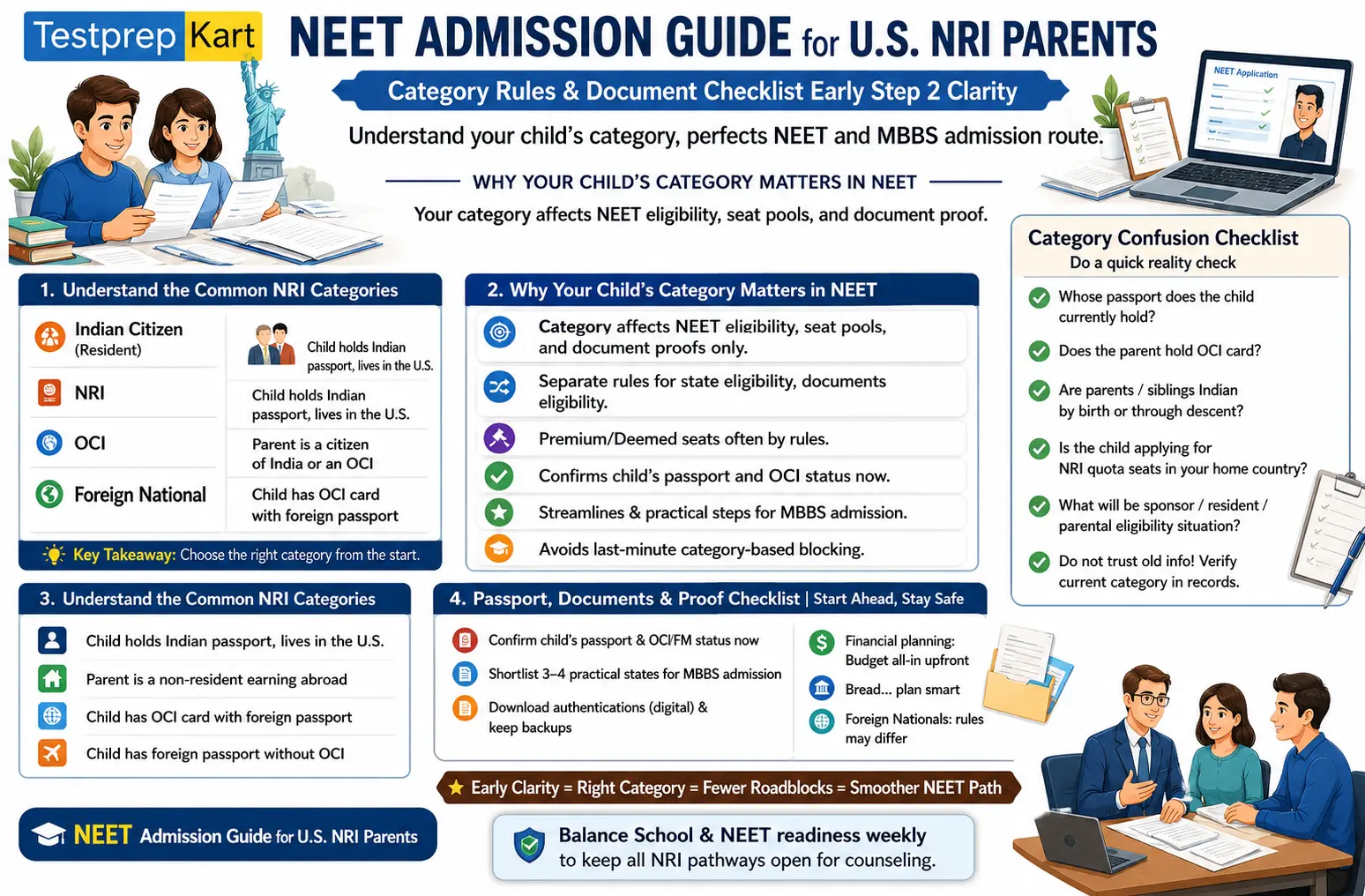
Get The Stage 2 Document Map As One Visual Sheet
We've turned this entire stage into a single reference graphic: the four category types, the documents tied to each, and a quick checklist you can keep open while filling forms.
Questions about your specific situation? Reach our team directly at info@testprepkart.com.
Download Stage 2 Visual Sheet
Checkout few of the app features below.
1) What Stage 2 Actually Covers
Think of this as the paperwork-planning stage, not the exam-strategy stage. Everything below is about confirming who your child is on paper, and what that status requires of you.
| Topic | Why It's Here |
|---|---|
| Indian Citizen, NRI, OCI, Foreign National - defined for U.S. families | These four terms are used loosely at home, which is where most confusion begins. |
| What the NEET bulletin actually requires | Parents frequently rely on rumors rather than the specific wording of the announcement. |
| OCI-specific rule history | In recent years, court rulings and notices have changed how OCI is treated. |
| Sponsor and "ward of NRI" logic | A relative's ability to sponsor your child is determined by this one connection aspect. |
| State-by-state document risk | In one state, a set of documents may pass, but in another, they may be flagged. |
| A worksheet to settle your category today | provides you with a documented response rather than a guess. |
2) Indian Citizen, NRI, OCI, Foreign National: What These Words Mean For Your Family
These four labels get thrown around in NRI WhatsApp groups as if they're interchangeable. They are not. Each one comes from a different legal basis, and NEET counseling cares about that basis, not just the label.
- Indian citizen living overseas: Your child has an Indian passport but resides in the United States; this is the most straightforward scenario on paper, but school-equivalency documentation is still required.
- NRI: this typically refers to the parent's place of residence and income outside of India rather than the child's passport.
- People of Indian descent with a foreign passport are granted OCI, a card-based status; your child's status here is determined by family history rather than present residence.
- A foreign national is someone with a foreign passport who does not have an OCI card; this is typically the method that requires the greatest additional verification.
| Family Setup | Likely Category | First Document To Check |
|---|---|---|
| Both parents Indian passport holders, working in the U.S. on a visa | NRI (parent), child's own status depends on their passport | The child's passport plus the parent's work permit or visa |
| Child born in the U.S., holds OCI card | OCI | Date of OCI card issuance and validity |
| Child has only a U.S. passport, no OCI applied for | Foreign National | Passport + proof of Indian-origin parentage, if relevant |
| Child holds an Indian passport despite living in the U.S. | Indian Citizen (NRI household) | Indian passport + U.S. school transcripts |
Key takeaway: Write down your family's actual setup against this table before reading further. Everything else on this page depends on knowing which row you're in.

3) What The NEET Bulletin Actually Says About Your Category
Rather than depending on messages that have been forwarded, it is worthwhile to read the bulletin itself. Indian nationals, NRIs, OCIs, and foreign nationals are all permitted to take the exam, according to the NEET information bulletin; however, admission is "subject to rules framed by respective State Governments / Institutions / Government of India." A "yes" at the national level doesn't always convert into a "yes" at the state level since that one clause is doing a lot of work.
The bulletin expressly requests a certificate from the Indian Diplomatic Mission in the place of residency for NRI and OCI candidates; the original is kept for advising. Applicants who are foreign nationals must present official documentation proving their citizenship, such as passport pages or a certificate from an appropriate authority.
| Applicant Type | What The Bulletin Asks For At Application |
|---|---|
| NRI or OCI | A certificate issued by the Indian diplomatic mission in your home country |
| Foreign National | Pages from a passport or a citizenship document issued by an appropriate body |
Key takeaway: On its own, an OCI card is not the end. For NRI and OCI candidates, the bulletin still need a separate diplomatic mission certificate. Make an early appointment at the consulate because U.S. consulate slots fill up more quickly than people anticipate.
4) OCI Status Has Changed Before. Here's Why That Matters Now
If a relative has told you that "OCI rules changed a few years back," they are correct, and it's important to comprehend what happened. OCI holders and NRIs were subject to parity-style restrictions on a number of issues, including all-India entrance tests, according to a March 2021 Ministry of Home Affairs notification. The rights of OCI holders were then returned to their pre-2021 status by a subsequent Supreme Court ruling.
Practically speaking, this means that OCI status is a policy position that has already changed and may still be interpreted differently by other governments. It is not a set, unchanging label. Some states have published their own detailed OCI admission rules separate from the national bulletin, which is exactly why a "general OCI rule" doesn't always settle the question for your specific target state.
| OCI Question | Where The Answer Actually Comes From |
|---|---|
| "Can my OCI child appear for NEET?" | According to the national NEET bulletin, yes. |
| "Will OCI be treated like Indian citizen for seat type?" | Not just the national bulletin, but also the target state's brochure |
| "Do reservation benefits apply to OCI?" | Usually restricted, however make sure to check the current set of rules for that particular state. |
Key takeaway: Consider "OCI" to be a shifting target rather than a fixed reality. Verify again using the current-year brochure for each target state instead of the assumption from the previous year.
5) Sponsor Rules: What "Ward Of NRI" Actually Requires
Parents in the United States are most surprised by this section. A common misconception is that any relative who resides overseas can "sponsor" their child for NRI quota seats. In actuality, the majority of states have a more stringent definition of what constitutes a qualifying relationship, and they require proof that goes beyond a notarized letter.
A typical gap: Families in the United States are accustomed to a notary stamp resolving the majority of paperwork issues. In addition to the sponsor's passport, visa, or work permit, an NRI certificate issued by the embassy, and financial documentation demonstrating the sponsor's ability to pay the price, Indian admission authorities often require something more formal, such as a family tree certificate issued by a revenue authority.
| Document | What It Proves |
|---|---|
| Sponsor's passport, visa, or work permit | that the sponsor is actually an NRI |
| Embassy or consulate NRI certificate | Verification of the sponsor's NRI status in writing |
| Relationship certificate / family tree | that the sponsor meets the state's definition of an eligible relative |
| Sponsor affidavit + financial proof | that the sponsor can afford to pay for entrance. |
Key takeaway: Decide who your sponsor is now, not after results. Relationship and financial documents take longer to assemble from the U.S. than most families expect.
6) The Same Documents, Different States, Different Outcomes
The risk that is most likely to be overlooked is this one. The national bulletin allows you to apply for NEET as an NRI, OCI, or foreign national; nevertheless, each state has its own counseling procedure, document norms, and definition of admissible proof. We have witnessed similar document sets being highlighted for clarification in one state's counseling and cleared in another.
Separate from the national framework, several governments have gone so far as to establish comprehensive regulations that expressly handle OCI eligibility and NRI quota verification. The practical lesson is that a counseling pamphlet for your target state is the genuine rulebook for your circumstances and should not be read as an alternative.
- Shortlist two to four realistic target states well before results
- Read each state's latest counseling brochure in full, not just the summary
- Build your document set to the strictest standard among your shortlisted states
- Keep one backup state in mind in case a rule changes close to counseling
Key takeaway: "We're eligible nationally" and "we're cleared for this specific state's counseling" are two different sentences. Confirm both, separately.
7) The Ten-Minute Worksheet: Settle Your Category Today
Sit down with your spouse or co-parent and answer these honestly. By the end, you'll have a written answer instead of a guess - and you'll know exactly which document folder to start building first.
- Which passport does your child currently possess?
- Does your youngster own an OCI card? If yes, what year did it come out?
- Are you parents living overseas on a permanent basis for work?
- Are you aiming for the general counseling pool or the NRI quota seats?
- Who is the actual sponsor - a parent or a qualified family member?
- Is it feasible to schedule a consular appointment for an embassy certificate on time?
- Do you have a format that is relationship-proof and will be accepted by your target states?
- Have you completed your plan for board recognition and 10+2 equivalency?
- If necessary, are you ready to travel to India for in-person verification?
- If the OCI treatment proves to be different in your target states, do you have a backup plan?
| Where You Land | Start Collecting This First |
|---|---|
| OCI child, foreign passport | OCI card + diplomatic mission certificate + brochure for each target state |
| Claiming NRI quota seats | Sponsor proof + relationship certificate + financial affidavit |
| Foreign National route | Proof of passport citizenship plus verified state-level eligibility |
Key takeaway: A ten-minute worksheet now saves weeks of scrambling during counseling. Do this before, not after, the NEET result.
8) What To Actually Do This Week
- Don't make assumptions about your child's passport and OCI status; instead, write it down.
- Make a shortlist of two to four states to apply to for MBBS admission.
- As soon as the most recent counseling brochure for each state on the short list is released, pull it.
- Combine originals and scans into a single folder, both digital and physical.
- If a diplomatic mission certificate is required, make an early appointment at the consulate.
- Verify the sponsor and begin the relationship-proof documentation right away.
- Maintain a documented backup plan in case the rules of a goal state change.
Key takeaway: None of these steps require your NEET result. They can all start this week, while you still have runway.
9) How This Connects To What Comes Next
The next question that naturally arises when your category is written down is how your child's academic background in the United States compares to what NEET requires, as well as the specific document distinctions between NRI status, OCI status, the Green Card holder route, and the whole NRI proof-document list. Since curriculum alignment is a truly distinct planning question from the category work you've just completed here, we go over that comparison in more detail in the following step.
10) Where TestprepKart Fits In
Our counseling team can map your child's category against the states you have nominated and indicate which documents should be prioritized if you would prefer not to piece this together on your own. "Which category fits my child, realistically?" We work from the most recent NEET bulletin and state counseling patterns every cycle, so we typically identify the paperwork traps before they cost you a seat. However, we are not a replacement for legal guidance.
- "What should we start collecting now, while there's still time?"
- "Which states make sense for our specific situation?"
- "How should our prep plan adjust once our likely admission pathway is clear?"
Download NEET E-Book For NRI's Students

Planning to pursue MBBS in India through the NRI Quota? This FREE NEET Guide for USA-based NRI students and parents provides everything you need in one place from NRI eligibility criteria and required documents to NRI quota fees, seat availability, top medical colleges accepting NRI admissions, important deadlines, and the complete admission process. You'll also discover alternative pathways beyond NEET Main and expert insights to help you make informed decisions and avoid costly mistakes during NEET 2026 admissions. Download now and stay ahead in your MBBS admission journey.
Keep Exploring
Questions U.S. NRI Parents Ask Us Most
My child has only ever studied in the U.S. Can they still appear for NEET?
Yes, in general. Foreign nationals, Indian nationals, NRIs, and OCIs are all permitted to appear in the NEET bulletin. Just keep in mind that this addresses the "can they sit for the exam" question rather than the "which seats can they claim" question.
We have an OCI card. Does that automatically cover NRI documentation too?
Not by default. OCI status by itself does not take the place of the bulletin's requirement that NRI and OCI applicants obtain a separate certificate from the Indian Diplomatic Mission in their home country, with the original being retained for counseling.
Can a relative in India be our child's NRI quota sponsor?
In most cases, the answer is yes, but it also relies on if the particular relationship meets the requirements of your target state and whether you have the necessary financial records, sponsor affidavits, and relationship proof.
If our documents work for one state, will they work everywhere?
Not always. Although the national eligibility rule is the same, states may have different document formats and verification requirements. The safer course of action is to prepare to the highest standards in each of the states you have shortlisted.
How early should we start on embassy and sponsor documents?
as soon as you are able to. Relationship-proof documentation and consulate appointment times take longer to arrive from the U.S. than families usually calculate for, so it's not too early.
Where can I read more on NRI vs OCI specifics, passport status, and the Green Card pathway?
We go deeper into each of those NRI vs OCI distinctions, passport status nuances, the Green Card holder route, and a full proof-document checklist in the next stage of this roadmap.