Your Child Has An MBBS From India. Now What? The Four Paths U.S. NRI Families Actually Choose - And What Each One Really Involves
An MBBS from India is not a destination; rather, it's a credential that opens a variety of doors based on your child's desired practice location, the number of further years of training they're ready for, and the type of medical career they want to pursue. Families in the United States view those doors differently than families in India, and the choices they make have actual repercussions. This step clearly maps each of them.
The majority of American families consider pursuing an MBBS degree for years. Few people take the same amount of time to consider what follows next, and this disparity is particularly noticeable in the final year of the degree, when choosing a course cannot be postponed any longer. In terms of timetable, exam load, location, and career form, the four options open to an NRI graduate with an Indian MBBS are actually distinct from one another. Early comprehension of them enables a family to make an informed decision as opposed to a reactive one.
Why Post-MBBS Planning Deserves Its Own Stage
The last stage of the NEET-to-seat sequence, medical admission, was covered in Stage 12. This phase starts looking ahead as soon as your child enrolls in an MBBS program. The post-MBBS decision is complicated for a U.S.-based NRI family in ways that do not apply to a student who began in India and intends to stay: whether to work in a third country like the UAE, UK, or Australia, stay in India for a postgraduate degree, or return to the U.S. to pursue American licensure comes with significantly different requirements, timelines, and career outcomes, and they are not equally compatible with each other.
Understanding each pathway's true components rather than just its name is the first step towards making the appropriate choice. That's what this stage is for.
| What Families Assume | What's Actually True |
|---|---|
| "An MBBS from India is automatically recognized in the US" | It is not; obtaining a U.S. license necessitates completing all USMLE steps and matching into a U.S. residency program, which is a competitive procedure separate from earning an MBBS degree. |
| "We can decide after graduation which direction to go" | Certain pathways require preparation, which should preferably start in the latter years of MBBS; delaying until after graduation can result in a lead time of at least a year. |
| "PG in India and USMLE are roughly equivalent career paths" | They result in distinct employment markets, licensing jurisdictions, and frequently distinct life timeframes; they are not interchangeable options. |
| "The Gulf/Middle East is a fallback, not a serious option" | Gulf practice with a DHA/HAAD/MOH license is a well-organized, lucrative pathway for many NRI graduates, and it is a conscious decision rather than a default. |
Key takeaway: Post-MBBS pathway planning is a discussion to begin in the third or fourth year of the degree, when options are still available, rather than a decision to be made at graduation.
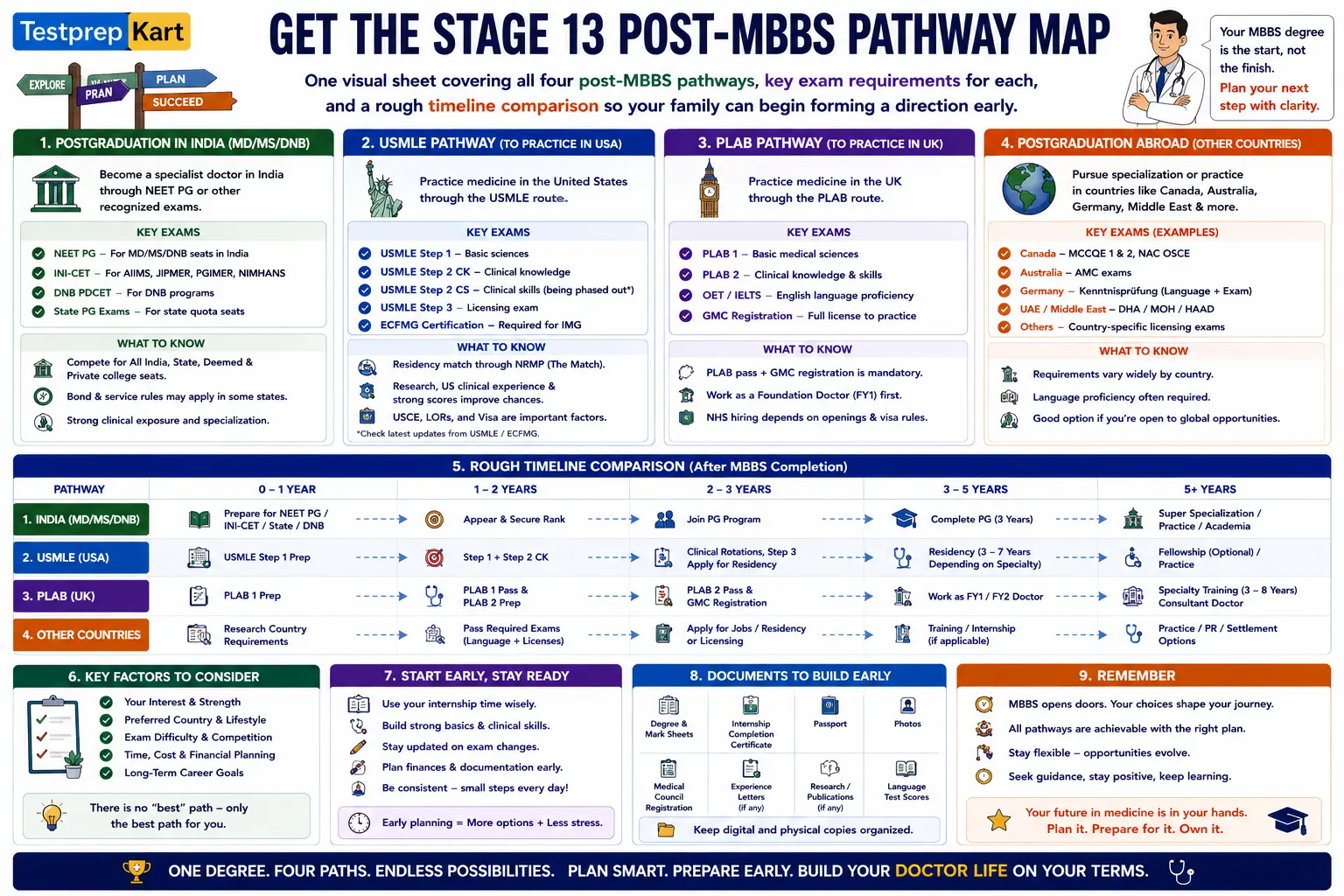
Get The Stage 13 Post-MBBS Pathway Map
One visual sheet covering all four post-MBBS pathways, key exam requirements for each, and a rough timeline comparison so your family can begin forming a direction early.
Questions about a specific pathway or country? Reach our team directly at info@testprepkart.com.
Download Stage 13 Visual Sheet1) What Stage 13 Actually Covers
This layer serves as an orientation for post-MBBS alternatives, outlining the primary pathways, their general components, and the considerations that determine which is best for a particular family's circumstances. In addition to purposefully not claiming to provide current exam-by-exam details (USMLE pass rates, NEET PG seat numbers, etc.) that change annually and necessitate current verification, it does not take the place of the in-depth help a counselor offers for pathway-specific preparation.
| Topic | Why It's Here |
|---|---|
| The four main post-MBBS pathways for NRI graduates | Before any one alternative is thoroughly investigated, there should be a clear map of what truly exists. |
| What the US licensure path (USMLE) broadly involves | The most popular objective among American families, but the least clear about what it really calls for |
| What PG in India (NEET PG / DNB) broadly involves | An excellent choice for those who wish to specialize in India prior to making a decision to return |
| Gulf, UK, Australia, and other global practice options | Often undervalued by American families as respectable, organized job options |
| How to begin forming a direction in the final MBBS years | Families who prefer to plan rather than react can benefit from this practical orientation. |

Checkout few of the app features below.
2) The Four Post-MBBS Pathways For NRI Graduates
An NRI graduate with an Indian MBBS has four realistic, tried-and-true possibilities. They differ enough in their immediate demands that it is often regretful to start one without first understanding the others, even if they are not always mutually exclusive, some families pursue two in succession.
USMLE & U.S. Residency Match
Apply to residency programs using the NRMP Match system after passing all three USMLE steps and completing the ECFMG certification process. Regardless of MBBS quality, this is the tough, multi-year path to becoming a licensed physician in the United States.
U.S. PRACTICEPG In India: NEET PG / DNB / Superspecialty
After finishing the required internship, apply for NEET PG, be eligible for MD, MS, or DNB programs, and focus on India. Before choosing a final location, many NRI graduates do this because it strengthens their credentials and provides doors to both Indian practice and international opportunities in the future.
INDIA PGGulf, UK, Australia & Other Global Pathways
Get a license specific to your country (DHA/HAAD/MOH for the UAE, GMC for the UK, and AMC for Australia) and work abroad. This is a real, lucrative career route, not a backup plan, for NRI families that already have ties to the Gulf. Each country's licensing body and eligibility requirements differ.
GLOBAL PRACTICEHybrid: PG In India Then USMLE / Global Move
Prior to pursuing USMLE or foreign licensing with a specialist's credential, finish a postgraduate specialty in India. Although it takes longer, this process creates a highly competitive application profile for positions as an international consultant or as a resident of the United States, especially in competitive specialties.
HYBRID SEQUENCEKey takeaway: The pathway decision is not as simple as "go back to the U.S. or stay in India"; rather, it is a planned decision between four possible courses with varying deadlines, tests, and professional goals. It is worthwhile to learn about all four before settling on one.
3) The U.S. Licensure Pathway: What USMLE Actually Involves
The majority of NRI families in the United States believe that "our child will do MBBS in India and then come back and practice here." In actuality, an Indian MBBS curriculum, no matter how good, is not always accepted for use in American healthcare. The same USMLE and residency match procedures apply to all foreign medical graduates (IMGs), including non-resident Indians (NRIs) with U.S. passports.
USMLE Step 1 - Basic Sciences
A thorough exam that covers the fundamental sciences. While the information is still relevant, many students prepare for and take Step 1 during or just after finishing the MBBS.
USMLE Step 2 CK - Clinical Knowledge
Covers all fields of clinical medicine. usually taken during an internship or in the final year of the MBBS program, following the completion of clinical rotations.
ECFMG Certification
Before an IMG can seek for U.S. residency, they must be certified by the Educational Commission for Foreign Medical Graduates. Along with USMLE results, it validates medical school qualifications.
NRMP Residency Match
Application for residency in the United States via the National Resident Matching Program. IMG match rates differ greatly depending on the application profile and specialty; this is an actual competitive process rather than a formality.
USMLE Step 3 - During Residency
The final licensure step, typically completed during residency training itself. Passing Step 3 is required for full, independent U.S. medical licensure.
Plan for this early: The best time to prepare for the USMLE is during the MBBS program, not after graduation. Students who put off finishing their degree and internship frequently have to spend an extra year or two catching up on content that was new during the program. USMLE Step 1 preparation should preferably start no later than the third year of MBBS if the U.S. road is the intended route.
4) PG In India: NEET PG, DNB, And What Specialization Involves
Regardless of whether they eventually return to the United States or practice abroad, postgraduate specialization in India through NEET PG is a fantastic track in and of itself and, for many NRI graduates, the ideal sequence. In overseas job markets, an MD or MS from a reputable Indian institution offers substantial clinical depth and competitive weight that an MBBS alone cannot match.
- The qualifying test for MD, MS, and diploma programs is called NEET PG. It is a different competitive exam from NEET UG and has different requirements for preparation.
- Instead of typical university seats, DNB (Diplomate of National Board) is an alternate postgraduate path through approved hospital training programs.
- The highest level of clinical specialization in India is represented by superspecialty programs (DM/MCh), which first need an MD or MS.
- Many NRI graduates use their postgraduate studies in India as a purposeful stepping stone, finishing their degree before taking the USMLE or seeking Gulf license with much stronger credentials.
Worth knowing: The severe NEET PG competition necessitates concentrated preparation beginning well in advance of the internship year's conclusion. Instead of approaching NEET PG preparation as something that may be undertaken after the MBBS is finished, families who plan for PG should incorporate it into the MBBS timeline.
5) Gulf, UK, Australia, And Global Practice Options
Gulf practice is not a backup plan for many NRI families in the United States, especially those with current family and professional ties to the United Arab Emirates, Saudi Arabia, Kuwait, or Qatar. It's a well-thought-out, financially sound, and professionally organized decision. For thousands of Indian-trained physicians, the route from an MBBS to a Gulf medical license is well-documented. Each Gulf nation has its own medical licensing board with its own eligibility requirements.
| Country / Region | Key Licensing Body | Broad What's Required |
|---|---|---|
| UAE (Dubai) | DHA (Dubai Health Authority) | Verification of credentials, DHA licensing exam, and pertinent experience records |
| UAE (Abu Dhabi) | DOH / HAAD | DOH license and qualifying standards, which differ depending on the specialty |
| Saudi Arabia | Saudi Commission (SCFHS) | Foreign medical graduates must pass the Saudi license exam and have their credentials evaluated. |
| United Kingdom | GMC (General Medical Council) | For NRI graduates who wish to work in the UK, the two-part PLAB exam or an accredited postgraduate degree is highly recommended. |
| Australia / New Zealand | AMC (Australian Medical Council) | Clinical exam and AMC CAT MCQ exam; route to fellowship and specialized training |
Key takeaway: Gulf and other global practice possibilities are legitimate, planned routes rather than haphazard substitutes. If your family already has ties to the Gulf, considering this as a real first option instead of a backup plan opens up a whole new set of planning options.
Not sure which post-MBBS pathway fits your child's goals and your family's situation?
Our counselors map your child's profile, target geography, and timeline against each pathway's real requirements - so the decision is informed, not guessed.
6) The Four Factors That Shape Which Pathway Is Right
For an NRI graduate, there is no one "correct" post-MBBS path. A deliberate plan differs from a reactive one in that it considers all four of the criteria unique to each family and student before completing the MBBS.
Where They Want To Practice Long-Term
Everything else is influenced by the destination's locale; for example, the United States requires USMLE and Match, India requires NEET PG, and the Gulf requires country-specific licensure. These are not interchangeable.
How Many Additional Years They're Prepared For
After MBBS, the hybrid road (PG in India followed by USMLE) may take more than eight years. It takes at least three to five years for USMLE Direct to match. It is possible to pursue Gulf licensing earlier. Timeline tolerance is important.
Specialty Preference
In U.S. Match, some specialty are more feasible for IMGs than others. The practical path should be determined by specialty goals, not the other way around.
Financial Planning Across The Full Timeline
There are actual expenditures associated with USMLE preparation, ECFMG fees, and the gap years prior to matching into residency. Each pathway's complete financial picture must be discussed with the family
7) Common Post-MBBS Planning Mistakes U.S. Families Make
Assuming the MBBS is automatically recognized in the U.S.
To practice in America, all foreign medical graduates including citizens of the United States must pass the USMLE and the Match. A pathway for automatic recognition does not exist.
Deferring the pathway decision until after graduation
The best time to prepare for USMLE Step 1 is during the MBBS. Putting off starting until after graduation lengthens the already drawn-out procedure by one to two years.
Treating Gulf or global options as a fallback rather than a first-choice evaluation
Early rejection of international pathways can cause families to lose out on the option that best suits their child's schedule, area of expertise, and family location.
Not budgeting for the post-MBBS years as a separate planning horizon
Families are caught off guard if they do not budget for the actual costs associated with the years between MBBS completion and initial full licensing in any jurisdiction, including as USMLE preparation, exam fees, and living expenses during residency.
Key takeaway: Timeline assumptions, not skill, are nearly invariably the cause of post-MBBS planning errors. It's nearly always a good idea to start the conversation a year or two before it becomes essential.
8) Quick Facts: NRI Options After MBBS
No Automatic U.S. Recognition
The ability to practice in the US is not granted by an Indian MBBS. Regardless of passport or NRI status, a complete USMLE and residence match are necessary.
NEET PG Is A Competitive Exam In Its Own Right
In order to be eligible for an MD/MS seat in India, one must pass NEET PG, which involves special preparation and is not a continuation of MBBS coursework.
Gulf Licensure Is Structured And Attainable
For Indian MBBS graduates, license pathways in the UAE, Saudi Arabia, and other Gulf countries are clearly established; they are neither unstructured nor informal.
Hybrid Pathways Are Common And Strategic
Many NRI graduates complete their postgraduate studies in India before pursuing USMLE or global licensing. This is a purposeful process that creates credentials that are competitive in a variety of markets.
9) This Week's Post-MBBS Planning Checklist
- Before the MBBS is even finished, have an honest family discussion regarding your child's preferred practice location: the United States, India, the Gulf, or somewhere else.
- If the United States is the target, study USMLE Step 1 and start figuring out when the schedule of the MBBS year makes preparation possible.
- Recognize that NEET PG requires additional preparation that coincides with the internship year if PG in India is an option.
- If practicing in the Gulf or abroad is an option, find out who the target country's licensing authority is and what qualifications an Indian MBBS graduate must meet.
- Before deciding which choice is best, get a general financial overview of each pathway's timetable and cost.
- Download the NRI Quota eBook for full context on the admissions journey leading to this post-MBBS decision point
Key takeaway: These discussions only need to begin early enough to prevent the answer from being made by default; they don't need to be certain of the answer.
10) The Full Journey: Where Stage 13 Sits In The 13-Stage Map
In the NEET NRI planning series, this is the last phase. By the time a family reaches this point, they have successfully handled eligibility, curriculum, exam logistics, study plans, NRI Quota specifics, the exam itself, the outcome, counseling, and acceptance. For some families, this preparatory process can take two to four years. With a clear-eyed perspective of what an Indian MBBS actually unlocks and what the options are for a graduate who began this journey from the United States, Stage 13 is designed to end that loop.
A medical career that lasts for decades will be shaped by the choices taken at this point, including which pathway, which location, and how early to begin preparation. They should be treated with the same caution and knowledge as the admissions process.
11) How TestprepKart Helps U.S. Families With Post-MBBS Planning
Since we assist U.S.-based NRI families throughout the whole NEET process, we are frequently the first person a family contacts when they start to wonder "and then what?" upon admission. Our counselors can discuss your child's unique profile, including target specialization, location, timeframe, and budgetary restraints, and assist you in determining which post-MBBS track is most practical for your circumstances rather than merely the one that seems most tempting.
- "Is USMLE still viable if our child starts preparation after MBBS?"
- "How does PG in India change the options for U.S. residency later?"
- "What does Gulf licensing actually look like for a fresh MBBS graduate?"
- "How do we plan financially for the years between MBBS and first full licensure?"
Talk to a counselor who already works with U.S. NRI families.
Get a post-MBBS pathway assessment built around your child's goals, specialty, and timeline not a generic answer.
Download NEET E-Book For NRI's Students

Are you considering using the NRI Quota to pursue an MBBS in India? From NRI eligibility requirements and necessary paperwork to NRI quota fees, seat availability, top medical colleges accepting NRI admissions, crucial deadlines, and the entire admissions process, our FREE NEET Guide for USA-based NRI students and parents has all you need in one location. Additionally, you will learn about non-NEET Main options and professional advice to assist you make wise choices and steer clear of expensive blunders during NEET 2026 admissions. Get it immediately to stay ahead of the MBBS admissions process.
Watch: NRI Options After MBBS, Explained
More Videos From TestprepKart's NRI Channel
Our "NRIs Medical Preparation" YouTube channel covers post-MBBS planning, USMLE basics for NRI graduates, PG in India, Gulf licensing options, and the complete NEET admission journey - all built for U.S.-based families.
New videos are added regularly as post-MBBS pathways and licensing requirements update each cycle.
Visit The Full ChannelCase Study: How Two U.S. NRI Families Approached Post-MBBS Planning Differently
| Family A - Reacted Late | Family B - Planned Early |
|---|---|
| Throughout the MBBS, it was assumed that going back to the United States to practice would be simple and would be resolved after graduation. | During the second year of MBBS, I studied the prerequisites for the USMLE, and in Year 3, I started preparing for Step 1. |
| Only after earning the MBBS degree did I learn about ECFMG certification, match deadlines, and IMG-specific competitiveness levels. | Step 1 in the last year of MBBS, while the material was still new, started the internship after reaching the first significant milestone. |
| Spent around eighteen months relearning the content, beginning over with preparation, and comprehending the Match process. | Submitted to residency programs on a competitive timeframe and used the internship year to get ready for Step 2 CK |
| Matched in the end, but it took two years longer than it could have with earlier preparation. | Matched on the initial application cycle and developed a more robust exam score profile during the MBBS program. |
It was information and time, not effort or skill, that separated these two families. Three to four years prior to graduation, rather than after, the planned choices that influenced Family B's outcome were made.
Keep Exploring
Questions U.S. NRI Parents Ask Us Most
Can my child practice medicine in the U.S. with an Indian MBBS directly?
No. Before they can practice independently in the United States, all international medical graduates—including nationals of the United States—must successfully match into a U.S. residency program, pass all three USMLE Steps, and earn ECFMG certification. A direct recognition channel does not exist.
When should USMLE preparation start?
The majority of counselors advise starting Step 1 preparation no later than the third year of the degree, ideally during the MBBS itself, while the fundamental science content covered in the test is still being actively studied. Significant ramp-up time is added when starting after graduation.
Is PG in India worth it if the long-term goal is returning to the U.S.?
Yes, most of the time. A USMLE applicant's residency match profile is greatly enhanced by an MD or MS from India, especially in competitive specialties. Many NRI grads take the hybrid track - PG in India, then USMLE - purposefully for exactly this reason.
How competitive is the U.S. residency match for Indian MBBS graduates?
By specialty and applicant profile, it varies considerably. Match rates vary, and some specializations are easier for IMGs to obtain than others. This is one of the main reasons it's important to comprehend the realistic terrain before committing to the U.S. pathway.
What does Gulf medical licensing involve for an Indian MBBS graduate?
Every Gulf nation has its own licensing body, such as the DHA in Dubai, the DOH in Abu Dhabi, and the SCFHS in Saudi Arabia, each with its own standards for credential verification and exams. Although qualifications vary by region and specialization, the process is well stated and achievable for a qualified MBBS graduate.
Can a child do PG in India and then still pursue USMLE later?
Indeed. A real and popular route is the hybrid sequence, which consists of MBBS, PG in India, and USMLE preparation. Although it takes longer overall, it strengthens the residency application profile and creates chances for both Indian and foreign specialists.
How do we plan financially for the years between MBBS and first full licensure?
Exam fees, living expenses, and residency pay vary greatly, and it usually takes several years for an MBBS graduate to receive their first full medical salary in any country. One of the most crucial preparatory actions a U.S. NRI family can take is creating a realistic financial plan for this window, not just for the MBBS itself.
Where can we get personalized post-MBBS pathway guidance?
Our counselors work specifically with U.S.-based NRI families on exactly these questions. You can schedule a free planning session to map your child's specific profile against each pathway's real requirements, or download our NRI Quota eBook for a full overview of the journey from NEET planning to post-MBBS options.