NEET Result Day: How To Read Your Child's Score Like Someone Who Actually Knows What It Means
The results of a NEET scorecard include an All India Rank, a percentile, and a raw score, with virtually little explanation of how any of these factors relate to admission prospects. This step is designed to translate the scorecard into something you can actually act on, calmly, before counseling advances quickly, for a family in the United States who are watching the outcome drop at an odd hour across the time difference.

On result day, the majority of American parents open the scorecard, see a number out of 720, and attempt to compare it to the "cutoff" from the previous year that they learned about online. This one practice produces more confusion than nearly anything else. The score is just the beginning. The percentile, the ensuing All India Rank, and how that rank compares to cutoffs that change annually are what truly determine admission opportunities. At this point, it's important to read the scorecard accurately the first time, without fear or false confidence.
Why Result Day Needs Its Own Stage
The exam itself was covered in Stage 9. This stage begins as soon as the findings are announced, which is a high-stakes, fast-paced window where misinterpreting a number can result in needless anxiety or false confidence, both of which cost families time throughout therapy. This stage is worth slowing down for three reasons: the scorecard presents several numbers that are easily confused with one another; cutoffs are not set values and change annually depending on variables beyond the control of any one student; and category is crucial, a score that easily passes one category's cutoff may be near the line for another.
None of this requires special expertise to understand. It just requires reading the scorecard the right way, the first time, rather than relying on a friend's WhatsApp forward or a single year's data point.
| What Families Assume | What's Actually True |
|---|---|
| "The score out of 720 is what matters most" | Admission prospects are actually determined by the percentile and resultant All India Rank rather than just the raw score. |
| "Cutoffs are fixed numbers we can plan around in advance" | Every year, cutoffs are updated based on the applicant pool and exam difficulty. They are based on percentiles. |
| "One cutoff number applies to everyone" | Cutoffs vary by category (General, OBC, SC/ST, EWS, PwD), and NRI Quota seats have a completely different procedure. |
| "Comparing to last year's cutoff tells us where we stand" | The same score can result in different outcomes in various years, so year-to-year comparisons are at best a general guide. |
Key takeaway: Read the scorecard as three connected numbers - score, percentile, rank - rather than fixating on the mark out of 720 alone.
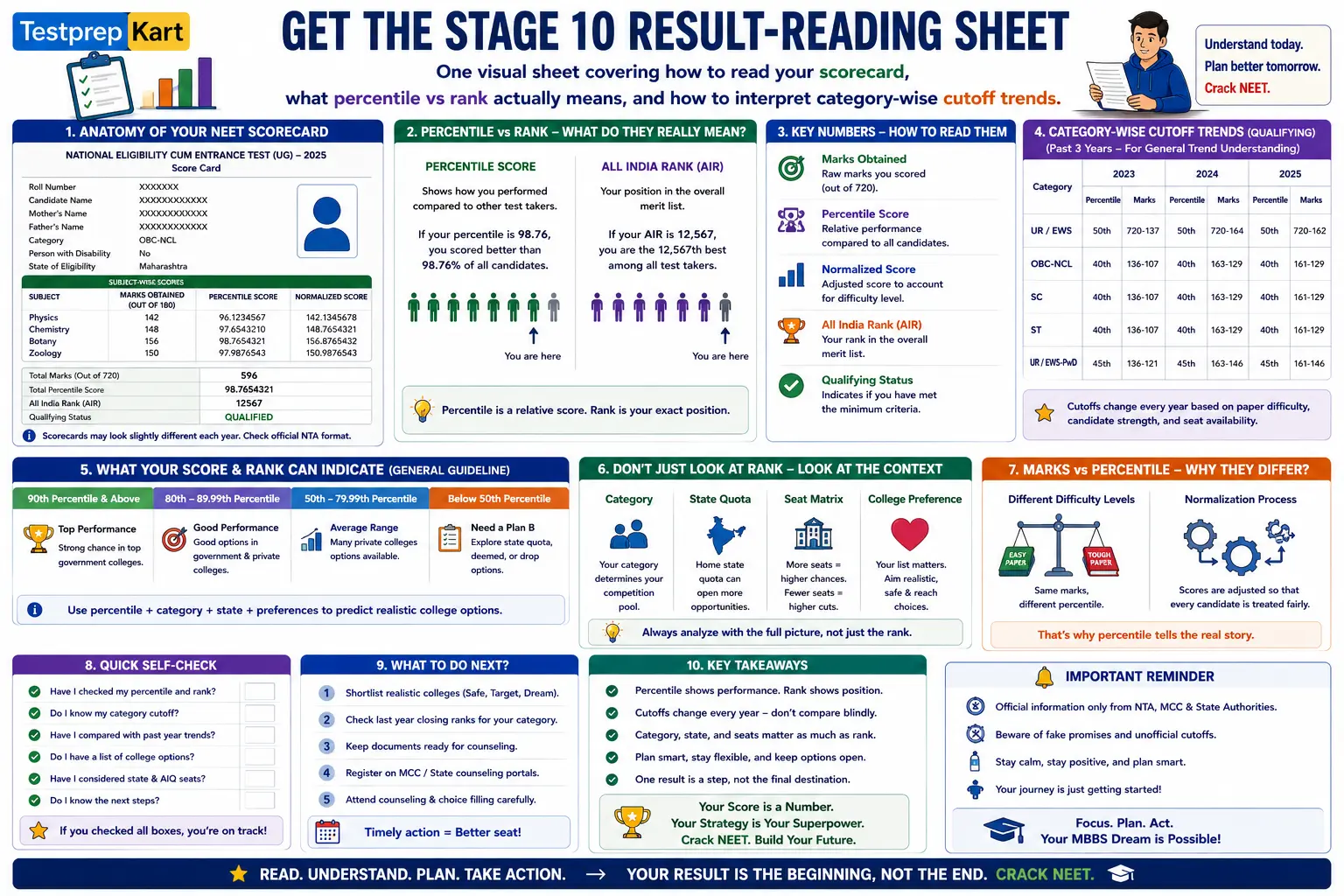
Get The Stage 10 Result-Reading Sheet
One visual sheet covering how to read your scorecard, what percentile vs rank actually means, and how to interpret category-wise cutoff trends.
Questions about your child's specific scorecard? Reach our team directly at info@testprepkart.com.
Download Stage 10 Visual Sheet1) What Stage 10 Actually Covers
This stage is about reading and interpreting the result - the scorecard itself, how percentile and rank are derived, and how qualifying and admission cutoffs generally work. It does not cover the counseling process, seat allotment rounds, or document verification, since the step-by-step admission sequence that follows the result is its own separate topic.
| Topic | Why It's Here |
|---|---|
| How to read the NEET scorecard correctly | Avoids the most frequent mistake that occurs on result day. |
| Percentile vs All India Rank | These are distinct numbers that are frequently mistaken for one another. |
| How qualifying cutoffs work, broadly | Establishes reasonable expectations on the definition of "qualifying" |
| Why admission cutoffs shift year to year | Avoids relying too much on data from a single prior year. |
| Category-wise cutoff differences, broadly | Just a general overview; at other levels, specific category mechanisms are discussed as needed. |

Checkout few of the app features below.
2) Reading The NEET Scorecard: Score, Percentile, And Rank
The scorecard presents multiple numbers, each of which provides an answer to a distinct query. The number of marks your child received is indicated by the raw score (out of 720). The percentile, which is a relative rather than a set number, shows you how that score stacks up against everyone else who took the test that year. The exact place that the percentage corresponds to among all candidates is known as the All India Rank. Rather of relying solely on the raw score, counseling and seat distribution are mostly determined by rank and category.
Raw Score
The number out of 720 is a good place to start, but it is not a reliable indicator of admission results on its own.
Percentile
Displays the score's position in relation to all other test takers that year. A percentile is not directly comparable across years because it is adjusted every year.
All India Rank (AIR)
The number that matters most when it comes to counseling and seat distribution is the real position, which is obtained from percentage.
Category Rank
A distinct rank that is particular to the applicant's category (General, OBC, SC/ST, EWS, PwD), which frequently has a greater bearing on seat distribution than the total AIR.
Key takeaway: The majority of result-day misunderstanding can be avoided by focusing the conversation on rank and percentile rather than the raw score out of 720 when discussing the outcome as a family.
3) Why Cutoffs Move Every Single Year
A NEET cutoff is determined after the exam, taking into account the size and performance of the applicant pool, the percentile threshold established for each category, and the overall difficulty level of that year. Because the underlying exam and candidate pool were different each time, it can be deceptive to compare a child's score straight to a cutoff number from two or three years ago..
Worth knowing: It's hardly a given that a score that would have easily passed a certain college's criteria two years ago will do so this year. Instead than using past cutoff numbers as an exact benchmark to compare this year's performance to, use them as a general directional indication.
4) Score Bands: A Rough Way To Think About Where You Stand
When having a first, realistic discussion about possibilities with your child, it helps to think in broad score bands without referring to any specific year's cutoff figures. The only trustworthy way to find out where a particular score truly stands is to look at the official qualifying cutoff for that year and category-wise trends once they are announced. These bands are merely illustrative starting places for discussion, not forecasts..
Strong Competitive Range
Although final results still rely on category and that year's cutoff patterns, scores in this range typically open up a wide range of alternatives across government and many private universities.
Solid, Category-Dependent Range
Here, results differ significantly by state and category, therefore it's crucial to know your individual category cutoff before assuming any given outcome.
At Or Near The Qualifying Line
Scores that are near the qualifying percentile cutoff should be discussed calmly and realistically, and in addition to conventional counseling, alternate pathways should be considered.
Key takeaway: Before making any serious conclusions, go on to the official cutoff data and use score bands for an open, relaxed initial discussion.
Not sure where your child's score actually stands this year?
Our counselors compare your child's score, percentile, and category against this year's real cutoff trends - not last year's numbers.
5) Category-Wise Cutoffs: Why One Number Doesn't Apply To Everyone
Each of the following categories has its own percentile criterion for NEET qualifying cutoffs: General, EWS, OBC, SC, ST, and PwD. This implies that two students with similar raw scores may have significantly different results depending on their category status. In the case of NRI Quota in particular, the more general category and quota mechanics which were already discussed in Stage 8, interact with these cutoffs in ways that are worth reviewing when the actual outcome is known, not only during the planning phase.
- Always verify the qualifying cutoff for your child's declared category rather than just the overall one.
- Keep in mind that most counseling rounds really employ category rank rather than just overall AIR.
- Now that you have a real score and rank to compare against, review your Stage 8 NRI Quota research.
6) Common Result-Day Mistakes U.S. Families Make
These mistakes show up every result season, almost always from acting on the first available number rather than the complete picture.
Reacting to the raw score before checking percentile and rank
Even if a score appears low out of 720, it can nonetheless rank in a challenging year and correspond to a great percentile, and vice versa.
Benchmarking against last year's cutoff as if it's fixed
Every year, cutoffs change. Without context, a direct year-over-year comparison may lead to mistaken optimism or worry.
Checking only the General category cutoff
Sometimes families fail to recognize their true appropriate category cutoff, which results in an incorrect assessment of their actual situation.
Waiting too long after results to plan next steps
Timelines for counseling move swiftly when findings are released; postponing a realistic discussion results in lost preparation time.
7) Quick Facts: NEET Result & Cut Off
Three Numbers, Not One
Planning for admission requires a grasp of the three separate numbers on the same scorecard: score, percentage, and All India Rank.
Cutoffs Are Recalculated Annually
Exam difficulty and applicant performance determine the new qualifying and admission cutoffs each year; they are not carried over from previous years.
Category Determines The Real Benchmark
The threshold for your child's declared category, not the overall headline number, is what truly applies to them.
The Result Starts The Clock On Counseling
Counseling registration and choice-filling windows open swiftly once results are announced; now is not the time to put off taking action.
8) This Week's Result-Day Checklist
- Before the results are announced, find and bookmark the official NTA result portal.
- When the results are announced, read the scorecard for the score, percentile, and All India Rank combined, not just the score. Make arrangements for the results to be examined at the appropriate time across the U.S.-India time difference; it is not assumed that they will line up with a convenient U.S. hour.
- Verify the qualifying threshold for your child's particular category rather than just the overall headline number.
- Now that you have a genuine score to compare it against, review your Stage 8 NRI Quota research.
- Don't base your final college choices solely on the cutoff figures from the previous year.
Key takeaway: The objective on result day is to accurately assess the situation rather than make a quick decision. As a result, counseling's subsequent actions are grounded in factual data rather than conjecture.
9) Where This Fits Into The Bigger Picture
The counseling process itself, which includes registration, choice-filling, seat allocation rounds, and document verification, comes next once the results have been accurately read and the score, percentile, rank, and applicable cutoff have all been comprehended. Since the mechanics of counseling are a different subject from understanding the outcome discussed here, we go into great length about that step-by-step process in Stage 11.
10) How TestprepKart Helps U.S. Families Read Their Result
We exclusively work with NRI families in the United States, so we are aware of the time-zone pressure of result day as well as the subtleties of the NRI Quota and category that affect your child's interpretation of a given score. Before therapy deadlines start moving quickly, our counselors can go over your child's actual scorecard, compare it to current-year cutoff trends, and assist you in having a calm, realistic discussion about what to do next.
- "What does our child's percentile actually mean for admission chances?" "How does this year's cutoff compare to recent years for our target category?"
- "Where does our score put us specifically for NRI Quota options?"
- "What should we be doing in the days right after the result, before counseling starts?"
Talk to a counselor who already works with U.S. families.
Get a clear, realistic read on your child's score and category-specific cutoff position - right when it matters most.
Download NEET E-Book For NRI's Students

Planning to pursue MBBS in India through the NRI Quota? This FREE NEET Guide for USA-based NRI students and parents provides everything you need in one place-from NRI eligibility criteria and required documents to NRI quota fees, seat availability, top medical colleges accepting NRI admissions, important deadlines, and the complete admission process. You'll also discover alternative pathways beyond NEET Main and expert insights to help you make informed decisions and avoid costly mistakes during NEET 2026 admissions. Download now and stay ahead in your MBBS admission journey.
Watch: How To Read Your NEET Result And Cutoff Correctly
More Videos From TestprepKart's NRI Channel
Our "NRIs Medical Preparation" YouTube channel is built specifically for U.S.-based families navigating NEET - result interpretation, cutoff trends, and what comes next, explained in plain language.
New videos are added regularly as NEET result and cutoff data updates each cycle.
Visit The Full ChannelCase Study: How One U.S. Family Handled Result Day
| Stage | What The Family Did |
|---|---|
| Before the result | Set a phone alarm aligned to the expected result-declaration time in India, rather than assuming it would land at a convenient U.S. hour |
| Minutes after the result | Read the scorecard fully - score, percentile, and All India Rank - before reacting to the raw mark out of 720 alone |
| Same day | Looked up the current year's qualifying cutoff for their specific category instead of comparing directly to a number a relative remembered from a prior year |
| Following days | Revisited their Stage 8 NRI Quota research with the actual rank in hand, narrowing their college list before counseling registration opened |
The pattern that repeats: families who treat result day as a moment to read carefully - not react instantly - move into counseling with a clearer, more accurate sense of their real options.
Keep Exploring
Questions U.S. NRI Parents Ask Us Most
What's the difference between NEET score, percentile, and rank?
The score represents the raw score out of 720. The score's percentile indicates how it stacks up against all other test takers that year. Together with category-specific rank, the All India Rank-which is the actual position obtained from that percentile—is the figure most pertinent to counseling and seat distribution.
Why does the same score sometimes lead to different outcomes in different years?
Because cutoffs are not predetermined; rather, they are revised annually based on the exam difficulty and candidate pool. A score that did well in one year can have a different relative status in another.
Should we compare our child's score to last year's cutoff?
Not as an exact benchmark, but only as a very basic directional guide. Examining the official qualifying cutoff for the current year and category-wise trends as soon as they are made public is the most dependable method.
Does NRI Quota use a different cutoff than the general category?
On top of the qualifying NEET cutoff, NRI Quota seats have their own quota-specific procedure. In Stage 8, which concentrates on reading the actual outcome, we go into great depth about that quota mechanism.
What should we check first when the result is declared?
When the outcome is announced, what should we look for first?
Instead of responding only to the raw result, start with the entire scorecard, which includes the score, percentile, and All India Rank. Next, look up the qualifying cutoff for the declared category of your child.
How quickly do we need to act after the result is out?
How soon after the results are announced must we take action?
It's important to have a realistic family chat and review your college shortlist within the first few days, not weeks, as counseling registration and choice-filling periods usually open shortly after results are announced.
Is a lower-than-expected score the end of the road?
Not always. When combined with an honest examination of NRI Quota and other channels, a thorough, correct reading of percentile, rank, and category-specific cutoffs frequently exposes more alternatives than a cursory scan at the raw score alone suggests.
Where can we get help interpreting our child's specific result?
Our counselors specialize in exactly this kind of result-day review for U.S.-based families. You can schedule a free session or download our NRI Quota eBook for additional context.